NAG-002150 · Accepted whole
The integral stabilizer of the unit Gauss point
Open in the English reader · PDF page 730
Statement · exact TeX
\begin{lemma}[\bi{The integral stabilizer of the unit Gauss point}
{单位 Gauss 点的整稳定子}]
\label{cand:gaussintegralstabilizer}
\bi{An element of $\operatorname{PGL}_2(F)$ fixes
$\zeta_{0,1}$ if and only if it is represented by a matrix
in $\operatorname{GL}_2(F^\circ)$.
The same criterion holds for a semilinear fractional
linear transformation with isometric coefficient
automorphism. Such a transformation extends uniquely
to a semilinear automorphism of
$\mathbf P^1_{F^\circ}$.}
{$\operatorname{PGL}_2(F)$ 中的元素固定
$\zeta_{0,1}$,当且仅当它可由
$\operatorname{GL}_2(F^\circ)$ 中的矩阵表示。
对系数自同构等距的半线性分式线性变换,
同一判据成立。这样的变换唯一延拓为
$\mathbf P^1_{F^\circ}$ 的半线性自同构。}
\end{lemma}
Full selected proof · exact TeX
\begin{proof}
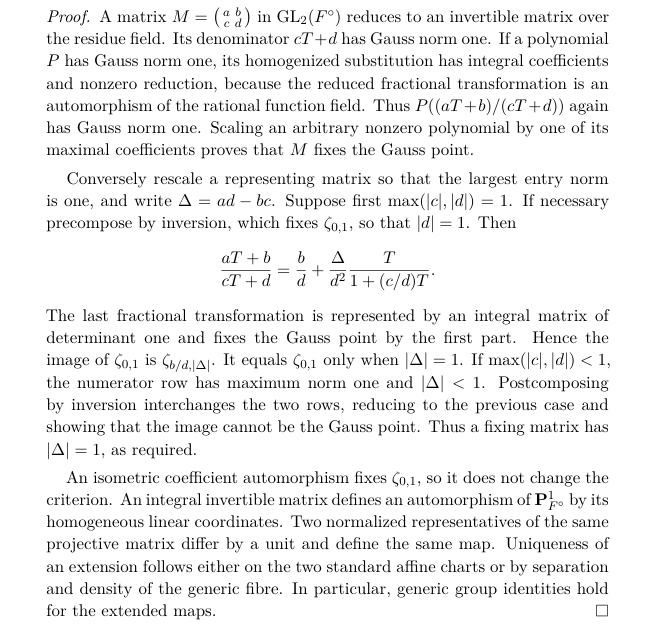
\bi{A matrix $M=\left(\begin{smallmatrix}a&b\\c&d\end{smallmatrix}\right)$
in $\operatorname{GL}_2(F^\circ)$ reduces to an invertible
matrix over the residue field. Its denominator $cT+d$
has Gauss norm one.
If a polynomial $P$ has Gauss norm one, its homogenized
substitution has integral coefficients and nonzero
reduction, because the reduced fractional transformation
is an automorphism of the rational function field.
Thus $P((aT+b)/(cT+d))$ again has Gauss norm one.
Scaling an arbitrary nonzero polynomial by one of its
maximal coefficients proves that $M$ fixes the Gauss point.}
{$\operatorname{GL}_2(F^\circ)$ 中的矩阵
$M=\left(\begin{smallmatrix}a&b\\c&d\end{smallmatrix}\right)$
约化为剩余域上的可逆矩阵。
其分母 $cT+d$ 的 Gauss 范数为一。
若多项式 $P$ 的 Gauss 范数为一,
则其齐次化代换具有整系数且约化非零,
因为约化后的分式变换为有理函数域自同构。
故 $P((aT+b)/(cT+d))$ 的 Gauss 范数仍为一。
对任意非零多项式,用一个达到最大范数的系数归一化,
就证明 $M$ 固定 Gauss 点。}

\bi{Conversely rescale a representing matrix so that the
largest entry norm is one, and write $\Delta=ad-bc$.
Suppose first $\max(|c|,|d|)=1$.
If necessary precompose by inversion, which fixes
$\zeta_{0,1}$, so that $|d|=1$.
Then}
{反之,缩放代表矩阵,使最大系数范数为一,
并记 $\Delta=ad-bc$。
先设 $\max(|c|,|d|)=1$。
必要时先与固定 $\zeta_{0,1}$ 的反演复合,
即可令 $|d|=1$。此时}
\[
 \frac{aT+b}{cT+d}
   =\frac bd+\frac{\Delta}{d^2}
                    \frac{T}{1+(c/d)T}.
\]
\bi{The last fractional transformation is represented by
an integral matrix of determinant one and fixes the Gauss
point by the first part. Hence the image of
$\zeta_{0,1}$ is $\zeta_{b/d,|\Delta|}$.
It equals $\zeta_{0,1}$ only when $|\Delta|=1$.
If $\max(|c|,|d|)<1$, the numerator row has maximum norm
one and $|\Delta|<1$. Postcomposing by inversion
interchanges the two rows, reducing to the previous case
and showing that the image cannot be the Gauss point.
Thus a fixing matrix has $|\Delta|=1$, as required.}
{最后一个分式变换由行列式为一的整矩阵表示,
由第一部分知其固定 Gauss 点。
因此 $\zeta_{0,1}$ 的像为 $\zeta_{b/d,|\Delta|}$。
它只有在 $|\Delta|=1$ 时才等于 $\zeta_{0,1}$。
若 $\max(|c|,|d|)<1$,
则分子一行的最大范数为一,且 $|\Delta|<1$。
再与反演后复合将两行交换,
归结于前一种情形,说明像不可能为 Gauss 点。
故固定该点的矩阵必有 $|\Delta|=1$,证明所需结论。}

\bi{An isometric coefficient automorphism fixes
$\zeta_{0,1}$, so it does not change the criterion.
An integral invertible matrix defines an automorphism of
$\mathbf P^1_{F^\circ}$ by its homogeneous linear
coordinates. Two normalized representatives of the same
projective matrix differ by a unit and define the same
map. Uniqueness of an extension follows either on the two
standard affine charts or by separation and density of
the generic fibre. In particular, generic group identities
hold for the extended maps.}
{等距系数自同构固定 $\zeta_{0,1}$,
所以不改变判据。整可逆矩阵通过齐次线性坐标定义
$\mathbf P^1_{F^\circ}$ 的自同构。
同一射影矩阵的两个归一化代表只差一个单位倍数,
因而定义相同映射。延拓的唯一性可在两个标准仿射片上
检查,也可由分离性及泛纤维稠密性得到。
特别地,泛纤维上的群恒等式对延拓后的映射仍成立。}
\end{proof}
Typeset reader excerpt
Typed proof inputs
- BASE-RINGS · standing context or base
- BASE-RINGS · standing context or base (requires)
- NAG-000182 · selected whole
- NAG-000182 · selected whole (requires)
- NAG-002148 · selected whole
- NAG-002148 · selected whole (requires)
Proof map
Verified map inputs · NAG-002150
AND · joint registered proof inputs
- NAG-000182 · Multiplicativity of the weighted Gauss norm · accepted whole
- NAG-002148 · Gauss discs and fractional linear maps · accepted whole
Standing context and base inputs
BASE-RINGS
NAG-002150 · The integral stabilizer of the unit Gauss point · Chapter argument