NAG-002158 · Accepted whole
The strict-time analytic lift
5 Tropicalization, multiplicities and balancing
Open in the English reader · PDF page 879
Statement · exact TeX
\begin{theorem}[\bi{The strict-time analytic lift}
{严格小于终点时刻的解析提升}]
\label{cand:etalestricttimehomotopy}
\bi{For $x\in\mathcal M(B)$ and $0\leq t<1$, the formula}
{对于 $x\in\mathcal M(B)$ 及 $0\leq t<1$,公式}
\[
 |b(H_B(x,t))|
       =\max_\nu |D_\nu(b)(x)|t^{|\nu|},
 \qquad 0^0=1,
 \tag{E}\label{eq:candetaledisplacementvalue}
\]
\bi{defines a jointly continuous map
$H_B:\mathcal M(B)\times[0,1)\to\mathcal M(B)$ with
$H_B(x,0)=x$. For the structure map $f:\mathcal M(B)\to V$,}
{定义联合连续映射
$H_B:\mathcal M(B)\times[0,1)\to\mathcal M(B)$,满足
$H_B(x,0)=x$。对结构映射 $f:\mathcal M(B)\to V$,有}
\[
 f(H_B(x,t))=H(f(x),t).
\]
\bi{If $b$ has quotient norm at most one, then
$|b(H_B(x,t))|<1$ if and only if $|b(x)|<1$. Thus every
strict-time trajectory preserves its reduction prime in the
displayed integral model.}
{若 $b$ 的商范数至多为一,则
$|b(H_B(x,t))|<1$ 当且仅当 $|b(x)|<1$。
因而每条严格小于终点时刻的轨迹,都保持所列整模型
中的约化素理想。}
\end{theorem}
Full selected proof · exact TeX
\begin{proof}
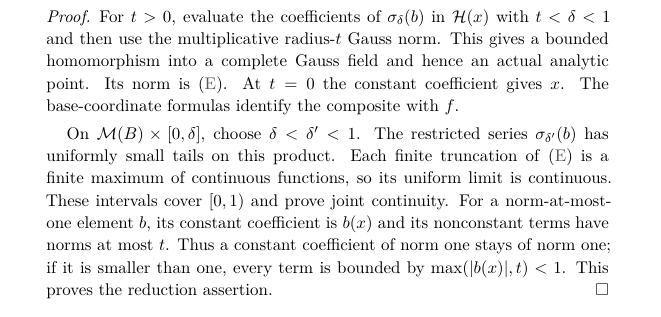
\bi{For $t>0$, evaluate the coefficients of
$\sigma_\delta(b)$ in $\mathcal H(x)$ with $t<\delta<1$
and then use the multiplicative radius-$t$ Gauss norm.
This gives a bounded homomorphism into a complete Gauss
field and hence an actual analytic point. Its norm is
\eqref{eq:candetaledisplacementvalue}. At $t=0$ the constant
coefficient gives $x$. The base-coordinate formulas identify
the composite with $f$.}
{当 $t>0$ 时,选 $t<\delta<1$,将
$\sigma_\delta(b)$ 的系数在 $\mathcal H(x)$ 中取值,
再使用乘性的半径 $t$ Gauss 范数。这给出到完备 Gauss
域的有界同态,因而给出实际解析点;其范数就是
\eqref{eq:candetaledisplacementvalue}。当 $t=0$ 时,
常数系数给出 $x$。基底坐标公式识别与 $f$ 的复合。}

\bi{On $\mathcal M(B)\times[0,\delta]$, choose
$\delta<\delta'<1$. The restricted series
$\sigma_{\delta'}(b)$ has uniformly small tails on this
product. Each finite truncation of
\eqref{eq:candetaledisplacementvalue} is a finite maximum
of continuous functions, so its uniform limit is continuous.
These intervals cover $[0,1)$ and prove joint continuity.
For a norm-at-most-one element $b$, its constant coefficient
is $b(x)$ and its nonconstant terms have norms at most $t$.
Thus a constant coefficient of norm one stays of norm one;
if it is smaller than one, every term is bounded by
$\max(|b(x)|,t)<1$. This proves the reduction assertion.}
{在 $\mathcal M(B)\times[0,\delta]$ 上,选取
$\delta<\delta'<1$。受限级数 $\sigma_{\delta'}(b)$
在此直积上有一致趋于零的尾项。
\eqref{eq:candetaledisplacementvalue} 的每个有限截断
都是有限个连续函数的最大值,其一致极限因而连续。
这些区间覆盖 $[0,1)$,证明联合连续性。对于范数至多
为一的 $b$,常数系数为 $b(x)$,全部非常数项的范数
至多为 $t$。所以范数为一的常数系数保持范数一;若
它小于一,则全部项均被 $\max(|b(x)|,t)<1$ 控制。
这证明约化断言。}
\end{proof}
Standing context 1 · exact TeX
\bi{Retain the standard algebra $A$ and its integral coordinates
from Lemma~\ref{cand:mixedgaussdisplacement}. Let
$F=(F_1,\ldots,F_m)$ be represented by restricted series in
$X_0,\ldots,X_r,T,Y_1,\ldots,Y_m$ with coefficients in
$K^\circ$. Write $J=\partial F/\partial Y$ and consider the
nonzero affinoid algebra}
{保留 Lemma~\ref{cand:mixedgaussdisplacement} 中的标准代数
$A$ 及其整坐标。设 $F=(F_1,\ldots,F_m)$ 由变量
$X_0,\ldots,X_r,T,Y_1,\ldots,Y_m$ 的受限级数表示,
系数属于 $K^\circ$。写 $J=\partial F/\partial Y$,并考虑
非零 affinoid 代数}
\[
 B=A\langle Y_1,\ldots,Y_m,Q\rangle/
                  (F_1,\ldots,F_m,Q\det J-1).
 \tag{J}\label{eq:candetalejacobianpresentation}
\]
\bi{We use its displayed quotient norm. In particular the
coordinate images and $J^{-1}=Q\operatorname{adj}(J)$ have
norm at most one. All the statements below keep this
presentation over the original valued field.}
{使用所列表示的商范数。特别地,坐标像及
$J^{-1}=Q\operatorname{adj}(J)$ 的范数至多为一。下述
全部陈述保留原赋值域上的这个表示。}
Typeset reader excerpt
Typed proof inputs
- CLAUSE:NAG-000648:arbitrary_complete_valued_target · selected scope (sealed retained clause)
- NAG-000182 · selected whole (sealed native whole)
- NAG-000655 · selected whole (sealed native whole)
- NAG-002139 · selected whole (earlier independently reviewed original whole in this tier)
- NAG-002157 · selected whole (earlier independently reviewed original whole in this tier)
- CLAUSE:NAG-000648:arbitrary_complete_valued_target · selected scope
- CLAUSE:NAG-000648:arbitrary_complete_valued_target · selected scope (requires)
- NAG-000182 · selected whole
- NAG-000182 · selected whole (requires)
- NAG-000655 · selected whole
- NAG-000655 · selected whole (requires)
- NAG-002139 · selected whole
- NAG-002139 · selected whole (requires)
- NAG-002157 · selected whole
- NAG-002157 · selected whole (requires)
Reader cross-references
Proof map
Verified map inputs · NAG-002158
AND · joint registered proof inputs
- CLAUSE:NAG-000648:arbitrary_complete_valued_target · arbitrary complete valued target · selected scope
- NAG-000182 · Multiplicativity of the weighted Gauss norm · accepted whole
- NAG-000655 · Result 1.6.1 · accepted whole
- NAG-002139 · Mixed Gauss displacement · accepted whole
- NAG-002157 · The bounded displacement expansion · accepted whole
NAG-002158 · The strict-time analytic lift · Chapter argument