NAG-002242 · Accepted whole
Finite formal models at the Gauss point
5 Tropicalization, multiplicities and balancing
Open in the English reader · PDF page 922
Statement · exact TeX
\begin{lemma}[Finite formal models at the Gauss point]
\label{v035:degreegaussrank}
Let
\[
 A_0=R\langle U_1^{\pm1},\ldots,U_d^{\pm1}\rangle,
 \qquad A=A_0[1/\pi],
\]
and let $A_0\to B_0$ be a formal homomorphism to an admissible
topologically finitely presented $R$-algebra. Suppose that
$\overline B_0=B_0/\mathfrak mB_0$ is finite over
$k[U_1^{\pm1},\ldots,U_d^{\pm1}]$.
Then $B_0$ is finite over $A_0$, and the generic algebra
$B=B_0[1/\pi]$ has its canonical finite-$A$-module topology.
If $H$ is the completed residue field of the Gauss point of
$\mathcal M(A)$, then
\begin{equation}
 \dim_H(B\widehat\otimes_A H)
  =\dim_{k(U)}\left(
     \overline B_0\otimes_{k[U^{\pm1}]}k(U)\right).
 \label{v035:eqdegreegaussrank}
\end{equation}
\end{lemma}
Full selected proof · exact TeX
\begin{proof}
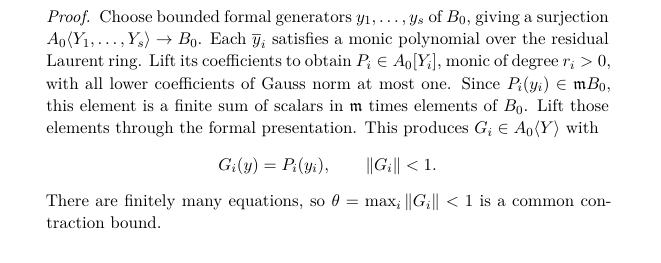
Choose bounded formal generators $y_1,\ldots,y_s$ of $B_0$,
giving a surjection $A_0\langle Y_1,\ldots,Y_s\rangle\to B_0$.
Each $\overline y_i$ satisfies a monic polynomial over the
residual Laurent ring. Lift its coefficients to obtain
$P_i\in A_0[Y_i]$, monic of degree $r_i>0$, with all lower
coefficients of Gauss norm at most one. Since
$P_i(y_i)\in\mathfrak mB_0$, this element is a finite sum of
scalars in $\mathfrak m$ times elements of $B_0$. Lift those
elements through the formal presentation. This produces
$G_i\in A_0\langle Y\rangle$ with
\[
 G_i(y)=P_i(y_i),\qquad \|G_i\|<1.
\]
There are finitely many equations, so
$\theta=\max_i\|G_i\|<1$ is a common contraction bound.

Apply Lemma~\ref{fnd:simultaneousmonicperturbation} over $A$.
Its convergent division formula expresses every bounded
restricted series, modulo the $P_i-G_i$, as a linear combination
of the monomials $Y^\nu$ with $0\leq\nu_i<r_i$. The coefficient
maps have norm at most one, so a series in
$A_0\langle Y\rangle$ has all its remainder coefficients in
$A_0$. The images of these finitely many monomials therefore
generate $B_0$ over $A_0$.

The same calculation compares the generic norms. Give $B$ the
quotient norm from $A\langle Y\rangle$ and let $\|\cdot\|_{\rm fin}$
be the quotient norm from the finite free $A$-module on the
remainder monomials. A finite remainder expression gives
$\|b\|_B\leq\|b\|_{\rm fin}$. Conversely, apply the bounded
division formula to each representative of $b$ and take the
infimum of its norms. It gives
$\|b\|_{\rm fin}\leq\|b\|_B$. Hence these quotient norms agree;
the equivalent admissible norms give the same Banach topology.

Let $S\subset A_0$ consist of the elements of Gauss norm one,
and put $V=S^{-1}A_0$. The Gauss norm is multiplicative by
Proposition~\ref{fnd:gaussnorm}. Every nonzero restricted
Laurent series $a$ has a coefficient $c\in K^\times$ of
maximal absolute value, so that $a=c s$ with $s\in S$.
Every element of $\operatorname{Frac}(A)^\times$ is consequently
of the form $c s/t$, where $c\in K^\times$ and $s,t\in S$.
It belongs to $V$ exactly when $|c|\leq1$. Thus $V$ is the
Gauss valuation ring in $\operatorname{Frac}(A)$, with residue
field $k(U)$: the reductions of $S$ are all the nonzero Laurent
polynomials. Its completion is $H^\circ$. Indeed, an element of
norm at most one in the completion of $\operatorname{Frac}(A)$
can be approximated, with error less than one, by elements of
norm at most one, which belong to $V$.

The finite $V$-module $M=S^{-1}B_0$ is torsion-free. Every
nonzero element of $V$ is a nonzero scalar from $R$ times a
unit; multiplication by that scalar is injective on $B_0$ and
remains injective after localization. A finite torsion-free
module over a valuation ring is free. One can see this directly
by choosing a generating set of minimal size: a nonzero
relation has a coefficient dividing all the others, and
torsion-freeness then expresses the corresponding generator
in terms of the rest. This contradicts minimality.

The rank of $M$ is therefore its residue dimension over
$k(U)$, which is the right-hand side of
\eqref{v035:eqdegreegaussrank}. Tensoring its free basis with
$H$ computes $\dim_H(B\otimes_A H)$ with the same value.
The norm comparison above and
Proposition~\ref{fnd:generalizedfinitebasechange} identify this
algebraic tensor product with $B\widehat\otimes_AH$.
\end{proof}
Standing context 1 · exact TeX
% v0.35 English revision of the five excluded v0.34 degree candidates.
% Author/reviser: /root/f6_degree. Mathematical status is assigned by the gate.
\section{Geometric degrees and tropical lattice indices}
\label{v035:degreesection}

Write $R=K^\circ$, $\mathfrak m=K^{\circ\circ}$ and
$k=\widetilde K$. In the first two lemmas, $K$ is complete and
nontrivially valued, and $\pi\in R$ satisfies $0<|\pi|<1$.
The formal algebras carry their quotient $\pi$-adic topologies.
For a lattice $M$, the notation $R\langle M\rangle$ denotes
the Gauss unit ball in $K\langle M\rangle$.
Typeset reader excerpt
Typed proof inputs
- NAG-000182 · selected whole
- NAG-000182 · selected whole (requires)
- NAG-001414 · selected whole
- NAG-001414 · selected whole (requires)
- NAG-001415 · selected whole
- NAG-001415 · selected whole (requires)
- NAG-001553 · selected whole
- NAG-001553 · selected whole (requires)
- NAG-001702 · selected whole
- NAG-001702 · selected whole (requires)
- NAG-001918 · selected whole
- NAG-001918 · selected whole (requires)
- NAG-001928 · selected whole
- NAG-001928 · selected whole (requires)
Reader cross-references
Proof map
Verified map inputs · NAG-002242
AND · joint registered proof inputs
- NAG-000182 · Multiplicativity of the weighted Gauss norm · accepted whole
- NAG-001414 · Weighted coefficient completeness · accepted whole
- NAG-001415 · The Laurent coefficient normal form · accepted whole
- NAG-001553 · The actual multi-Laurent relation quotient · accepted whole
- NAG-001702 · General finite base change · accepted whole
- NAG-001918 · Affinoid generic fibres and integral presentations · accepted whole
- NAG-001928 · Simultaneous monic division with a small perturbation · accepted whole
NAG-002242 · Finite formal models at the Gauss point · Chapter argument