NAG-002254 · Accepted whole
Faithful rational tropicalization of a projective skeleton
5 Tropicalization, multiplicities and balancing
Open in the English reader · PDF page 935
Statement · exact TeX
\begin{theorem}[Faithful rational tropicalization of a projective skeleton]
\label{v035:faithfulglobal}
In the stated projective algebraic model setting, there
are a dense open $U\subset X$ with $S\subset U^{\an}$ and
a closed immersion $\varphi:U\hookrightarrow\mathbf G_{m,K}^N$
such that $\trop\circ\varphi^{\an}|_S$ is a homeomorphism
onto its image. On every cell of a finite subdivision of
$S$, this map is $\Gamma$-integral-affine and identifies
the tangent lattice with the saturated lattice of its
image. All coordinates belong to the original field
$K(X)$ and use the specified absolute value of $K$.
\end{theorem}
Full selected proof · exact TeX
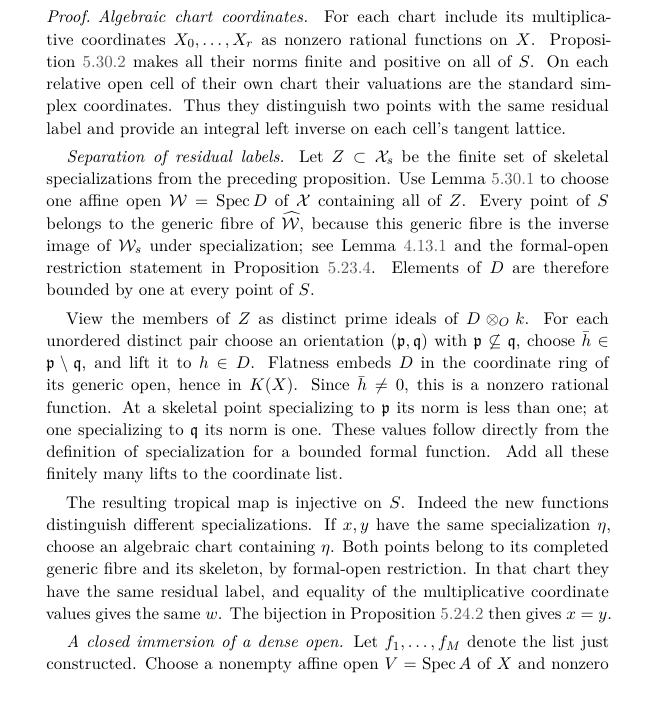
\begin{proof}
\emph{Algebraic chart coordinates.}
For each chart include its multiplicative coordinates
$X_0,\ldots,X_r$ as nonzero rational functions on $X$.
Proposition~\ref{v035:faithfulrationalpl} makes all their
norms finite and positive on all of $S$. On each relative
open cell of their own chart their valuations are the
standard simplex coordinates. Thus they distinguish two
points with the same residual label and provide an
integral left inverse on each cell's tangent lattice.

\emph{Separation of residual labels.}
Let $Z\subset\mathcal X_s$ be the finite set of skeletal
specializations from the preceding proposition. Use
Lemma~\ref{v035:faithfulaffinepairs} to choose one affine
open $\mathcal W=\operatorname{Spec}D$ of $\mathcal X$
containing all of $Z$. Every point of $S$ belongs to
the generic fibre of $\widehat{\mathcal W}$, because this
generic fibre is the inverse image of $\mathcal W_s$
under specialization; see
Lemma~\ref{cand:affineflatformalcompletion} and the
formal-open restriction statement in
Proposition~\ref{cand:semistableformalopenrestriction}.
Elements of $D$ are therefore bounded by one at every
point of $S$.

View the members of $Z$ as distinct prime ideals of
$D\otimes_O k$. For each unordered distinct pair choose
an orientation $(\mathfrak p,\mathfrak q)$ with
$\mathfrak p\not\subseteq\mathfrak q$, choose
$\bar h\in\mathfrak p\setminus\mathfrak q$, and lift it
to $h\in D$. Flatness embeds $D$ in the coordinate ring
of its generic open, hence in $K(X)$. Since $\bar h\ne0$,
this is a nonzero rational function. At a skeletal point
specializing to $\mathfrak p$ its norm is less than one;
at one specializing to $\mathfrak q$ its norm is one.
These values follow directly from the definition of
specialization for a bounded formal function. Add all
these finitely many lifts to the coordinate list.

The resulting tropical map is injective on $S$. Indeed
the new functions distinguish different specializations.
If $x,y$ have the same specialization $\eta$, choose
an algebraic chart containing $\eta$. Both points belong
to its completed generic fibre and its skeleton, by
formal-open restriction. In that chart they have the
same residual label, and equality of the multiplicative
coordinate values gives the same $w$. The bijection in
Proposition~\ref{cand:actualskeletalfibrestrata} then
gives $x=y$.

\emph{A closed immersion of a dense open.}
Let $f_1,\ldots,f_M$ denote the list just constructed.
Choose a nonempty affine open $V=\operatorname{Spec}A$
of $X$ and nonzero algebra generators $t_1,\ldots,t_b$
for the finitely generated integral $K$-algebra $A$;
zero generators can be omitted. Write
$f_i=p_i/q_i$ with nonzero $p_i,q_i\in A$, and put
\[
        s=\prod_j t_j\prod_i p_iq_i,
        \qquad U=\operatorname{Spec}A[1/s].
\]
Append the functions $t_j,p_i,q_i$ to the list. They
are units on $U$, and the induced homomorphism from
the Laurent polynomial coordinate ring of the torus
onto $A[1/s]$ is surjective: it contains the generators
$t_j$ of $A$ and the inverse of their displayed product
$s$. This gives a closed immersion. The norm statement
in Proposition~\ref{v035:faithfulrationalpl} says that
every point of $S$ has generic scheme support. It
therefore belongs to the analytification of every
nonempty open of $X$, in particular to $U^{\an}$.

\emph{Lattices and topology.}
All coordinates of the final list are finite piecewise
$\Gamma$-integral-affine on $S$. Subdivide each original
cell so that these finitely many coordinates are affine.
Its original chart coordinates remain among them, and
projection to those coordinates gives an integral left
inverse. The graph argument in
Theorem~\ref{v035:faithfullocal} shows that the resulting
map on every such subcell is unimodular.
Their images are finitely many $\Gamma$-integral
polyhedra. To see this explicitly, the coordinate
projection identifies each image with its source
polyhedron, and its other coordinates are the graphs
of integral-affine formulas with constants in $\Gamma$.
Cut the finite family of image polyhedra by their
supporting hyperplanes. As in
Lemma~\ref{cand:polyhedralrefinementproduct}, this gives
a finite common polyhedral subdivision. Pulling it back
under the injective map gives a subdivision compatible
with every face identification in $S$, and preserves
the integral left inverses on tangent lattices.
Finally $S$ is compact, and its continuous injective
map to $\mathbf R^N$ is a homeomorphism onto its image.
\end{proof}
Standing context 1 · exact TeX
Assume that $\mathcal X_s$ has a finite affine open cover
$\mathcal U_\lambda=\operatorname{Spec}C_\lambda$, where
each $\mathcal U_\lambda$ admits an \etale $O$-morphism to
\[
 \operatorname{Spec}
 O[X_0,\ldots,X_{r_\lambda},T_1,\ldots,T_{q_\lambda}]/
       (X_0\cdots X_{r_\lambda}-a_\lambda),
 \qquad 0<|a_\lambda|<1.
\]
Here an affine open cover of $\mathcal X_s$ means affine
opens of $\mathcal X$ whose special fibres cover
$\mathcal X_s$. Complete along any $\pi\in O$ with
$0<|\pi|<1$. Lemma~\ref{cand:affineflatformalcompletion}
and Theorem~\ref{cand:projectiveformalcompletion} identify
the completion with an admissible model of $X^{\an}$.
The completed charts are formally \etale and form a finite
formal-open cover: a square-zero lifting problem modulo
$\pi^m$ is the algebraic \etale lifting problem, and its
compatible solutions give the completed lifting property.
Consequently Theorem~\ref{cand:globalintegralaffineskeleton}
gives its compact finite integral-affine skeleton $S$.
Typeset reader excerpt
Typed proof inputs
- NAG-001707 · selected whole (exact native application)
- NAG-002037 · selected whole (exact native application)
- NAG-002176 · selected whole (exact native application)
- NAG-002180 · selected whole (exact native application)
- NAG-002212 · selected whole (exact native application)
- NAG-002218 · selected whole (exact native application)
- NAG-002251 · selected whole (exact native application)
- NAG-002252 · selected whole (exact native application)
- NAG-002253 · selected whole (exact native application)
- SUPPORT:NAG-001944:given_atlas_open_preimages_and_contraction · typed target unresolved in this export (exact native application)
Reader cross-references
Proof map
Verified map inputs · NAG-002254
AND · joint registered proof inputs
- NAG-001707 · Affine analytification and its mapping property · accepted whole Exact source window 424–444
- Extend the finite rational tuple using generators of an actual dense affine open. Restrict to the locus where all chosen coordinates are defined and nonzero; every skeletal point has zero evaluation kernel on the relevant field of rational functions.
- NAG-002037 · Affine algebraic models · accepted whole Exact source window 374–422
- The finite specialization labels lie in one actual affine neighbourhood. Lift separating elements of the residual primes and use bounded formal evaluation on the supplied overlap atlas. The base chart units distinguish points with the same label.
- NAG-002176 · Restriction to formal open subsets · accepted whole Exact source window 374–422
- The finite specialization labels lie in one actual affine neighbourhood. Lift separating elements of the residual primes and use bounded formal evaluation on the supplied overlap atlas. The base chart units distinguish points with the same label.
- NAG-002180 · Refinement and products of balanced complexes · accepted whole Exact source window 446–468
- Refine simultaneously all affine formulas. On each cell the original base coordinates are an integral left inverse, and the local chart argument identifies the saturated tangent lattice. Compactness gives the global topological embedding.
- NAG-002212 · Actual skeletal fibres and residual strata · accepted whole Exact source window 374–422
- The finite specialization labels lie in one actual affine neighbourhood. Lift separating elements of the residual primes and use bounded formal evaluation on the supplied overlap atlas. The base chart units distinguish points with the same label.
- NAG-002218 · The integral-affine skeleton of a formal model · accepted whole Exact source window 446–468
- Refine simultaneously all affine formulas. On each cell the original base coordinates are an integral left inverse, and the local chart argument identifies the saturated tangent lattice. Compactness gives the global topological embedding.
- NAG-002251 · Faithful analytic coordinates · accepted whole Exact source window 446–468
- Refine simultaneously all affine formulas. On each cell the original base coordinates are an integral left inverse, and the local chart argument identifies the saturated tangent lattice. Compactness gives the global topological embedding.
- NAG-002252 · Common affine neighbourhoods of residual points · accepted whole Exact source window 374–422
- The finite specialization labels lie in one actual affine neighbourhood. Lift separating elements of the residual primes and use bounded formal evaluation on the supplied overlap atlas. The base chart units distinguish points with the same label.
- NAG-002253 · Skeletal valuations of rational functions · accepted whole Exact source windows 374–422, 424–444, 446–468
- The finite specialization labels lie in one actual affine neighbourhood. Lift separating elements of the residual primes and use bounded formal evaluation on the supplied overlap atlas. The base chart units distinguish points with the same label.
- Extend the finite rational tuple using generators of an actual dense affine open. Restrict to the locus where all chosen coordinates are defined and nonzero; every skeletal point has zero evaluation kernel on the relevant field of rational functions.
- Refine simultaneously all affine formulas. On each cell the original base coordinates are an integral left inverse, and the local chart argument identifies the saturated tangent lattice. Compactness gives the global topological embedding.
Unlinked source pointers
These pointers have no operative linked edge in this map.
SUPPORT:NAG-001944:given_atlas_open_preimages_and_contraction
NAG-002254 · Faithful rational tropicalization of a projective skeleton · Chapter argument