NAG-002256 · Accepted whole
Boundary avoidance gives an actual finite algebra
5 Tropicalization, multiplicities and balancing
Open in the English reader · PDF page 937
Statement · exact TeX
\begin{theorem}[Boundary avoidance gives an actual finite algebra]
\label{v035:analytic:levelisfinite}
Let $X=\mathcal M(B)$ be a generalized $K$-affinoid space and let
$g_1,\ldots,g_d\in B^\times$. For $r_i>0$ set
\[
 \begin{gathered}
 F_r=\{x\in X:|g_i(x)|=r_i\text{ for every }i\},\\
 B_r=B\{r^{-1}U,rV\}/(U_i-g_i,V_i-g_i^{-1})_{i=1}^d.
 \end{gathered}
\]
Suppose $F_r\cap\partial_KX=\varnothing$. Then $B_r$ is finite
over $A_r$ under $T_i\mapsto U_i$, $S_i\mapsto V_i$, and its
given affinoid norm is equivalent to its canonical finite-module
norm. The spectrum of this algebra is the actual affinoid domain
$F_r$, with its induced analytic structure. The assertion includes
the empty domain and uses the original field and absolute value.
\end{theorem}
Full selected proof · exact TeX
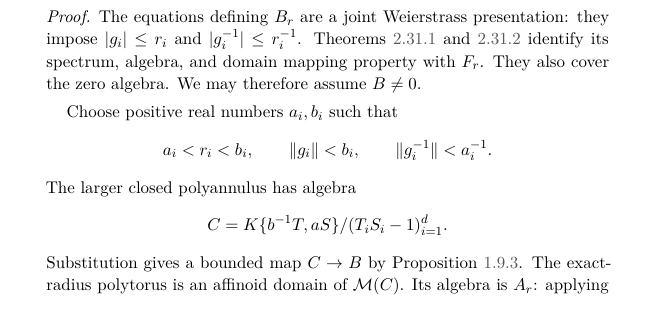
\begin{proof}
The equations defining $B_r$ are a joint Weierstrass presentation:
they impose $|g_i|\leq r_i$ and $|g_i^{-1}|\leq r_i^{-1}$.
Theorems~\ref{fnd:generalizedrationalpoints}
and~\ref{fnd:generalizedrationaluniversal} identify its spectrum,
algebra, and domain mapping property with $F_r$.
They also cover the zero algebra. We may therefore assume $B\ne0$.

Choose positive real numbers $a_i,b_i$ such that
\[
 a_i<r_i<b_i,\qquad
 \|g_i\|<b_i,\qquad \|g_i^{-1}\|<a_i^{-1}.
\]
The larger closed polyannulus has algebra
\[
 C=K\{b^{-1}T,aS\}/(T_iS_i-1)_{i=1}^d.
\]
Substitution gives a bounded map $C\to B$ by
Proposition~\ref{fnd:powerboundedsubstitution}. The exact-radius
polytorus is an affinoid domain of $\mathcal M(C)$. Its algebra is
$A_r$: applying the rational universal property in both directions
identifies the joint inequalities $|T_i|\leq r_i$ and
$|S_i|\leq r_i^{-1}$ with its displayed presentation.

For $x\in F_r$, the hypothesis says that
$x\in\operatorname{Int}(\mathcal M(B)/\mathcal M(K))$.
Apply the affinoid composition formula
\ref{fnd:affinoidinteriorcompositionequality} to
\[
 \mathcal M(B)\longrightarrow\mathcal M(C)
                         \longrightarrow\mathcal M(K).
\]
It gives $x\in\operatorname{Int}(\mathcal M(B)/\mathcal M(C))$.
By the actual rational base-change presentation and
Proposition~\ref{fnd:generalizedrelativepushout},
\[
                       B\widehat\otimes_C A_r\simeq B_r
\]
boundedly, with bounded inverse. The bounded maps from $B$ and
$A_r$ to $B_r$ agree on $C$, so the pushout gives one map.
In the pushout the images of $g_i$ and $g_i^{-1}$ are the images
of the two coordinates of $A_r$; their powers therefore have
bounds by constant multiples of $r_i^m$ and $r_i^{-m}$.
Bounded substitution gives the reverse map from $B_r$.
Both composites fix all coefficient and coordinate images, hence
are identities by polynomial density.
The base-change assertion of
Proposition~\ref{fnd:affinoidinteriorcalculus} now puts every point
of $\mathcal M(B_r)$ in its relative interior over $\mathbb T_r$.
Theorem~\ref{fnd:affinoidboundarylessfinite} proves both finite
generation over $A_r$ and equivalence with the canonical finite
module norm.
\end{proof}
Standing context 1 · exact TeX
Let $K$ be complete for its given real-valued non-Archimedean
absolute value. The first two results allow the trivial valuation
and generalized affinoid algebras. For an affinoid space $X$, write
\[
 \partial_KX=X\setminus\operatorname{Int}(X/\mathcal M(K)).
\]
For a tuple $r=(r_1,\ldots,r_d)$ of positive real numbers put
\[
 A_r=K\{r^{-1}T,rS\}/(T_iS_i-1)_{i=1}^d,
 \qquad \mathbb T_r=\mathcal M(A_r).
\]
Thus $\mathbb T_r$ is the exact-radius polytorus $|T_i|=r_i$.
All quotient ideals below are actual algebraic ideals, and all
tensor products with a hat are separated completed tensor products.
Typeset reader excerpt
Typed proof inputs
- CLAUSE:NAG-001626:source_factor_interior_for_actual_affinoid_maps · selected scope (sealed exact native clause)
- NAG-001398 · selected whole (sealed native whole)
- NAG-001553 · selected whole (sealed native whole)
- NAG-001572 · selected whole (sealed native whole)
- NAG-001573 · selected whole (sealed native whole)
- NAG-001576 · selected whole (sealed native whole)
- NAG-001577 · selected whole (sealed native whole)
- NAG-001578 · selected whole (sealed native whole)
- NAG-001688 · selected whole (sealed native whole)
- NAG-001693 · selected whole (sealed native whole)
- NAG-001704 · selected whole (sealed native whole)
- NAG-001997 · selected whole (earlier original whole proof in this batch)
- CLAUSE:NAG-001626:source_factor_interior_for_actual_affinoid_maps · selected scope
- CLAUSE:NAG-001626:source_factor_interior_for_actual_affinoid_maps · selected scope (requires)
- NAG-001398 · selected whole
- NAG-001398 · selected whole (requires)
- NAG-001553 · selected whole
- NAG-001553 · selected whole (requires)
- NAG-001572 · selected whole
- NAG-001572 · selected whole (requires)
- NAG-001573 · selected whole
- NAG-001573 · selected whole (requires)
- NAG-001576 · selected whole
- NAG-001576 · selected whole (requires)
- NAG-001577 · selected whole
- NAG-001577 · selected whole (requires)
- NAG-001578 · selected whole
- NAG-001578 · selected whole (requires)
- NAG-001688 · selected whole
- NAG-001688 · selected whole (requires)
- NAG-001693 · selected whole
- NAG-001693 · selected whole (requires)
- NAG-001704 · selected whole
- NAG-001704 · selected whole (requires)
- NAG-001997 · selected whole
- NAG-001997 · selected whole (requires)
Reader cross-references
Proof map
Verified map inputs · NAG-002256
AND · joint registered proof inputs
- CLAUSE:NAG-001626:source_factor_interior_for_actual_affinoid_maps · source factor interior for actual affinoid maps · selected scope Exact source window 61–69
- NAG-001398 · Bounded substitution criterion · accepted whole Exact source window 54–55
- NAG-001553 · The actual multi-Laurent relation quotient · accepted whole Exact source window 50–59
- NAG-001572 · Nonemptiness and the unit-ideal test · accepted whole Exact source window 42–43
- NAG-001573 · Scaled power bounds for arbitrary positive radii · accepted whole Exact source window 77–82
- NAG-001576 · Points of an arbitrary-radius rational presentation · accepted whole Exact source window 38–43
- NAG-001577 · Bounded and geometric rational factorization · accepted whole Exact source window 38–59
- NAG-001578 · Joint presentations and completed pushouts · accepted whole Exact source window 38–43
- NAG-001688 · Pushouts with complete-extension affinoids · accepted whole Exact source window 70–82
- NAG-001693 · Rational domains under complete-extension base change · accepted whole Exact source window 70–82
- NAG-001704 · Presentation calculus for relative interior · accepted whole Exact source window 83–85
- NAG-001997 · Boundaryless affinoid morphisms are finite · accepted whole Exact source window 86–88
NAG-002256 · Boundary avoidance gives an actual finite algebra · Chapter argument