NAG-002271 · Accepted whole
The arithmetic of a model vertex
Open in the English reader · PDF page 769
Statement · exact TeX
\begin{proposition}[The arithmetic of a model vertex]
\label{v036:f5:vertexarithmetic}
Let $\mathcal C/O$ be a projective flat finitely presented
nodal model of a smooth projective curve. If $v$ is the
component point belonging to a special component $E$, then
\[
 |\mathcal H(v)^\times|=|K^\times|,
 \qquad \widetilde{\mathcal H(v)}=k(E).
\]
The field $k(E)/k$ is separably generated of transcendence
degree one. For the comparison field $\Omega$ above, the
entire inverse image of $v$ in $C_\Omega^{\an}$ consists
of the component points of the geometric components above
$E$. In particular it is finite.
\end{proposition}
Full selected proof · exact TeX
\begin{proof}
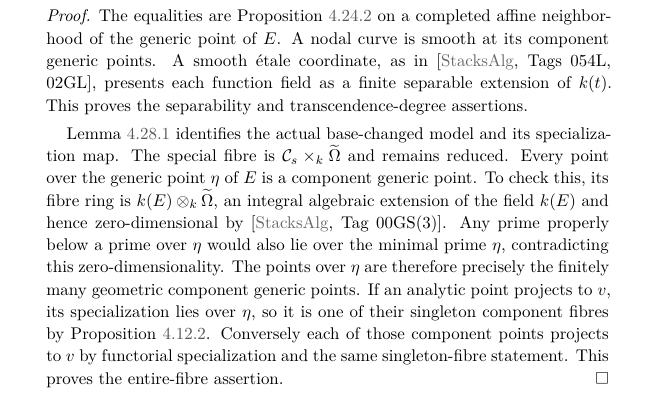
The equalities are Proposition~\ref{cand:componentvaluedresiduefield}
on a completed affine neighborhood of the generic point of
$E$. A nodal curve is smooth at its component generic
points. A smooth \textup{\'etale} coordinate, as in
\cite[Tags 054L, 02GL]{StacksAlg}, presents each function
field as a finite separable extension of $k(t)$. This proves
the separability and transcendence-degree assertions.

Lemma~\ref{cand:algebraicmodelscalar} identifies the actual
base-changed model and its specialization map. The special
fibre is $\mathcal C_s\times_k\widetilde\Omega$ and remains
reduced. Every point over the generic point $\eta$ of $E$
is a component generic point. To check this, its fibre ring
is $k(E)\otimes_k\widetilde\Omega$, an integral algebraic
extension of the field $k(E)$ and hence zero-dimensional
by \cite[Tag 00GS(3)]{StacksAlg}.
Any prime properly below a prime over $\eta$ would also
lie over the minimal prime $\eta$, contradicting this
zero-dimensionality. The points over $\eta$ are therefore
precisely the finitely many geometric component generic
points. If an analytic point projects to $v$, its
specialization lies over $\eta$, so it is one of their
singleton component fibres by
Proposition~\ref{cand:reducedmodelcomponentpoints}.
Conversely each of those component points projects to $v$
by functorial specialization and the same singleton-fibre
statement. This proves the entire-fibre assertion.
\end{proof}
Typeset reader excerpt
Typed proof inputs
- NAG-002036 · selected whole
- NAG-002038 · selected whole
- NAG-002070 · selected whole
- NAG-002094 · selected whole
- NAG-002270 · selected whole
- STACKS-02GL · named external application
- STACKS-054L · named external application
- NAG-002036 · selected whole (requires)
- NAG-002038 · selected whole (requires)
- NAG-002070 · selected whole (requires)
- NAG-002094 · selected whole (requires)
- NAG-002270 · selected whole (requires)
- STACKS-02GL · named external application (requires)
- STACKS-054L · named external application (requires)
Reader cross-references
Proof map
Verified map inputs · NAG-002271
AND · joint registered proof inputs
- NAG-002036 · The analytic point of a residual component · accepted whole
- NAG-002038 · Completion of a projective model · accepted whole
- NAG-002070 · The valued field of a component point · accepted whole
- NAG-002094 · Scalar extension of algebraic formal models · accepted whole
- NAG-002270 · An algebraically closed comparison field · accepted whole
Unlinked source pointers
These pointers have no operative linked edge in this map.
STACKS-02GLSTACKS-054L
NAG-002271 · The arithmetic of a model vertex · Chapter argument