NAG-002274 · Accepted whole
Exact marked contraction over the original field
Open in the English reader · PDF page 770
Statement · exact TeX
\begin{theorem}[Exact marked contraction over the original field]
\label{v036:f5:markedcontraction}
Let $(\mathcal C_0,D)$ be a marked semistable algebraic
model of $C$, and let $\varnothing\ne V\subset W$ satisfy
the marked forest condition. There is a marked semistable
algebraic model $(\mathcal C_V,D_V)$ and a proper morphism
\[
                         q_V:\mathcal C_0\longrightarrow\mathcal C_V
\]
inducing the identity on $C$, with $D\xrightarrow{\sim}D_V$
and with component vertices exactly the original points
of $V$ in $C^{\an}$.

On a geometric special fibre, the positive-dimensional
fibres of $q_V$ are exactly the trees $T$ in
Definition~\ref{v036:f5:forestcondition}. A tree with
$b(T)=1$ maps to a smooth point, and a tree with $b(T)=2$
maps to a node with the indicated attaching branches.
Outside these fibres the special-fibre map is an
isomorphism. Moreover
$(q_V)_*\mathcal O_{\mathcal C_0}=\mathcal O_{\mathcal C_V}$.
\end{theorem}
Full selected proof · exact TeX
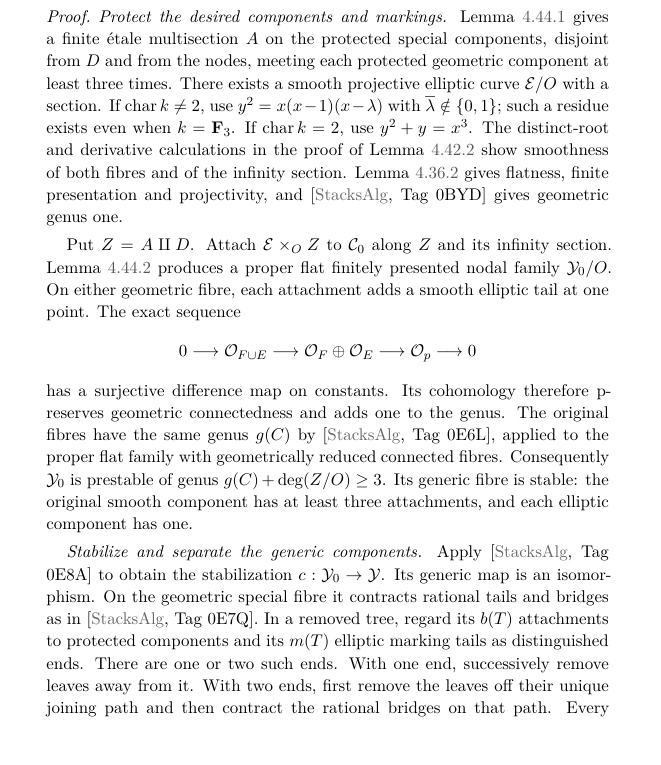
\begin{proof}
\emph{Protect the desired components and markings.}
Lemma~\ref{v036:f5:multisections} gives a finite
\textup{\'etale} multisection $A$ on the protected special
components, disjoint from $D$ and from the nodes, meeting
each protected geometric component at least three times.
There exists a smooth projective elliptic curve
$\mathcal E/O$ with a section. If $\operatorname{char}k\ne2$,
use $y^2=x(x-1)(x-\lambda)$ with
$\overline\lambda\notin\{0,1\}$; such a residue exists
even when $k=\mathbf F_3$. If $\operatorname{char}k=2$,
use $y^2+y=x^3$. The distinct-root and derivative calculations
in the proof of Lemma~\ref{v035:f5:elliptictails} show
smoothness of both fibres and of the infinity section.
Lemma~\ref{cand:integralplanecubicfamily} gives flatness,
finite presentation and projectivity, and
\cite[Tag 0BYD]{StacksAlg} gives geometric genus one.

Put $Z=A\amalg D$. Attach $\mathcal E\times_O Z$ to
$\mathcal C_0$ along $Z$ and its infinity section.
Lemma~\ref{v036:f5:multisectionpinch} produces a proper
flat finitely presented nodal family $\mathcal Y_0/O$.
On either geometric fibre, each attachment adds a smooth
elliptic tail at one point. The exact sequence
\[
 0\longrightarrow\mathcal O_{F\cup E}
 \longrightarrow\mathcal O_F\oplus\mathcal O_E
 \longrightarrow\mathcal O_p\longrightarrow0
\]
has a surjective difference map on constants. Its cohomology
therefore preserves geometric connectedness and adds one
to the genus. The original fibres have the same genus
$g(C)$ by \cite[Tag 0E6L]{StacksAlg}, applied to the proper
flat family with geometrically reduced connected fibres.
Consequently $\mathcal Y_0$ is prestable of genus
$g(C)+\deg(Z/O)\geq3$. Its generic fibre is stable:
the original smooth component has at least three
attachments, and each elliptic component has one.

\emph{Stabilize and separate the generic components.}
Apply \cite[Tag 0E8A]{StacksAlg} to obtain the stabilization
$c:\mathcal Y_0\to\mathcal Y$. Its generic map is an
isomorphism. On the geometric special fibre it contracts
rational tails and bridges as in
\cite[Tag 0E7Q]{StacksAlg}. In a removed tree, regard its
$b(T)$ attachments to protected components and its $m(T)$
elliptic marking tails as distinguished ends. There are
one or two such ends. With one end, successively remove
leaves away from it. With two ends, first remove the
leaves off their unique joining path and then contract
the rational bridges on that path. Every removed vertex
disappears. Every protected component keeps its three
auxiliary elliptic attachments, and every elliptic component
keeps its attachment; all these components are stable.
Uniqueness of stabilization consequently identifies these
as exactly the surviving components. In the two-ended
case the ends retain separate branch labels even if they
lie on the same protected component.

The stable family $\mathcal Y$ is projective over $O$:
\cite[Tag 0E74]{StacksAlg} makes its dualizing line bundle
ample over a neighborhood of the closed point, hence
over the entire local base, and
\cite[Tags 0D32, 0B5N]{StacksAlg} give projectivity.
Apply Proposition~\ref{v036:f5:genericnormalization} to
$\mathcal Y$. Its generic normalization has the distinguished
component $C$ and the elliptic components attached along
$Z_K$. Let $\mathcal C_V$ be its open-and-closed
$C$-labelled piece. It is normal, projective, flat and
finitely presented with nodal geometric fibres.

The source $\mathcal C_0$ is normal and integral by the same
proposition. The morphism
$\mathcal C_0\to\mathcal Y_0\to\mathcal Y$ has its specified
generic lift to $C$. Lemma~\ref{v035:f5:normalizationlift}
therefore gives an actual proper morphism
$q_V:\mathcal C_0\to\mathcal C_V$ inducing the identity
on $C$.

\emph{Identify the fibres, marks, and original vertices.}
The normalization calculation is the identity at smooth
points and at nodes with nonzero smoothing parameter;
at a node with zero parameter it separates the two
generic branches. Hence it introduces no vertical
component. Each surviving auxiliary or marking elliptic
component belongs to its own generic-normalization piece:
apply the same normalization-lift lemma to its smooth
normal elliptic model after an unramified coefficient
extension splitting $Z$. Thus $\mathcal C_V$ contains
precisely the protected original components.

The geometric fibre maps of stabilization are compositions
of the elementary rational-tail and rational-bridge
contractions. They identify an unmarked one-ended tree
with its smooth attaching point. A two-ended tree without
marks gives a node joining its two original branches.
For a one-ended tree with one mark, its second distinguished
end is the marking elliptic tail. Stabilization joins
that tail to the protected component, and generic
normalization separates this horizontal node. The mark
therefore lands at the resulting smooth point of
$\mathcal C_V$. These descriptions also cover marks on
protected components. Distinct marks remain distinct:
each removed one-ended tree contains at most one, different
such trees have different attaching points, and the
original protected marks avoid those nodal attachments.
They show that the claimed trees are exactly the
positive-dimensional geometric fibres and that the map
is an isomorphism away from them. In particular the
special fibre of $\mathcal C_V$ is geometrically connected.

The map $D\to\mathcal C_V$ is finite by the closed-graph
argument, since $D/O$ is finite. After a finite unramified
cover splitting $D$, it is the union of the just identified
disjoint smooth sections, hence a closed immersion. On
an affine open of $\mathcal C_V$, its ring map is therefore
surjective after the faithfully flat coefficient extension;
the cokernel vanishes already over $O$. This proves the
closed immersion. Its image is smooth because all its
generic and geometric special points are smooth in the
nodal family.

At the generic point $\eta_v$ of any protected original
component, stabilization is an isomorphism and generic
normalization is the identity. Thus $q_V(\eta_v)$ is
the generic point of the corresponding new component.
Complete the projective models as in
Theorem~\ref{cand:projectiveformalcompletion}.
Functoriality of specialization in
Proposition~\ref{fnd:formalglobalgenericfaithful} gives
\[
 \operatorname{sp}_{\mathcal C_V}(v)=q_V(\eta_v).
\]
Proposition~\ref{cand:reducedmodelcomponentpoints} identifies
its singleton analytic fibre with the original point $v$.
Every surviving component has just been accounted for,
so the vertex set is exactly $V$. Finally apply
Lemma~\ref{v036:f5:properquotient} to the proper birational
map $q_V$ and its normal target.
\end{proof}
Standing context 1 · exact TeX
\begin{definition}[Marked semistable models over the original field]
\label{v036:f5:modelclass}
Let $C/K$ be smooth, projective and geometrically connected.
A \emph{semistable algebraic model} of $C$
means a projective flat finitely presented nodal $O$-curve
with generic fibre identified with $C$ and geometrically
connected special fibre. Its special fibre is geometrically
reduced. A \emph{marking} is a finite \textup{\'etale}
$O$-scheme $D$ embedded as a closed subscheme of the relative
smooth locus. An empty marking is allowed. Write $W$ for
the component vertex set of the model. A morphism of marked
models carries a specified isomorphism of its marking with
the target marking, compatible with the curve morphism
and with the specified generic identifications.

The \emph{geometric marked dual graph} has one vertex for
each component over $\overline k$, one edge for each
geometric node, and one labelled leg for each point of
$D_{\overline k}$. The two branches of a self-node give the
two ends of its loop.
\end{definition}
Standing context 2 · exact TeX
Fix a nonempty subset $V\subset W$,
and let $\overline V$ denote all geometric vertices over
its special components. For a connected component $T$ of
the subgraph induced by the vertices outside $\overline V$,
let $b(T)$ count its incident edges leading to
$\overline V$, with multiplicity, and let $m(T)$ count
its marked legs.

\begin{definition}[The marked forest condition]
\label{v036:f5:forestcondition}
The subset $V$ satisfies the marked forest condition if
every such $T$ is a tree, all the geometric special
components at its vertices are smooth $\mathbf P^1_{\overline k}$,
and
\[
                         b(T)+m(T)\leq2.
\]
Connectedness and $V\ne\varnothing$ give $b(T)\geq1$.
Thus a tree with one attaching branch carries at most one
mark, and a tree with two attaching branches carries none.
The two attaching branches may end on the same protected
component.
\end{definition}
Standing context 3 · exact TeX
\begin{definition}[Semistable formal curve models with pointed charts]
\label{v035:formal:modelclass}
Suppose $K$ is algebraically closed and $C/K$ is a smooth
connected projective curve. A point of $C^{\an}$ is of
\emph{type II} when its completed residue field has residual
transcendence degree one and relative rational value-group
rank zero. A \emph{pointedly semistable
formal model} of $C^{\an}$ is a quasi-compact admissible
formal $O$-scheme with an identification of its generic
fibre with $C^{\an}$, reduced pure one-dimensional special
fibre, and a diagram as in
Proposition~\ref{v035:formal:tubeends} at each closed
special-fibre point. Morphisms induce the identity on
$C^{\an}$. Its vertex set consists of its component
points $v_\eta$.
\end{definition}
Typeset reader excerpt
Typed proof inputs
- NAG-002036 · selected whole (exact native application)
- NAG-002038 · selected whole (exact native application)
- NAG-002168 · selected whole (exact native application)
- NAG-002236 · selected whole (exact native application)
- NAG-002262 · selected whole (exact native application)
- NAG-002265 · selected whole (exact native application)
- NAG-002266 · selected whole (exact native application)
- NAG-002267 · selected whole (exact native application)
- NAG-002268 · selected whole (exact native application)
- SUPPORT:NAG-001944:given_atlas_open_preimages_and_contraction · typed target unresolved in this export (exact native application)
- SUPPORT:NAG-002235:smooth_integral_cubic_with_infinity · typed target unresolved in this export (exact native application)
Reader cross-references
Proof map
Verified map inputs · NAG-002274
AND · joint registered proof inputs
- NAG-002036 · The analytic point of a residual component · accepted whole Exact source window 714–715
- Singleton fibre at each surviving component's generic point.
- NAG-002038 · Completion of a projective model · accepted whole Exact source window 707–708
- Complete the given projective flat model morphisms over the original K.
- NAG-002168 · The integral plane-cubic family · accepted whole Exact source window 588–597
- Integral projective cubic with smooth geometric fibres and section.
- NAG-002236 · Lifting to a generic normalization · accepted whole Exact source window 652–669
- Lift the C-labelled source with its prescribed generic map; apply again to auxiliary elliptic pieces on the actual unramified coefficient cover.
- NAG-002262 · Integral Galois descent for unramified coefficients · accepted whole Exact source window 692–698
- The actual finite étale faithfully flat coefficient cover splits D; surjectivity of the finite immersion ring maps descends.
- NAG-002265 · Result 4.44.1 · accepted whole Exact source window 582–587
- Actual disjoint finite étale multisections on all protected geometric components, avoiding D and nodes.
- NAG-002266 · Result 4.44.2 · accepted whole Exact source window 598–610
- Pinch precisely the compatible finite étale multisections to sections of the attached elliptic families.
- NAG-002267 · Generic normalization of a nodal family · accepted whole Exact source window 646–654
- Relative normalization gives the projective flat C-labelled piece, and the actual smooth-generic source is normal integral.
- NAG-002268 · Proper contractions as ringed-space quotients · accepted whole Exact source window 717–719
- Proper birational morphism with normal integral target; structure sheaf identification.
Unlinked source pointers
These pointers have no operative linked edge in this map.
SUPPORT:NAG-001944:given_atlas_open_preimages_and_contractionSUPPORT:NAG-002235:smooth_integral_cubic_with_infinity
NAG-002274 · Exact marked contraction over the original field · Chapter argument