NAG-002282 · Accepted whole
Component lengths under a finite model comparison
5 Tropicalization, multiplicities and balancing
Open in the English reader · PDF page 944
Statement · exact TeX
\begin{proposition}[Component lengths under a finite model comparison]
\label{v036:projection:componentcomparison}
Let $D_0\subset C_0\subset D$ be actual admissible models of the
same affinoid algebra, both finite over
\[
 A_0=O\langle U_1^{\pm1},\ldots,U_d^{\pm1}\rangle.
\]
The inclusion induces a finite morphism
$\nu:\operatorname{Spec}\overline C_0\to
\operatorname{Spec}\overline D_0$, and
\[
              \nu_*[\operatorname{Spec}\overline C_0]_d
                  =[\operatorname{Spec}\overline D_0]_d.
\]
More precisely, for every $d$-dimensional minimal prime
$\mathfrak p$ of $\overline D_0$,
\begin{equation}
\label{v036:projection:eqcomponentlength}
 \operatorname{length}((\overline D_0)_{\mathfrak p})
   =\sum_{\mathfrak q\mapsto\mathfrak p}
      \operatorname{length}((\overline C_0)_{\mathfrak q})
      [\kappa(\mathfrak q):\kappa(\mathfrak p)],
\end{equation}
where the sum is over the $d$-dimensional minimal primes of
$\overline C_0$ above $\mathfrak p$.
\end{proposition}
Full selected proof · exact TeX
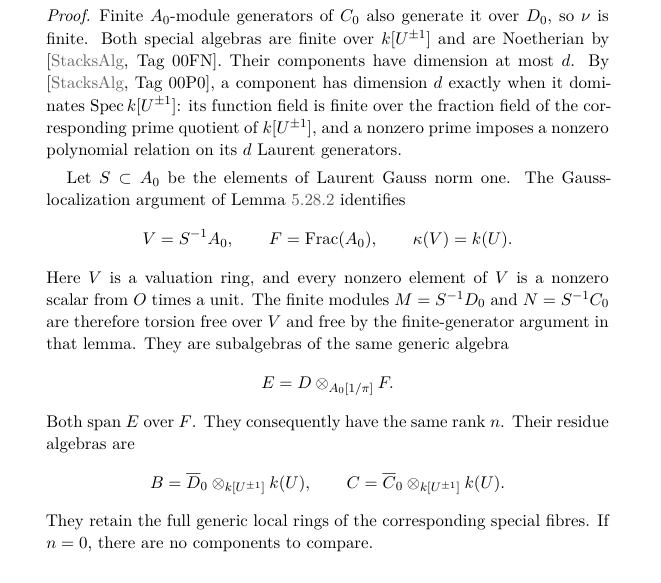
\begin{proof}
Finite $A_0$-module generators of $C_0$ also generate it over
$D_0$, so $\nu$ is finite. Both special algebras are finite
over $k[U^{\pm1}]$ and are Noetherian by
\cite[Tag 00FN]{StacksAlg}. Their components have dimension at
most $d$. By \cite[Tag 00P0]{StacksAlg}, a component has
dimension $d$ exactly when it dominates
$\operatorname{Spec}k[U^{\pm1}]$: its function field is finite
over the fraction field of the corresponding prime quotient
of $k[U^{\pm1}]$, and a nonzero prime imposes a nonzero
polynomial relation on its $d$ Laurent generators.

Let $S\subset A_0$ be the elements of Laurent Gauss norm one.
The Gauss-localization argument of
Lemma~\ref{v035:degreegaussrank} identifies
\[
 V=S^{-1}A_0,\qquad F=\operatorname{Frac}(A_0),\qquad
 \kappa(V)=k(U).
\]
Here $V$ is a valuation ring, and every nonzero element of $V$
is a nonzero scalar from $O$ times a unit. The finite modules
$M=S^{-1}D_0$ and $N=S^{-1}C_0$ are therefore torsion free
over $V$ and free by the finite-generator argument in that
lemma. They are subalgebras of the same generic algebra
\[
                         E=D\otimes_{A_0[1/\pi]}F.
\]
Both span $E$ over $F$. They consequently have the same rank
$n$. Their residue algebras are
\[
 B=\overline D_0\otimes_{k[U^{\pm1}]}k(U),\qquad
 C=\overline C_0\otimes_{k[U^{\pm1}]}k(U).
\]
They retain the full generic local rings of the corresponding
special fibres. If $n=0$, there are no components to compare.

By \cite[Tag 00JB]{StacksAlg}, $B$ and $C$ are products of
their Artinian local factors. Fix a maximal ideal
$\mathfrak p$ of $B$, and let $\overline b\in B$ be the
idempotent which is one on $B_{\mathfrak p}$ and zero on the
other factors. Choose any lift $b\in M$. Multiplication by
$b$ on the two free $V$-modules $M$ and $N$ has the same
characteristic polynomial: after scalar extension to $F$,
both operators are multiplication by the same element on
$E$. Equality over $V$ follows from $V\subset F$.

Reducing this equality to $k(U)$ gives
\[
 t^{n-a}(t-1)^a=t^{n-a'}(t-1)^{a'},\qquad
 a=\dim_{k(U)} B_{\mathfrak p},\quad
 a'=\dim_{k(U)}(\overline b C).
\]
The factors $t$ and $t-1$ are relatively prime in every
characteristic, so $a=a'$. The idempotent $\overline b$
selects exactly the local factors $C_{\mathfrak q}$ whose
maximal ideals contract to $\mathfrak p$ in $B$.
Taking a composition series of each Artinian local factor
therefore gives
\[
 \operatorname{length}(B_{\mathfrak p})
          [\kappa(\mathfrak p):k(U)]
 =\sum_{\mathfrak q\mapsto\mathfrak p}
     \operatorname{length}(C_{\mathfrak q})
          [\kappa(\mathfrak q):k(U)].
\]
Divide by the positive integer $[\kappa(\mathfrak p):k(U)]$
and use the tower formula for field degrees.
Localization identifies these local rings with those in
\eqref{v036:projection:eqcomponentlength}, proving that
formula and the cycle identity. No local factor has been
replaced by its reduced quotient.
\end{proof}
Standing context 1 · exact TeX
% Author: /root/f6_degree. English candidate; status is assigned by review and gate.
\section{Common models for finite moment projections}
\label{v036:projection:section}

Fix a complete nontrivially valued field $K$ with its given real-valued
absolute value, and write
\[
 O=K^\circ,\qquad \mathfrak m=K^{\circ\circ},\qquad
 k=O/\mathfrak m.
\]
Choose $\pi\in O$ with $0<|\pi|<1$. An \emph{actual admissible model}
of a $K$-affinoid algebra $D$ is an admissible topologically finitely
presented $O$-subalgebra $D_0\subset D$ for which $D_0[1/\pi]=D$
and the generic-fibre Banach topology is the given topology of $D$.
The special algebra is always the actual quotient
$\overline D_0=D_0/\mathfrak mD_0$.
Typeset reader excerpt
Typed proof inputs
- APP-STACKS-00FN@NAG-002282:Gauss-original-site-1 · named external application
- APP-STACKS-00FN@NAG-002282:Gauss-original-site-1 · named external application (requires)
- APP-STACKS-00JB@NAG-002282:Gauss-original-site-4 · named external application
- APP-STACKS-00JB@NAG-002282:Gauss-original-site-4 · named external application (requires)
- APP-STACKS-00P0@NAG-002282:Gauss-original-site-2 · named external application
- APP-STACKS-00P0@NAG-002282:Gauss-original-site-2 · named external application (requires)
- NAG-002242 · selected whole
- NAG-002242 · selected whole (requires)
Named external registrations
Reader cross-references
Proof map
Verified map inputs · NAG-002282
Registered proof input
- NAG-002242 · Finite formal models at the Gauss point · accepted whole
Unlinked source pointers
These pointers have no operative linked edge in this map.
APP-STACKS-00FN@NAG-002282:Gauss-original-site-1APP-STACKS-00JB@NAG-002282:Gauss-original-site-4APP-STACKS-00P0@NAG-002282:Gauss-original-site-2
NAG-002282 · Component lengths under a finite model comparison · Chapter argument