NAG-002289 · Accepted whole
Projection comparison at a flat analytic tropical germ
5 Tropicalization, multiplicities and balancing
Open in the English reader · PDF page 949
Statement · exact TeX
\begin{theorem}[Projection comparison at a flat analytic tropical germ]
\label{v036:projection:flatgermcomparison}
Let $X=\mathcal M(B)$ be a generalized $K$-affinoid space and
let $f_1,\ldots,f_n\in B^\times$ define the moment map
\[
 t:X\longrightarrow\mathbf R^n,\qquad
 t(x)=(-\log|f_1(x)|,\ldots,-\log|f_n(x)|).
\]
Let $w\in\mathbf R^n$, and choose $b_j\in K^\times$ with
$|b_j|=\exp(-w_j)$. Put $h_j=f_j/b_j$, let $D=B_w$ be the
actual algebra of $F_w=t^{-1}(w)$, and set $N=\mathbf Z^n$.
Suppose there are a saturated rank-$d$ sublattice $L\subset N$
and a neighborhood $W$ of $w$ such that
\[
 t(X)\cap W\subset w+L_{\mathbf R},\qquad
 F_w\cap\partial_KX=\varnothing.
\]
Assume that the normalized moment tuple on $D$ admits a finite
projection to a $d$-dimensional unit polytorus with its canonical
finite-module norm.

Every integral support of $\mathcal C_d(D,h)$ is a fibre of
$\mathbb T_N\to\mathbb T_{N/L}$ over a closed point.
Consequently, for any finite projections $Q_0,Q_1$ of this same
actual algebra with $Q_i|_L$ injective,
\[
 \frac{\dim_{H_{Q_0}}(D\widehat\otimes_{A_{Q_0}}H_{Q_0})}
      {[\mathbf Z^d:Q_0(L)]}
 =\frac{\dim_{H_{Q_1}}(D\widehat\otimes_{A_{Q_1}}H_{Q_1})}
      {[\mathbf Z^d:Q_1(L)]}
 =\sum_s c_s[\kappa(s):k]\in\mathbf Z_{\geq0},
\]
where $\mathcal C_d(D,h)=\sum_s c_s[\rho^{-1}(s)]$.
\end{theorem}
Full selected proof · exact TeX
\begin{proof}
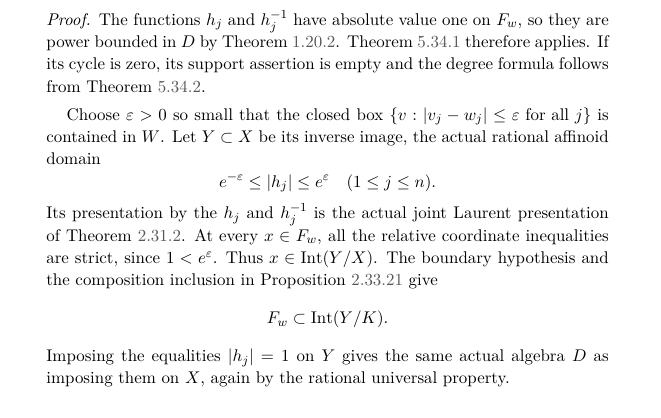
The functions $h_j$ and $h_j^{-1}$ have absolute value one
on $F_w$, so they are power bounded in $D$ by
Theorem~\ref{fnd:generalizedpointwisepowerbound}.
Theorem~\ref{v036:projection:intrinsiccycle} therefore applies.
If its cycle is zero, its support assertion is empty and the
degree formula follows from
Theorem~\ref{v036:projection:invariantweight}.

Choose $\varepsilon>0$ so small that the closed box
$\{v:|v_j-w_j|\leq\varepsilon\text{ for all }j\}$ is contained
in $W$. Let $Y\subset X$ be its inverse image, the actual
rational affinoid domain
\[
       e^{-\varepsilon}\leq|h_j|\leq e^{\varepsilon}
                         \quad(1\leq j\leq n).
\]
Its presentation by the $h_j$ and $h_j^{-1}$ is the actual
joint Laurent presentation of
Theorem~\ref{fnd:generalizedrationaluniversal}.
At every $x\in F_w$, all the relative coordinate inequalities
are strict, since $1<e^{\varepsilon}$. Thus
$x\in\operatorname{Int}(Y/X)$.
The boundary hypothesis and the composition inclusion in
Proposition~\ref{fnd:affinoidinteriorcalculus} give
\[
                        F_w\subset\operatorname{Int}(Y/K).
\]
Imposing the equalities $|h_j|=1$ on $Y$ gives the same actual
algebra $D$ as imposing them on $X$, again by the rational
universal property.

Put $M_0=M\cap L_{\mathbf R}^{\perp}$. For $u\in M_0$,
the unit $h_u=\prod_j h_j^{u_j}$ has absolute value one at
every point of $Y$, because $t(Y)-w\subset L_{\mathbf R}$.
Theorem~\ref{fnd:generalizedpointwisepowerbound} and bounded
substitution, Proposition~\ref{fnd:powerboundedsubstitution},
give a morphism
\[
          h_u:Y\longrightarrow\mathcal M(K\langle T^{\pm1}\rangle).
\]
For \(x\in F_w\), apply the
\hyperref[fnd:gradedabsoluteevaluationforward]{forward implication for absolute evaluation}
to the actual collar \(Y\), using \(x\in\operatorname{Int}(Y/K)\). The image \(S_x\) of
\(\widetilde{\mathcal O(Y)}^{\rm gr}\) in
\(\widetilde{\mathcal H(x)}^{\rm gr}\) is finite over
\(\widetilde K^{\rm gr}\).
Choose finitely many homogeneous module generators for \(S_x\).
The component of \(\widetilde K^{\rm gr}\) that takes any given
generator to degree one has dimension at most one over \(k\).
Thus \((S_x)_1\) is a finite-dimensional \(k\)-algebra.
The identity \(\lvert h_u\rvert=1\) on \(Y\) gives spectral radius one,
and \(\lvert h_u(x)\rvert=1\) makes its degree-one initial image the
nonzero residue of \(h_u(x)\) in \(\widetilde{\mathcal H(x)}\).
This residue lies in \((S_x)_1\) and is therefore algebraic over \(k\).

Choose an actual model $D_0$ compatible with $h$ and a
$d$-dimensional minimal prime $\mathfrak p$ of
$\overline D_0$. The formal specialization theorem
\ref{fnd:affineformalspecializationsurjective} supplies
$x\in\mathcal M(D)=F_w$ specializing to $\mathfrak p$.
By the definition of specialization, evaluation induces an
injection
\[
              \overline D_0/\mathfrak p
                   \hookrightarrow\widetilde{\mathcal H(x)},
\]
and hence an injection of its fraction field. The preceding
paragraph shows that the residue of every $h_u$, $u\in M_0$,
is algebraic over $k$ in this fraction field.

Let $Z$ be the residual moment image of this component.
Its coordinate ring is the image of $k[M]$ in that field,
and $\dim Z=d$ by finiteness of the residual moment map.
The image of $k[M_0]$ is a finitely generated algebraic
domain over $k$, hence a finite field $k'$ by monic equations
and finite-dimensional linear algebra. It corresponds to a
closed point $s$ of $\mathbb T_{N/L}$.
Split $N=L\oplus N_1$ using
Lemma~\ref{cand:elementarylatticesplitting}. The coordinate
ring of $Z$ is then an integral quotient of $k'[L^\vee]$.
A nonzero kernel would give a nonzero Laurent polynomial
relation on its $d$ character generators and lower the
transcendence degree below $d$. This contradicts
$\dim Z=d$ and \cite[Tag 00P0]{StacksAlg}. The quotient map
is therefore an isomorphism. Thus $Z=\rho^{-1}(s)$ as a
closed subscheme. This treats every support of the residual
cycle, and Theorem~\ref{v036:projection:invariantweight}
now gives the displayed degree comparison.
\end{proof}
Typeset reader excerpt
Typed proof inputs
- CLAUSE:NAG-001962:absolute_evaluation_forward · selected scope, text unavailable
- NAG-001398 · selected whole
- NAG-001573 · selected whole
- NAG-001577 · selected whole
- NAG-001704 · selected whole
- NAG-001939 · selected whole
- NAG-002179 · selected whole
- NAG-002285 · selected whole
- NAG-002287 · selected whole
- STACKS-00P0 · named external application
- CLAUSE:NAG-001962:absolute_evaluation_forward · selected scope, text unavailable (requires)
- NAG-001398 · selected whole (requires)
- NAG-001573 · selected whole (requires)
- NAG-001577 · selected whole (requires)
- NAG-001704 · selected whole (requires)
- NAG-001939 · selected whole (requires)
- NAG-002179 · selected whole (requires)
- NAG-002285 · selected whole (requires)
- NAG-002287 · selected whole (requires)
- STACKS-00P0 · named external application (requires)
Reader cross-references
Proof map
Verified map inputs · NAG-002289
AND · joint registered proof inputs
- NAG-001398 · Bounded substitution criterion · accepted whole
- NAG-001573 · Scaled power bounds for arbitrary positive radii · accepted whole
- NAG-001577 · Bounded and geometric rational factorization · accepted whole
- NAG-001704 · Presentation calculus for relative interior · accepted whole
- NAG-001939 · Surjectivity of formal specialization · accepted whole
- NAG-002179 · Primitive vectors and saturated lattices · accepted whole
- NAG-002285 · A residual moment cycle independent of the projection · accepted whole
- NAG-002287 · The degree of a subtorus-invariant residual cycle · accepted whole
Unlinked source pointers
These pointers have no operative linked edge in this map.
CLAUSE:NAG-001962:absolute_evaluation_forwardSTACKS-00P0
NAG-002289 · Projection comparison at a flat analytic tropical germ · Chapter argument