NAG-002285 · Accepted whole
A residual moment cycle independent of the projection
5 Tropicalization, multiplicities and balancing
Open in the English reader · PDF page 946
Statement · exact TeX
\begin{theorem}[A residual moment cycle independent of the projection]
\label{v036:projection:intrinsiccycle}
Suppose at least one such finite projection $Q$ exists.
For any actual model $D_0$ compatible with $h$, the residual
moment morphism
\[
 \phi_0:\operatorname{Spec}\overline D_0\longrightarrow\mathbb T_N
\]
is finite, and the effective cycle
\[
             \mathcal C_d(D,h)=(\phi_0)_*
                                   [\operatorname{Spec}\overline D_0]_d
\]
is independent of the model and of the finite projection used
to construct it. If
$\mathcal C_d(D,h)=\sum_Z c_Z[Z]$, then every finite projection
$Q$ restricts to a finite dominant map
$q_Z:Z\to\mathbb T_{\mathbf Z^d}$, and
\begin{equation}
\label{v036:projection:eqdegreecycle}
              \delta_Q=\sum_Z c_Z
                    [k(Z):k(U_1,\ldots,U_d)].
\end{equation}

The cycles also respect monomial changes of moment coordinates.
Precisely, let $a:N\to N'$ and $h'=h\circ a^*$, and suppose
that $h'$ admits a finite projection to a $d$-dimensional unit
polytorus for the same actual algebra $D$. The residual monomial
map is finite on every component of $\mathcal C_d(D,h)$ and
\[
                  \mathcal C_d(D,h')=a_*\mathcal C_d(D,h).
\]
\end{theorem}
Full selected proof · exact TeX
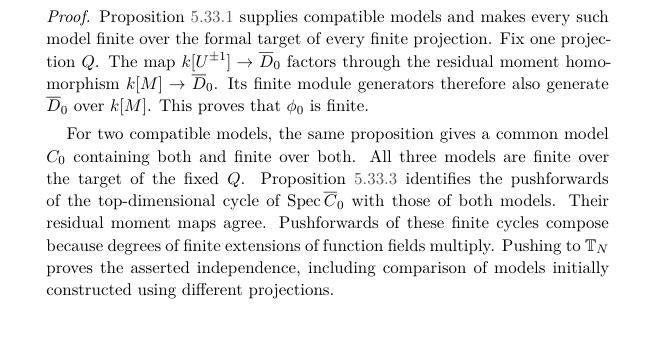
\begin{proof}
Proposition~\ref{v036:projection:commonmodel} supplies compatible
models and makes every such model finite over the formal target
of every finite projection. Fix one projection $Q$. The map
$k[U^{\pm1}]\to\overline D_0$ factors through the residual
moment homomorphism $k[M]\to\overline D_0$. Its finite module
generators therefore also generate $\overline D_0$ over
$k[M]$. This proves that $\phi_0$ is finite.

For two compatible models, the same proposition gives a common
model $C_0$ containing both and finite over both. All three
models are finite over the target of the fixed $Q$.
Proposition~\ref{v036:projection:componentcomparison} identifies
the pushforwards of the top-dimensional cycle of
$\operatorname{Spec}\overline C_0$ with those of both models.
Their residual moment maps agree. Pushforwards of these finite
cycles compose because degrees of finite extensions of function
fields multiply. Pushing to $\mathbb T_N$ proves the asserted
independence, including comparison of models initially constructed
using different projections.

For any other finite projection, use the same compatible model.
Each $d$-dimensional component of its special fibre dominates
$\mathbb T_{\mathbf Z^d}$ by the dimension argument in
Proposition~\ref{v036:projection:componentcomparison}.
Its residual moment image $Z$ is also $d$-dimensional. The
coordinate ring of $Z$ lies between the image of
$k[U^{\pm1}]$ and the coordinate domain of the source
component. The latter is finite over $k[U^{\pm1}]$.
Every generator of the intermediate ring is consequently
integral over $k[U^{\pm1}]$, and finitely many generators
satisfying monic equations make it finite. Thus $q_Z$ is
finite and dominant.

By Lemma~\ref{v035:degreegaussrank} and the Artinian length
formula in Theorem~\ref{v035:analytic:finitequotientmodel},
\[
 \delta_Q
    =\sum_{\dim(\overline D_0/\mathfrak p)=d}
       \operatorname{length}((\overline D_0)_{\mathfrak p})
       [\kappa(\mathfrak p):k(U)].
\]
Group the terms having the same residual moment image $Z$.
The definition of $c_Z$ and the field-degree tower formula
give exactly \eqref{v036:projection:eqdegreecycle}.

For the last assertion, a model compatible with $h$ is also
compatible with $h'$. It is finite over a target of a finite
projection for $h'$. On every component, the coordinate ring
of the residual $h$-image is intermediate between the ring of
the residual $h'$-image and a finite algebra over the latter.
The same monic-equation argument proves finiteness of the
induced map of image components. The two residual moment maps
now compose through $a$, and multiplication of the full field
degrees proves the cycle identity.
\end{proof}
Standing context 1 · exact TeX
Let $N$ be a lattice, $M=N^\vee$, and
$\mathbb T_N=\operatorname{Spec}k[M]$. A normalized moment tuple
on $D$ is a homomorphism
\[
                     h:M\longrightarrow D^\times
\]
such that every character value and its inverse are power
bounded. A basis and its inverses suffice for this condition.
For $Q:N\to\mathbf Z^d$, put
\[
 A_Q=K\langle U_1^{\pm1},\ldots,U_d^{\pm1}\rangle,
 \qquad U_j\longmapsto h(Q^*e_j).
\]
We consider those $Q$ for which this map is finite and the given
norm on $D$ is equivalent to the canonical finite-$A_Q$-module
norm. Write $H_Q$ for the completed residue field of the Gauss
point of $\mathcal M(A_Q)$, and put
\[
                 \delta_Q=\dim_{H_Q}(D\widehat\otimes_{A_Q}H_Q).
\]
An actual model is \emph{compatible with $h$} if it contains
the values of a basis of $M$ and their inverses.
Typeset reader excerpt
Typed proof inputs
- NAG-002242 · selected whole (sealed native whole)
- NAG-002259 · selected whole (earlier original whole proof in this batch)
- NAG-002280 · selected whole (earlier original whole proof in this batch)
- NAG-002282 · selected whole (sealed native whole)
- NAG-002242 · selected whole
- NAG-002242 · selected whole (requires)
- NAG-002259 · selected whole
- NAG-002259 · selected whole (requires)
- NAG-002280 · selected whole
- NAG-002280 · selected whole (requires)
- NAG-002282 · selected whole
- NAG-002282 · selected whole (requires)
Reader cross-references
Proof map
Verified map inputs · NAG-002285
AND · joint registered proof inputs
- NAG-002242 · Finite formal models at the Gauss point · accepted whole Exact source window 301–311
- NAG-002259 · A finite formal model containing prescribed bounded elements · accepted whole Exact source window 301–311
- NAG-002280 · Simultaneous finite models · accepted whole Exact source windows 268–285, 313–321
- NAG-002282 · Component lengths under a finite model comparison · accepted whole Exact source windows 276–286, 288–299, 313–321
NAG-002285 · A residual moment cycle independent of the projection · Chapter argument