NAG-002259 · Accepted whole
A finite formal model containing prescribed bounded elements
5 Tropicalization, multiplicities and balancing
Open in the English reader · PDF page 939
Statement · exact TeX
\begin{theorem}[A finite formal model containing prescribed bounded elements]
\label{v035:analytic:finitequotientmodel}
Let $A\to D$ be a bounded map of generalized $K$-affinoid
algebras. Assume that $D$ is finite over $A$ and its given norm
is equivalent to its canonical finite-$A$-module norm. Let
$h_1,\ldots,h_m\in D$ be power-bounded elements.
There is an admissible topologically finitely presented
$O$-algebra $D_0\subset D$, finite over $A_0$, such that
\[
                 D_0[1/\pi]=D,
                 \qquad h_1,\ldots,h_m\in D_0.
\]
It can be chosen as the actual image of a finite restricted-series
presentation $A_0\langle Y\rangle\to D$. Its generic-fibre
Banach structure is the given one on $D$.

Let $\xi$ be the Gauss point of $\mathcal M(A)$ and
$H=\mathcal H(\xi)$. For this model put
\[
 C_0=(D_0/\mathfrak mD_0)
          \otimes_{k[T^{\pm1}]} k(T_1,\ldots,T_d).
\]
Then $C_0$ is a finite-dimensional algebra, and
\begin{equation}
\label{v035:eq:analyticgaussdegree}
 \begin{aligned}
 \dim_H(D\widehat\otimes_AH)
   &=\dim_{k(T)}C_0\\
   &=\sum_{\mathfrak n\in\operatorname{Max}C_0}
       \operatorname{length}_{(C_0)_{\mathfrak n}}
                              ((C_0)_{\mathfrak n})
       [\kappa(\mathfrak n):k(T)].
 \end{aligned}
\end{equation}
For fixed $A\to D$, this total degree is independent of the
chosen presentation and of the chosen admissible finite
$A_0$-model with generic algebra $D$.
\end{theorem}
Full selected proof · exact TeX
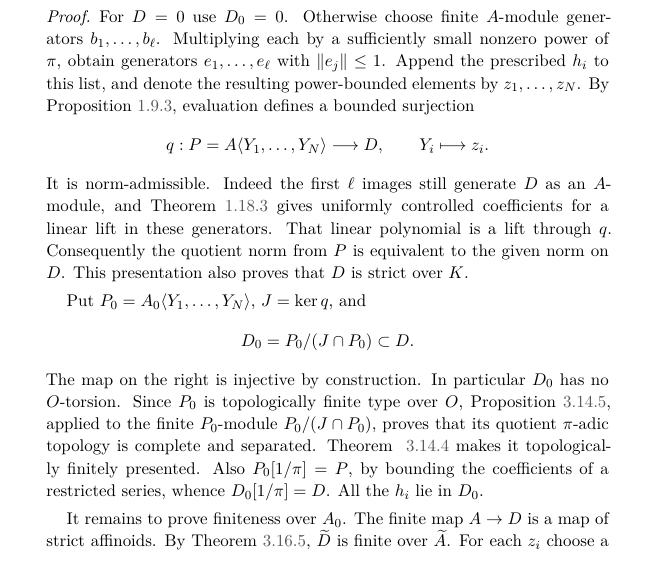
\begin{proof}
For $D=0$ use $D_0=0$. Otherwise choose finite $A$-module
generators $b_1,\ldots,b_\ell$. Multiplying each by a sufficiently
small nonzero power of $\pi$, obtain generators $e_1,\ldots,e_\ell$
with $\|e_j\|\leq1$. Append the prescribed $h_i$ to this list,
and denote the resulting power-bounded elements by
$z_1,\ldots,z_N$. By Proposition~\ref{fnd:powerboundedsubstitution},
evaluation defines a bounded surjection
\[
             q:P=A\langle Y_1,\ldots,Y_N\rangle\longrightarrow D,
             \qquad Y_i\longmapsto z_i.
\]
It is norm-admissible. Indeed the first $\ell$ images still
generate $D$ as an $A$-module, and
Theorem~\ref{fnd:generalizedfinitemodules} gives uniformly
controlled coefficients for a linear lift in these generators.
That linear polynomial is a lift through $q$. Consequently the
quotient norm from $P$ is equivalent to the given norm on $D$.
This presentation also proves that $D$ is strict over $K$.

Put $P_0=A_0\langle Y_1,\ldots,Y_N\rangle$, $J=\ker q$, and
\[
                         D_0=P_0/(J\cap P_0)\subset D.
\]
The map on the right is injective by construction. In particular
$D_0$ has no $O$-torsion. Since $P_0$ is topologically finite type
over $O$, Proposition~\ref{fnd:formalmoduletopology}, applied to
the finite $P_0$-module $P_0/(J\cap P_0)$, proves that its quotient
$\pi$-adic topology is complete and separated. Theorem~
\ref{fnd:formaltorsionfreepresentation} makes it topologically
finitely presented. Also $P_0[1/\pi]=P$, by bounding the
coefficients of a restricted series, whence $D_0[1/\pi]=D$.
All the $h_i$ lie in $D_0$.

It remains to prove finiteness over $A_0$. The finite map
$A\to D$ is a map of strict affinoids. By
Theorem~\ref{fnd:strictcanonicalfinitecriterion},
$\widetilde D$ is finite over $\widetilde A$. For each $z_i$
choose a monic relation for its residue over
$k[T^{\pm1}]$, and lift its coefficients to a monic
$p_i(Z)\in A_0[Z]$. Then
\[
                        w_i=p_i(z_i)\in D^{\circ\circ}.
\]
In the quotient norm from $q$, $\|w_i^n\|\to0$; topological
nilpotence is unchanged by the equivalent norm just established.
For each of the finitely many $i$, choose $a_i\geq1$ and an
actual lift $G_i\in P$ of $w_i^{a_i}$ with $\|G_i\|<1$.
Such a lift exists by the definition of the quotient infimum
once $\|w_i^{a_i}\|<1$. Since there are finitely many lifts,
\[
                    \theta=\max_i\|G_i\|<1.
\]
In particular $G_i\in P_0$ and
$p_i(Y_i)^{a_i}-G_i\in J\cap P_0$.
The strict Laurent coefficient norm of a nonzero $G_i$ attains
its maximum at a coefficient in $K$. Choosing such a coefficient
$c_i$ gives $G_i=c_iG'_i$ with $G'_i\in P_0$ and
$c_i\in\mathfrak m$. The zero lift has the same conclusion.
Thus every $G_i$ vanishes modulo $\mathfrak mD_0$.

Reduction of $P_0$ is the polynomial algebra
$k[T^{\pm1},Y_1,\ldots,Y_N]$, since restricted coefficients
are eventually smaller than one. The images of the $Y_i$ in
$D_0/\mathfrak mD_0$ satisfy the monic equations
$\overline p_i(Y_i)^{a_i}=0$. The bounded powers below their
degrees span this quotient over $k[T^{\pm1}]$.
Lemma~\ref{v035:degreegaussrank} now applies to the actual
admissible quotient $A_0\to D_0$. It proves that $D_0$ is finite
over $A_0$, compares its generic norm with the canonical finite
module norm, and gives the first equality in
\eqref{v035:eq:analyticgaussdegree}.

For the second equality, decompose the finite-dimensional
Artinian algebra $C_0$ into its local factors by
\cite[Tag 00JB]{StacksAlg}. A composition
series of the factor $(C_0)_{\mathfrak n}$ has
$\operatorname{length}_{(C_0)_{\mathfrak n}}((C_0)_{\mathfrak n})$
successive quotients equal to $\kappa(\mathfrak n)$.
Taking vector-space dimensions proves the formula. In particular
the local lengths are those of the actual quotient algebra.
Finally any admissible finite $A_0$-model of the same $D$ has
finite reduction, so Lemma~\ref{v035:degreegaussrank} identifies
its total degree with the same left side. This proves independence.
\end{proof}
Standing context 1 · exact TeX
Now assume that $K$ is nontrivially valued, and put
$O=K^\circ$, $\mathfrak m=K^{\circ\circ}$, $k=O/\mathfrak m$.
Choose $\pi\in O$ with $0<|\pi|<1$ and set
\[
 A_0=O\langle T_1^{\pm1},\ldots,T_d^{\pm1}\rangle,
 \qquad A=A_0[1/\pi].
\]
The integral algebra $A_0$ is the unit ball for the Laurent Gauss
norm, and $\widetilde A=k[T_1^{\pm1},\ldots,T_d^{\pm1}]$.
These identifications follow from the actual Laurent normal form
\ref{fnd:multilaurentactualpresentation} and the multiplicative
Gauss norm \ref{fnd:gaussnorm}.
Typeset reader excerpt
Typed proof inputs
- NAG-000182 · selected whole (sealed native whole)
- NAG-001398 · selected whole (sealed native whole)
- NAG-001553 · selected whole (sealed native whole)
- NAG-001561 · selected whole (sealed native whole)
- NAG-001573 · selected whole (sealed native whole)
- NAG-001574 · selected whole (sealed native whole)
- NAG-001915 · selected whole (sealed native whole)
- NAG-001916 · selected whole (sealed native whole)
- NAG-001929 · selected whole (sealed native whole)
- NAG-002242 · selected whole (sealed native whole)
- STACKS-00JB · named external application (existing frozen Stacks authority and named consumer)
- APP-STACKS-00JB@NAG-002259:11589 · named external application
- APP-STACKS-00JB@NAG-002259:11589 · named external application (requires)
- NAG-000182 · selected whole
- NAG-000182 · selected whole (requires)
- NAG-001398 · selected whole
- NAG-001398 · selected whole (requires)
- NAG-001553 · selected whole
- NAG-001553 · selected whole (requires)
- NAG-001561 · selected whole
- NAG-001561 · selected whole (requires)
- NAG-001573 · selected whole
- NAG-001573 · selected whole (requires)
- NAG-001574 · selected whole
- NAG-001574 · selected whole (requires)
- NAG-001915 · selected whole
- NAG-001915 · selected whole (requires)
- NAG-001916 · selected whole
- NAG-001916 · selected whole (requires)
- NAG-001929 · selected whole
- NAG-001929 · selected whole (requires)
- NAG-002242 · selected whole
- NAG-002242 · selected whole (requires)
Named external registrations
Reader cross-references
Proof map
Verified map inputs · NAG-002259
AND · joint registered proof inputs
- NAG-000182 · Multiplicativity of the weighted Gauss norm · accepted whole Exact source window 207–224
- NAG-001398 · Bounded substitution criterion · accepted whole Exact source window 207–224
- NAG-001553 · The actual multi-Laurent relation quotient · accepted whole Exact source window 207–224
- NAG-001561 · Canonical norms and exactness for finite modules · accepted whole Exact source window 207–224
- NAG-001573 · Scaled power bounds for arbitrary positive radii · accepted whole Exact source window 240–272
- NAG-001574 · The spectral-radius formula in the affinoid category · accepted whole Exact source window 240–272
- NAG-001915 · Torsion-free finite modules are finitely presented · accepted whole Exact source window 226–238
- NAG-001916 · Adic topology on finite formal modules · accepted whole Exact source window 226–238
- NAG-001929 · The strict reduction criterion for finiteness · accepted whole Exact source window 240–243
- NAG-002242 · Finite formal models at the Gauss point · accepted whole Exact source window 267–285
Unlinked source pointers
These pointers have no operative linked edge in this map.
APP-STACKS-00JB@NAG-002259:11589STACKS-00JB
NAG-002259 · A finite formal model containing prescribed bounded elements · Chapter argument