NAG-002280 · Accepted whole
Simultaneous finite models
5 Tropicalization, multiplicities and balancing
Open in the English reader · PDF page 942
Statement · exact TeX
\begin{proposition}[Simultaneous finite models]
\label{v036:projection:commonmodel}
For $1\leq i\leq r$, let
\[
 A_{i,0}=O\langle U_{i,1}^{\pm1},\ldots,U_{i,d}^{\pm1}\rangle,
 \qquad A_i=A_{i,0}[1/\pi],
\]
and let $A_i\to D$ be bounded homomorphisms. Assume that $D$ is
finite over every $A_i$ and that its given norm is equivalent to
each canonical finite-module norm.

Every actual admissible model $D_0\subset D$ containing the images
of all the $U_{i,j}$ and $U_{i,j}^{-1}$ is finite over every $A_{i,0}$.
Such models exist and may contain any prescribed finite list of
power-bounded elements of $D$.

More generally, let $E_{1,0},\ldots,E_{s,0}$ be actual admissible
models of $D$, each containing the target coordinates and their
inverses for at least one of the maps $A_i\to D$. There is an
actual admissible model $C_0\subset D$ containing all the $E_{j,0}$
and all target coordinates and inverses. It is finite over every
$A_{i,0}$ and over every $E_{j,0}$.
\end{proposition}
Full selected proof · exact TeX
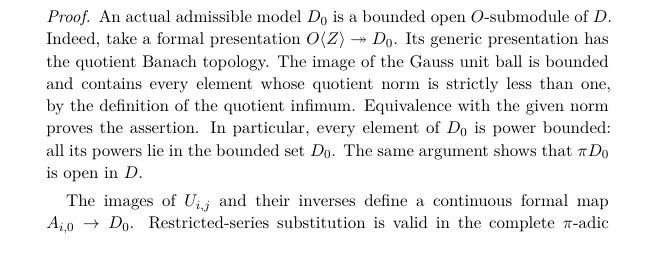
\begin{proof}
An actual admissible model $D_0$ is a bounded open $O$-submodule
of $D$. Indeed, take a formal presentation
$O\langle Z\rangle\twoheadrightarrow D_0$. Its generic
presentation has the quotient Banach topology. The image of the
Gauss unit ball is bounded and contains every element whose
quotient norm is strictly less than one, by the definition of the
quotient infimum. Equivalence with the given norm proves the
assertion. In particular, every element of $D_0$ is power bounded:
all its powers lie in the bounded set $D_0$. The same argument
shows that $\pi D_0$ is open in $D$.

The images of $U_{i,j}$ and their inverses define a continuous
formal map $A_{i,0}\to D_0$. Restricted-series substitution is
valid in the complete $\pi$-adic ring $D_0$, and agrees in $D$
with the given bounded homomorphism. Fix $i$, and choose formal
generators $z_1,\ldots,z_N$ of $D_0$ over $O$.
The generic algebra $D$ is strict, since it is the generic fibre
of this model. Theorem~\ref{fnd:strictcanonicalfinitecriterion}
makes its canonical reduction $\widetilde D$ finite over
$k[U_i^{\pm1}]$. For each $z_a$, lift a monic equation of its
canonical residue to a monic polynomial
$p_a(Z)\in A_{i,0}[Z]$. Its value $p_a(z_a)$ is topologically
nilpotent in $D$. Since $\pi D_0$ is open, some positive power
of this value belongs to $\pi D_0$. Consequently the image
$\overline z_a\in\overline D_0$ satisfies a monic equation
$\overline p_a(Z)^{n_a}=0$ over $k[U_i^{\pm1}]$.

The algebra $\overline D_0$ is generated by the finitely many
$\overline z_a$ over this Laurent ring. The powers below the
degrees of these monic equations span it as a module. Thus
$\overline D_0$ is finite over $k[U_i^{\pm1}]$.
Lemma~\ref{v035:degreegaussrank} gives finiteness of $D_0$ over
$A_{i,0}$. This argument applies separately to every $i$ and
does not require flatness over $A_{i,0}$.

For existence, use Theorem~\ref{v035:analytic:finitequotientmodel}
with $A_1\to D$. Append to its prescribed list all target
coordinates and inverses, and all formal generators of all
$E_{j,0}$. The target elements are power bounded because the
maps $A_i\to D$ are bounded. The model generators are power
bounded by the first paragraph. The resulting actual model
$C_0$ contains every $E_{j,0}$: restricted series in its formal
generators converge in $C_0$, and their values in $D$ are the
original values. It is finite over all $A_{i,0}$ by the part
already proved. If $A_{i,0}$ maps into $E_{j,0}$, any finite
list of $A_{i,0}$-module generators of $C_0$ also generates it
over $E_{j,0}$. This proves the last assertion. For $D=0$ all
the models may be taken to be zero.
\end{proof}
Standing context 1 · exact TeX
Fix a complete nontrivially valued field $K$ with its given real-valued
absolute value, and write
\[
 O=K^\circ,\qquad \mathfrak m=K^{\circ\circ},\qquad
 k=O/\mathfrak m.
\]
Choose $\pi\in O$ with $0<|\pi|<1$. An \emph{actual admissible model}
of a $K$-affinoid algebra $D$ is an admissible topologically finitely
presented $O$-subalgebra $D_0\subset D$ for which $D_0[1/\pi]=D$
and the generic-fibre Banach topology is the given topology of $D$.
The special algebra is always the actual quotient
$\overline D_0=D_0/\mathfrak mD_0$.
Typeset reader excerpt
Typed proof inputs
- NAG-001553 · selected whole (sealed native whole)
- NAG-001573 · selected whole (sealed native whole)
- NAG-001574 · selected whole (sealed native whole)
- NAG-001918 · selected whole (sealed native whole)
- NAG-001929 · selected whole (sealed native whole)
- NAG-002242 · selected whole (sealed native whole)
- NAG-002259 · selected whole (earlier original whole proof in this batch)
- NAG-001553 · selected whole
- NAG-001553 · selected whole (requires)
- NAG-001573 · selected whole
- NAG-001573 · selected whole (requires)
- NAG-001574 · selected whole
- NAG-001574 · selected whole (requires)
- NAG-001918 · selected whole
- NAG-001918 · selected whole (requires)
- NAG-001929 · selected whole
- NAG-001929 · selected whole (requires)
- NAG-002242 · selected whole
- NAG-002242 · selected whole (requires)
- NAG-002259 · selected whole
- NAG-002259 · selected whole (requires)
Reader cross-references
Proof map
Verified map inputs · NAG-002280
AND · joint registered proof inputs
- NAG-001553 · The actual multi-Laurent relation quotient · accepted whole Exact source window 53–55
- NAG-001573 · Scaled power bounds for arbitrary positive radii · accepted whole Exact source window 61–72
- NAG-001574 · The spectral-radius formula in the affinoid category · accepted whole Exact source window 61–72
- NAG-001918 · Affinoid generic fibres and integral presentations · accepted whole Exact source windows 42–55, 83–88
- NAG-001929 · The strict reduction criterion for finiteness · accepted whole Exact source window 58–61
- NAG-002242 · Finite formal models at the Gauss point · accepted whole Exact source window 73–74
- NAG-002259 · A finite formal model containing prescribed bounded elements · accepted whole Exact source window 77–88