NAG-002298 · Accepted whole
Monomial covers of Gauss fields
5 Tropicalization, multiplicities and balancing
Open in the English reader · PDF page 958
Statement · exact TeX
\begin{proposition}[Monomial covers of Gauss fields]
\label{v036:gaussisogeny}
Let $C=(c_{ji})\in M_d(\mathbb Z)$ have nonzero determinant, put
$s_j=\prod_i r_i^{c_{ji}}$, and set $e=|\det C|$.
The substitution $S_j\mapsto\prod_iT_i^{c_{ji}}$ gives an isometric
inclusion $A_{K,s}\hookrightarrow A_{K,r}$. If $R$ is a set of
representatives for $\mathbb Z^d/C^{\mathsf t}\mathbb Z^d$, then
\begin{equation}
\label{v036:eq:gausscosets}
 A_{K,r}=\bigoplus_{u\in R}A_{K,s}T^u,
 \qquad
 \left\|\sum_{u\in R}a_uT^u\right\|_r
       =\max_{u\in R}r^u\|a_u\|_s.
\end{equation}
In particular the map is finite free of rank $e$, with the canonical
finite-module Banach structure. Its actual fibre over $\xi_{K,s}$ is
the field
\[
 A_{K,r}\widehat\otimes_{A_{K,s}}H_{K,s}=H_{K,r},
 \qquad [H_{K,r}:H_{K,s}]=e.
\]
The Gauss point is the only point of this fibre.
\end{proposition}
Full selected proof · exact TeX
\begin{proof}
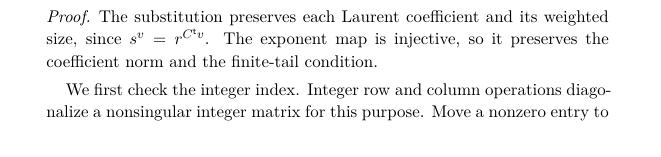
The substitution preserves each Laurent coefficient and its weighted
size, since $s^v=r^{C^{\mathsf t}v}$. The exponent map is injective,
so it preserves the coefficient norm and the finite-tail condition.

We first check the integer index. Integer row and column operations
diagonalize a nonsingular integer matrix for this purpose. Move a
nonzero entry to the upper left. If an entry in its row or column
is not divisible by it, division with remainder followed by a swap
strictly decreases the positive absolute value of the pivot.
After finitely many such reductions the pivot divides its entire
row and column. Clear both by integer elementary operations and
repeat on the remaining nonsingular square block. These operations
are unimodular. A diagonal matrix has quotient index the product
of the absolute values of its diagonal entries, which is its
absolute determinant. Applying the same operations in transposed
order also proves
\[
 [\mathbb Z^d:C\mathbb Z^d]
   =[\mathbb Z^d:C^{\mathsf t}\mathbb Z^d]=|\det C|.
\]

Every exponent has a unique expression $u+C^{\mathsf t}v$ with
$u\in R$ and $v\in\mathbb Z^d$. Grouping a convergent Laurent
series by these finitely many cosets gives
\eqref{v036:eq:gausscosets}. Each grouped series converges: its
weighted coefficients are those of the original series, divided
by the fixed positive number $r^u$. Conversely a finite sum of
such grouped series has a vanishing weighted tail. Disjoint
exponents prove uniqueness and the norm equality. Since $R$ is
finite, its weighted maximum norm is equivalent to the usual
maximum norm of a free $A_{K,s}$-module.

Put $F_s=\operatorname{Frac}(A_{K,s})$. The localization
$A_{K,r}\otimes_{A_{K,s}}F_s$ is a finite-dimensional domain over
$F_s$, hence a field: multiplication by a nonzero element is an
injective linear endomorphism and is therefore surjective. It is
thus $\operatorname{Frac}(A_{K,r})$, with the same coset basis.
Clearing a common denominator in $A_{K,s}$ proves the weighted
norm identity for coefficients in $F_s$ as well.

Its completion is consequently
$\bigoplus_{u\in R}H_{K,s}T^u$ with that weighted norm. Multiplication
extends continuously, and its norm remains multiplicative by
approximating two elements with elements of the dense valued field.
It is a finite-dimensional domain over $H_{K,s}$, hence a field.
By the definition of $H_{K,r}$ this completed field is $H_{K,r}$,
of degree $|R|=e$. Proposition~\ref{fnd:generalizedfinitebasechange}
identifies the algebraic tensor with the stated completed tensor;
Theorem~\ref{fnd:allpointaffinoidfibres} identifies its spectrum with
the actual analytic fibre.

Finally, a bounded multiplicative seminorm on the field $H_{K,r}$
is at most its given multiplicative norm, by applying its bound
to successive powers. Applying the same inequality to the inverse
of a nonzero element gives the reverse inequality. Its spectrum
over $H_{K,s}$ is therefore a single point, with completed residue
field $H_{K,r}$.
\end{proof}
Standing context 1 · exact TeX
Let $K$ be complete for its specified real-valued non-Archimedean
absolute value, which may be trivial. For $r\in\mathbb R_{>0}^d$ put
\[
 A_{K,r}=K\{r^{-1}T,rU\}/(T_iU_i-1)_{i=1}^d.
\]
The actual Laurent presentation of
Theorem~\ref{fnd:multilaurentactualpresentation} identifies this algebra
isometrically with the convergent Laurent series
\[
 \begin{gathered}
 \sum_{m\in\mathbb Z^d}a_mT^m,
 \qquad |a_m|r^m\longrightarrow0
 \quad\text{outside finite subsets},\\
 \left\|\sum_m a_mT^m\right\|_r=\max_m|a_m|r^m.
 \end{gathered}
\]
By Proposition~\ref{fnd:gaussnorm} and density of finite Laurent sums,
this norm is multiplicative. Write $\xi_{K,r}$ for its spectrum point
and $H_{K,r}$ for the completion of $\operatorname{Frac}(A_{K,r})$
for this norm. Thus $H_{K,r}=\mathcal H(\xi_{K,r})$. Empty tuples
give $A_{K,r}=H_{K,r}=K$.
Typeset reader excerpt
Typed proof inputs
- NAG-000182 · selected whole (sealed native whole)
- NAG-001553 · selected whole (sealed native whole)
- NAG-001692 · selected whole (sealed native whole)
- NAG-001702 · selected whole (sealed native whole)
- NAG-000182 · selected whole
- NAG-000182 · selected whole (requires)
- NAG-001553 · selected whole
- NAG-001553 · selected whole (requires)
- NAG-001692 · selected whole
- NAG-001692 · selected whole (requires)
- NAG-001702 · selected whole
- NAG-001702 · selected whole (requires)
Reader cross-references
Proof map
Verified map inputs · NAG-002298
AND · joint registered proof inputs
- NAG-000182 · Multiplicativity of the weighted Gauss norm · accepted whole Exact source window 83–96
- NAG-001553 · The actual multi-Laurent relation quotient · accepted whole Exact source window 51–81
- NAG-001692 · Affinoid fibres at all Berkovich points · accepted whole Exact source window 99–100
- NAG-001702 · General finite base change · accepted whole Exact source window 97–98
NAG-002298 · Monomial covers of Gauss fields · Chapter argument