NAG-002333 · Accepted whole
The actual Gauss fibres of an integral chart
Open in the English reader · PDF page 794
Statement · exact TeX
\begin{proposition}[The actual Gauss fibres of an integral chart]
\label{v037:f5:integralgaussdegree}
The special fibre $Y$ is a reduced pure curve. For each
irreducible component $E$ of $Y$, its function field $k(E)$
is finite separable over $k(t)$. Let $\eta$ be the unit
Gauss point of $\mathcal M(R)$ and let
$H=\mathcal H(\eta)$ with its specified absolute value.
The actual fibre of $U\to\mathcal M(R)$ over $\eta$ consists
exactly of the component points $v_E$. For every such point,
\[
 \begin{aligned}
 [\mathcal H(v_E):H]&=[k(E):k(t)],\\
 \widetilde{\mathcal H(v_E)}&=k(E),\qquad
 |\mathcal H(v_E)^\times|=|K^\times|.
 \end{aligned}
\]
More precisely, its actual integral fibre algebra satisfies
\[
 A_0\otimes_{R_0}H^\circ
       \simeq\prod_E H_E^\circ,
\]
where $H_E/H$ is a finite unramified lift of $k(E)/k(t)$.
After inverting $\pi$, this is the decomposition of the
actual analytic fibre algebra into its completed residue fields.
\end{proposition}
Full selected proof · exact TeX
\begin{proof}
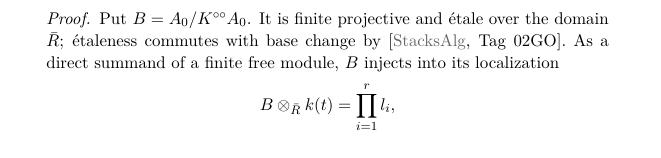
Put $B=A_0/K^{\circ\circ}A_0$. It is finite projective and
\textup{\'etale} over the domain $\bar R$; \textup{\'etaleness}
commutes with base change by \cite[Tag 02GO]{StacksAlg}.
As a direct summand of a finite free module, $B$ injects
into its localization
\[
        B\otimes_{\bar R}k(t)=\prod_{i=1}^r l_i,
\]
where the $l_i/k(t)$ are finite separable fields by
\cite[Tag 02GL]{StacksAlg}. Thus $B$ is reduced.
Let $P_i$ be the kernel of its map to $l_i$. These prime
ideals have intersection zero and are pairwise incomparable:
localization gives the distinct factor primes in the displayed
product. Every prime of $B$ contains one of the $P_i$,
because the product of these finitely many ideals is zero.
They are consequently exactly the minimal primes. Moreover
$\operatorname{Frac}(B/P_i)=l_i$: localization by the
nonzero elements of $\bar R$ already gives $l_i$.
By \cite[Tag 00P0]{StacksAlg}, every component has dimension
one. This proves the special-fibre assertions and identifies
the index $i$ with its component $E$.

The weighted Gauss calculation of
Proposition~\ref{fnd:gaussnorm} gives $|g(\eta)|=1$.
The field $H$ is the completion of $K(T)$ for its unit
Gauss norm. Indeed, polynomials and their fractions are
dense in the completed residue field; adjoining $1/g$
does not change that dense rational subfield. A quotient
of two polynomials has norm in $|K^\times|$. If it has
norm one, dividing numerator and denominator by coefficients
of their respective maximal sizes identifies its residue
with a rational function of $t$. Conversely every rational
function of $t$ arises this way. Completion changes neither
values nor residues by
Lemma~\ref{fnd:valuedfielddimensioncalculus}. Hence
\[
                  \widetilde H=k(t),\qquad
                         |H^\times|=|K^\times|.
\]
Evaluation gives an $O$-homomorphism $R_0\to H^\circ$.

Set $D_0=A_0\otimes_{R_0}H^\circ$. This algebra is
finite projective and \textup{\'etale} over $H^\circ$.
By \cite[Tag 00NX]{StacksAlg}, its module is free, because
$H^\circ$ is local. Its reduction is
\[
                D_0/H^{\circ\circ}D_0=\prod_E k(E).
\]
For each factor, Lemma~\ref{cand:residueextensionlift}
provides a complete finite extension $H_E/H$ with residue
field $k(E)$, unchanged value group, and degree
$[k(E):k(t)]$. Lemma~\ref{cand:unramifiedmodelbasechange}
makes $H_E^\circ$ finite free over $H^\circ$ with that rank.
The projection of the displayed product to $k(E)$ is a
rational point of the special fibre of
$\operatorname{Spec}(D_0\otimes_{H^\circ}H_E^\circ)$.
The henselian section lemma
\ref{cand:completevaluationhenselian} gives a homomorphism
$D_0\to H_E^\circ$ reducing to that projection. Combining
these homomorphisms gives
\[
                        D_0\longrightarrow\prod_E H_E^\circ.
\]
Both sides are finite free of rank
$\sum_E[k(E):k(t)]$: on the left this rank is read by
reduction of a basis. Its matrix has invertible reduction,
so its determinant is a unit of the local ring $H^\circ$.
The adjugate matrix proves that it is an isomorphism.

Choose an $R_0$-linear splitting
$A_0\longrightarrow R_0^m\longrightarrow A_0$.
The integral presentations of
Proposition~\ref{fnd:affineformalpresentations} identify
$A_0$ and $R_0$ with the closed unit balls of their
presentation norms. Both split maps preserve these unit
balls. Scaling by powers of $\pi$ makes both maps bounded
after inversion, so the given norm on $A$ is equivalent
to its canonical finite-$R$-module quotient norm.
Proposition~\ref{fnd:generalizedfinitetensor} identifies
\[
 A\widehat\otimes_RH=A\otimes_RH=D_0[1/\pi]
                                      =\prod_E H_E.
\]
Theorem~\ref{fnd:allpointaffinoidfibres} identifies this
with the actual fibre over $\eta$, including its completed
residue fields. Each factor has just its specified valued
point, by uniqueness of the absolute value in
Lemma~\ref{fnd:finiteextensionnorms}. Its specialization
in $Y$ is the component generic point of $E$, by the
reduction of the map just constructed. Proposition
\ref{cand:reducedmodelcomponentpoints} identifies that
point with $v_E$, and gives uniqueness above each component
generic point. The degree, residue-field and value-group
equalities follow from the construction of $H_E$.
\end{proof}
Typeset reader excerpt
Typed proof inputs
- CLAUSE:NAG-002060:actual_monic_coefficients · selected scope, text unavailable (sealed exact native clause)
- CLAUSE:NAG-002060:actual_monic_coefficients · selected scope, text unavailable
- NAG-000182 · selected whole (sealed native whole)
- NAG-000182 · selected whole
- NAG-001450 · selected whole (sealed native whole)
- NAG-001450 · selected whole
- NAG-001565 · selected whole (sealed native whole)
- NAG-001565 · selected whole
- NAG-001586 · selected whole, export unavailable (sealed native whole)
- NAG-001586 · selected whole, export unavailable
- NAG-001692 · selected whole (sealed native whole)
- NAG-001692 · selected whole
- NAG-001918 · selected whole (sealed native whole)
- NAG-001918 · selected whole
- NAG-001943 · selected whole (sealed native whole)
- NAG-001943 · selected whole
- NAG-002036 · selected whole (sealed native whole)
- NAG-002036 · selected whole
- NAG-002049 · selected whole (sealed native whole)
- NAG-002049 · selected whole
- NAG-002050 · selected whole (sealed native whole)
- NAG-002050 · selected whole
- STACKS-00NX · named external application (existing frozen Stacks authority and named consumer)
- STACKS-00NX · named external application
- STACKS-00P0 · named external application (existing frozen Stacks authority and named consumer)
- STACKS-00P0 · named external application
- STACKS-02GL · named external application (existing frozen Stacks authority and named consumer)
- STACKS-02GL · named external application
- STACKS-02GO · named external application (existing frozen Stacks authority and named consumer)
- STACKS-02GO · named external application
- CLAUSE:NAG-002060:actual_monic_coefficients · selected scope, text unavailable (requires)
- NAG-000182 · selected whole (requires)
- NAG-001450 · selected whole (requires)
- NAG-001565 · selected whole (requires)
- NAG-001586 · selected whole, export unavailable (requires)
- NAG-001692 · selected whole (requires)
- NAG-001918 · selected whole (requires)
- NAG-001943 · selected whole (requires)
- NAG-002036 · selected whole (requires)
- NAG-002049 · selected whole (requires)
- NAG-002050 · selected whole (requires)
- STACKS-00NX · named external application (requires)
- STACKS-00P0 · named external application (requires)
- STACKS-02GL · named external application (requires)
- STACKS-02GO · named external application (requires)
Reader cross-references
Proof map
Verified map inputs · NAG-002333
AND · joint registered proof inputs
- NAG-000182 · Multiplicativity of the weighted Gauss norm · accepted whole
- NAG-001450 · Finite-dimensional norms and finite field extensions · accepted whole
- NAG-001565 · Finite tensors with generalized affinoid targets · accepted whole
- NAG-001586 · Result 3.22.2 · accepted whole; PDF destination
- NAG-001692 · Affinoid fibres at all Berkovich points · accepted whole
- NAG-001918 · Affinoid generic fibres and integral presentations · accepted whole
- NAG-001943 · Principal formal opens and flat restriction · accepted whole
- NAG-002036 · The analytic point of a residual component · accepted whole
- NAG-002049 · Simple roots over a complete valued field · accepted whole
- NAG-002050 · Lifting a finite separable residue extension · accepted whole
Unlinked source pointers
These pointers have no operative linked edge in this map.
CLAUSE:NAG-002060:actual_monic_coefficientsSTACKS-00NXSTACKS-00P0STACKS-02GLSTACKS-02GO
NAG-002333 · The actual Gauss fibres of an integral chart · Chapter argument