NAG-002342 · Accepted whole
Principal formal domains inside a Gauss neighbourhood
Open in the English reader · PDF page 805
Statement · exact TeX
\begin{lemma}[Principal formal domains inside a Gauss neighbourhood]
\label{v037:f5:gaussprincipalshrink}
Let $g\in O[T]$ have nonzero reduction, and put
\[
 D_g=\{x:|T(x)|\leq1,\ |g(x)|=1\}.
\]
Every ordinary open neighbourhood $N$ of $\eta$ in $D_g$
contains $D_{gh}$ for some $h\in O[T]$ with nonzero reduction.
\end{lemma}
Full selected proof · exact TeX
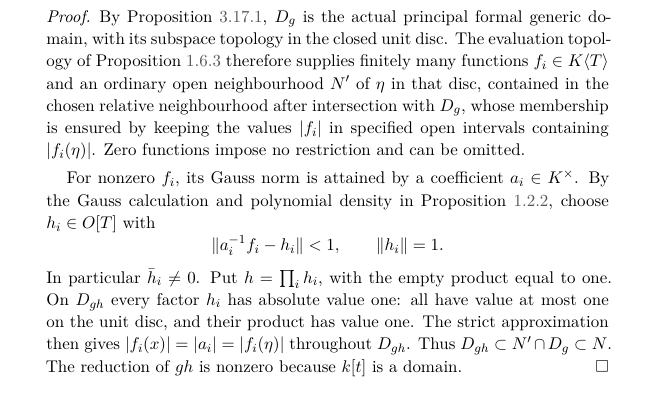
\begin{proof}
By Proposition~\ref{fnd:formalprincipalopenflat}, $D_g$ is
the actual principal formal generic domain, with its
subspace topology in the closed unit disc. The evaluation topology of
Proposition~\ref{new:affinoidcompact} therefore supplies finitely
many functions $f_i\in K\langle T\rangle$ and an ordinary
open neighbourhood $N'$ of $\eta$ in that disc, contained
in the chosen relative neighbourhood after intersection with
$D_g$, whose membership is ensured by keeping the values
$|f_i|$ in specified open intervals containing $|f_i(\eta)|$.
Zero functions impose no restriction and can be omitted.

For nonzero $f_i$, its Gauss norm is attained by a coefficient
$a_i\in K^\times$. By the Gauss calculation and polynomial
density in Proposition~\ref{fnd:gaussnorm}, choose
$h_i\in O[T]$ with
\[
          \|a_i^{-1}f_i-h_i\|<1,
                    \qquad\|h_i\|=1.
\]
In particular $\bar h_i\ne0$. Put $h=\prod_i h_i$, with
the empty product equal to one. On $D_{gh}$ every factor
$h_i$ has absolute value one: all have value at most one
on the unit disc, and their product has value one.
The strict approximation then gives
$|f_i(x)|=|a_i|=|f_i(\eta)|$ throughout $D_{gh}$.
Thus $D_{gh}\subset N'\cap D_g\subset N$.
The reduction of $gh$ is nonzero because $k[t]$ is a domain.
\end{proof}
Standing context 1 · exact TeX
Except in statements explicitly requiring discreteness, $K$ is any
complete nontrivially real-valued field, with its specified absolute
value, $O=K^\circ$ and $k=\widetilde K$. Choose
$0\ne\pi\in K^{\circ\circ}$ for formal completions.
Write $\eta$ for the
unit Gauss point of the analytic affine line and
$H=\mathcal H(\eta)$. Thus $H$ is the Gauss completion of $K(T)$,
with residue field $k(t)$ and value group $|K^\times|$, as computed
in Proposition~\ref{v037:f5:integralgaussdegree}.
Typeset reader excerpt
Typed proof inputs
- NAG-000182 · selected whole (sealed native whole)
- NAG-000305 · selected whole (sealed native whole)
- NAG-000655 · selected whole (sealed native whole)
- NAG-001943 · selected whole (sealed native whole)
- NAG-000182 · selected whole
- NAG-000182 · selected whole (requires)
- NAG-000305 · selected whole
- NAG-000305 · selected whole (requires)
- NAG-000655 · selected whole
- NAG-000655 · selected whole (requires)
- NAG-001943 · selected whole
- NAG-001943 · selected whole (requires)
Reader cross-references
Proof map
Verified map inputs · NAG-002342
AND · joint registered proof inputs
- NAG-000182 · Multiplicativity of the weighted Gauss norm · accepted whole Exact source window 80–87
- NAG-000305 · Result 1.6.3 · accepted whole Exact source window 71–77
- NAG-000655 · Result 1.6.1 · accepted whole Exact source window 80–94
- NAG-001943 · Principal formal opens and flat restriction · accepted whole Exact source window 69–77
NAG-002342 · Principal formal domains inside a Gauss neighbourhood · Chapter argument