NAG-002346 · Accepted whole
Rational Gauss degree criterion
Open in the English reader · PDF page 809
Statement · exact TeX
\begin{theorem}[Rational Gauss degree criterion]
\label{v037:f5:rationalgausscriterion}
Assume that $C$ admits one semistable algebraic model over
the original $O$. A point $v\in C^{\an}$ occurs as a
component vertex of such a model if and only if there is
a rational function $t\in F$, defined at $v$, satisfying
the following conditions. Write $L=\mathcal H(v)$ and
$l=\widetilde L$.
\begin{enumerate}
\item $|t(v)|=1$, and its residue $\bar t\in l$ is
transcendental over $k$.
\item $F/K(t)$ and $l/k(\bar t)$ are finite separable
field extensions.
\item If $H_t$ is the completion of $K(t)$ for the norm
induced by $v$, then the actual extension $H_t\to L$ is
finite and
\[
                         [L:H_t]=[l:k(\bar t)].
\]
\end{enumerate}
Here $H_t$ is the unit Gauss completion for the coordinate
$t$. The criterion applies without a discreteness or
characteristic-zero assumption on $K$.
\end{theorem}
Full selected proof · exact TeX
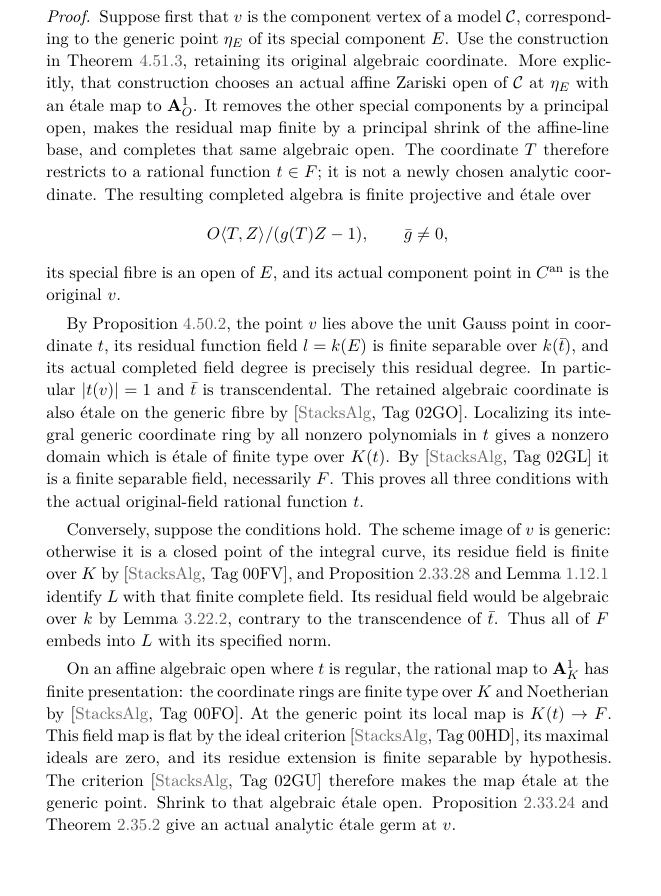
\begin{proof}
Suppose first that $v$ is the component vertex of a model
$\mathcal C$, corresponding to the generic point $\eta_E$
of its special component $E$.
Use the construction in
Theorem~\ref{v037:f5:gausschartrecognition}, retaining its
original algebraic coordinate. More explicitly, that
construction chooses an actual affine Zariski open of
$\mathcal C$ at $\eta_E$ with an \textup{\'etale} map
to $\mathbf A^1_O$. It removes the other special
components by a principal open, makes the residual map
finite by a principal shrink of the affine-line base,
and completes that same algebraic open.
The coordinate $T$ therefore restricts to a rational
function $t\in F$; it is not a newly chosen analytic
coordinate. The resulting completed algebra is finite
projective and \textup{\'etale} over
\[
                   O\langle T,Z\rangle/(g(T)Z-1),
                           \qquad \bar g\ne0,
\]
its special fibre is an open of $E$, and its actual
component point in $C^{\an}$ is the original $v$.

By Proposition~\ref{v037:f5:integralgaussdegree}, the
point $v$ lies above the unit Gauss point in coordinate
$t$, its residual function field $l=k(E)$ is finite
separable over $k(\bar t)$, and its actual completed
field degree is precisely this residual degree.
In particular $|t(v)|=1$ and $\bar t$ is transcendental.
The retained algebraic coordinate is also
\textup{\'etale} on the generic fibre by
\cite[Tag 02GO]{StacksAlg}.
Localizing its integral generic coordinate ring by all
nonzero polynomials in $t$ gives a nonzero domain which
is \textup{\'etale} of finite type over $K(t)$.
By \cite[Tag 02GL]{StacksAlg} it is a finite separable
field, necessarily $F$. This proves all three conditions
with the actual original-field rational function $t$.

Conversely, suppose the conditions hold.
The scheme image of $v$ is generic: otherwise it is
a closed point of the integral curve, its residue field
is finite over $K$ by \cite[Tag 00FV]{StacksAlg}, and
Proposition~\ref{fnd:analytificationvaluedfibres} and
Lemma~\ref{fnd:finiteextensionnorms} identify $L$ with
that finite complete field. Its residual field would
be algebraic over $k$ by
Lemma~\ref{fnd:valuedfielddimensioncalculus}, contrary
to the transcendence of $\bar t$.
Thus all of $F$ embeds into $L$ with its specified norm.

On an affine algebraic open where $t$ is regular, the
rational map to $\mathbf A^1_K$ has finite presentation:
the coordinate rings are finite type over $K$ and
Noetherian by \cite[Tag 00FO]{StacksAlg}.
At the generic point its local map is $K(t)\to F$.
This field map is flat by the ideal criterion
\cite[Tag 00HD]{StacksAlg}, its maximal ideals are zero,
and its residue extension is finite separable by hypothesis.
The criterion \cite[Tag 02GU]{StacksAlg} therefore makes
the map \textup{\'etale} at the generic point.
Shrink to that algebraic \textup{\'etale} open.
Proposition~\ref{fnd:analytificationzariskiopens} and
Theorem~\ref{fnd:analytificationetalepreservation}
give an actual analytic \textup{\'etale} germ at $v$.

For any nonzero polynomial $Q\in K[T]$, divide by a
coefficient of maximal absolute value and reduce at $v$.
Transcendence of $\bar t$ gives
\[
                         |Q(t)(v)|=\max_i|Q_i|.
\]
Consequently this germ sends $v$ to the unit Gauss point,
and its actual completed-residue-field map is $H_t\to L$.
Condition (3) and the finite separable residual extension
in (2) are exactly the hypotheses of
Proposition~\ref{v037:f5:gaussgermintegralchart}.
It supplies an integral \textup{\'etale} Gauss chart
whose generic fibre is an actual affinoid domain of
$C^{\an}$ and whose component point is $v$.
The equivalence in
Theorem~\ref{v037:f5:gausschartrecognition}, using the
assumed existence of one original-field model, realizes
$v$ as a component vertex of such a model.
Every norm and every field embedding in the degree
identity is the one induced by the original point $v$.
\end{proof}
Typeset reader excerpt
Typed proof inputs
- NAG-001450 · selected whole (accepted native whole)
- NAG-001586 · selected whole, export unavailable (accepted native whole)
- NAG-001708 · selected whole (accepted native whole)
- NAG-001712 · selected whole (accepted native whole)
- NAG-001736 · selected whole (accepted native whole)
- NAG-002333 · selected whole (accepted native whole)
- NAG-002339 · selected whole (earlier same packet whole if selected)
- NAG-002343 · selected whole (earlier same packet whole if selected)
Reader cross-references
Proof map
Verified map inputs · NAG-002346
AND · joint registered proof inputs
- NAG-001450 · Finite-dimensional norms and finite field extensions · accepted whole Exact source window 77–102
- A closed scheme image contradicts residual transcendence. Use an actual finite-presentation affine open for the function. Apply 02GU(6) ⇒ (1) at the generic point with both maximal ideals zero and the stipulated finite separable field extension.
- NAG-001586 · Result 3.22.2 · accepted whole; PDF destination Exact source window 77–102
- A closed scheme image contradicts residual transcendence. Use an actual finite-presentation affine open for the function. Apply 02GU(6) ⇒ (1) at the generic point with both maximal ideals zero and the stipulated finite separable field extension.
- NAG-001708 · Principal opens and global analytification · accepted whole Exact source window 77–102
- A closed scheme image contradicts residual transcendence. Use an actual finite-presentation affine open for the function. Apply 02GU(6) ⇒ (1) at the generic point with both maximal ideals zero and the stipulated finite separable field extension.
- NAG-001712 · Residue fields, algebraic fibres and surjectivity · accepted whole Exact source window 77–102
- A closed scheme image contradicts residual transcendence. Use an actual finite-presentation affine open for the function. Apply 02GU(6) ⇒ (1) at the generic point with both maximal ideals zero and the stipulated finite separable field extension.
- NAG-001736 · Result 2.35.2 · accepted whole Exact source window 77–102
- A closed scheme image contradicts residual transcendence. Use an actual finite-presentation affine open for the function. Apply 02GU(6) ⇒ (1) at the generic point with both maximal ideals zero and the stipulated finite separable field extension.
- NAG-002333 · The actual Gauss fibres of an integral chart · accepted whole Exact source window 38–75
- Retain the actual algebraic coordinate from the original chart construction. The generic coordinate ring gives a finite separable rational extension. The integral chart gives equality of actual complete and residual degrees at the original vertex.
- NAG-002339 · Integral Gauss-chart recognition of model vertices · accepted whole Exact source windows 38–75, 104–123
- Retain the actual algebraic coordinate from the original chart construction. The generic coordinate ring gives a finite separable rational extension. The integral chart gives equality of actual complete and residual degrees at the original vertex.
- Transcendental residue gives the unit Gauss norm in the original scale. The prescribed complete degree equality gives the actual chart and original model existence realizes its vertex.
- NAG-002343 · An unramified Gauss germ gives an actual integral chart · accepted whole Exact source window 104–123
- Transcendental residue gives the unit Gauss norm in the original scale. The prescribed complete degree equality gives the actual chart and original model existence realizes its vertex.
NAG-002346 · Rational Gauss degree criterion · Chapter argument