NAG-002356 · Accepted whole
A finite Gauss-fibre cover of the analytic boundary
5 Tropicalization, multiplicities and balancing
Open in the English reader · PDF page 980
Statement · exact TeX
\begin{theorem}[A finite Gauss-fibre cover of the analytic boundary]
\label{v037:globaltrop:boundarycover}
Let $X=\mathcal M(A)$ be a nonempty generalized affinoid space
of analytic dimension $d$. There are finitely many elements
$a_j\in A$, with positive spectral radii $r_j=\rho_A(a_j)$,
and bounded maps
\[
                  K\{r_j^{-1}T\}\longrightarrow A,
                              \qquad T\longmapsto a_j,
\]
with the following property. Let $\eta_j$ be the radius-$r_j$
Gauss point, let $H_j=\mathcal H(\eta_j)$ with its specified
absolute value, and put
\[
             X_j=\mathcal M_{H_j}
                 \bigl(A\widehat\otimes_{K\{r_j^{-1}T\}}H_j\bigr).
\]
The natural maps identify these actual analytic fibres with
compact subsets of $X$, preserve completed residue fields,
and satisfy
\[
                  \partial_KX=\bigcup_j X_j,
                      \qquad \dim_{H_j}X_j\leq d-1
\]
for every nonempty $X_j$. The empty list is allowed. In
particular an affinoid of analytic dimension zero has empty
absolute boundary.
\end{theorem}
Full selected proof · exact TeX
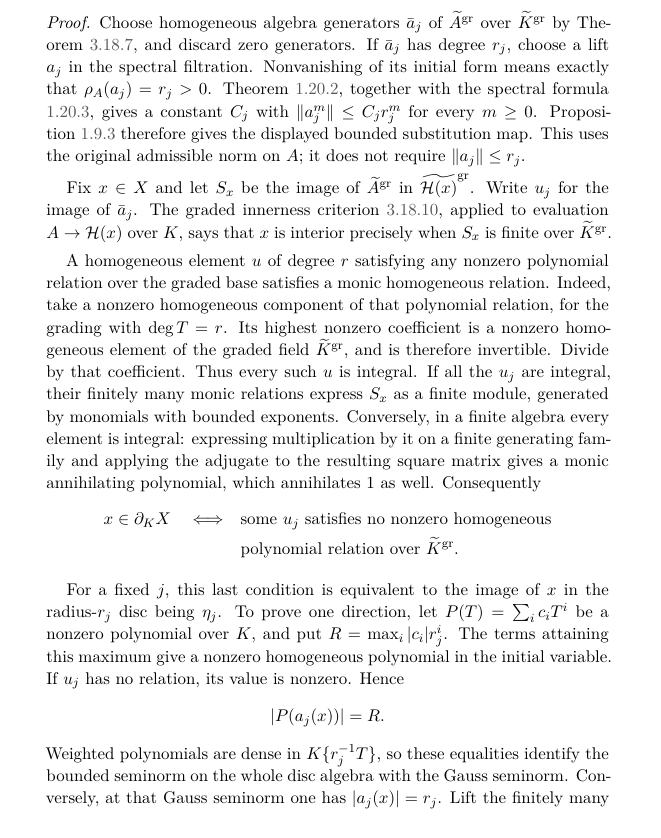
\begin{proof}
Choose homogeneous algebra generators $\bar a_j$ of
$\widetilde A^{\rm gr}$ over $\widetilde K^{\rm gr}$ by
Theorem~\ref{fnd:generalgradedfinitecriterion}, and discard
zero generators. If $\bar a_j$ has degree $r_j$, choose a lift
$a_j$ in the spectral filtration. Nonvanishing of its initial
form means exactly that $\rho_A(a_j)=r_j>0$.
Theorem~\ref{fnd:generalizedpointwisepowerbound}, together
with the spectral formula
\ref{fnd:generalizedspectralradiusformula}, gives a constant
$C_j$ with $\|a_j^m\|\leq C_jr_j^m$ for every $m\geq0$.
Proposition~\ref{fnd:powerboundedsubstitution} therefore gives
the displayed bounded substitution map. This uses the original admissible
norm on $A$; it does not require $\|a_j\|\leq r_j$.

Fix $x\in X$ and let $S_x$ be the image of
$\widetilde A^{\rm gr}$ in
$\widetilde{\mathcal H(x)}^{\rm gr}$. Write $u_j$ for the
image of $\bar a_j$. The graded innerness criterion
\ref{fnd:gradedinnernesscriterion}, applied to evaluation
$A\to\mathcal H(x)$ over $K$, says that $x$ is interior
precisely when $S_x$ is finite over $\widetilde K^{\rm gr}$.

A homogeneous element $u$ of degree $r$ satisfying any
nonzero polynomial relation over the graded base satisfies
a monic homogeneous relation. Indeed, take a nonzero
homogeneous component of that polynomial relation, for the
grading with $\deg T=r$. Its highest nonzero coefficient is
a nonzero homogeneous element of the graded field
$\widetilde K^{\rm gr}$, and is therefore invertible.
Divide by that coefficient. Thus every such $u$ is integral.
If all the $u_j$ are integral, their finitely many monic
relations express $S_x$ as a finite module, generated by
monomials with bounded exponents. Conversely, in a finite
algebra every element is integral: expressing multiplication
by it on a finite generating family and applying the adjugate
to the resulting square matrix gives a monic annihilating
polynomial, which annihilates $1$ as well. Consequently
\[
 \begin{aligned}
 x\in\partial_KX\quad\Longleftrightarrow\quad
 &\text{some }u_j\text{ satisfies no nonzero homogeneous}\\
 &\text{polynomial relation over }\widetilde K^{\rm gr}.
 \end{aligned}
\]

For a fixed $j$, this last condition is equivalent to the
image of $x$ in the radius-$r_j$ disc being $\eta_j$.
To prove one direction, let $P(T)=\sum_i c_iT^i$ be a
nonzero polynomial over $K$, and put
$R=\max_i|c_i|r_j^i$. The terms attaining this maximum give
a nonzero homogeneous polynomial in the initial variable.
If $u_j$ has no relation, its value is nonzero. Hence
\[
                          |P(a_j(x))|=R.
\]
Weighted polynomials are dense in $K\{r_j^{-1}T\}$, so
these equalities identify the bounded seminorm on the
whole disc algebra with the Gauss seminorm. Conversely,
at that Gauss seminorm one has $|a_j(x)|=r_j$. Lift the
finitely many coefficients of a proposed nonzero
homogeneous relation for $u_j$ to elements of $K$ with
their exact prescribed sizes. All its terms have one
common weighted size. A relation of initial forms would
make the evaluated polynomial have strictly smaller size,
contrary to the Gauss equality. This proves the equivalence
and the asserted equality of boundary sets.

Theorem~\ref{fnd:allpointaffinoidfibres} constructs $X_j$ as
the actual generalized $H_j$-affinoid fibre. It gives its
homeomorphism onto the full inverse image of $\eta_j$ and
the isometric identification of its completed residue field
at a point $z$ with $\mathcal H_A(x)$ at the corresponding
point $x\in X$. The field $H_j$ is the completion of
$K(T)$ for the radius-$r_j$ Gauss absolute value: weighted
polynomial density also gives density of their fractions.
Lemma~\ref{fnd:gaussvaluedfielddimension} gives $d(H_j/K)=1$.
The tower formula of
Lemma~\ref{fnd:valuedfielddimensioncalculus} therefore gives
\[
          d_{H_j}(z)=d(\mathcal H_A(x)/H_j)=d_K(x)-1\leq d-1.
\]
Taking the maximum on the nonempty affinoid $X_j$ and
using Theorem~\ref{fnd:affinoidabhyankarmaximum} proves the
dimension bound. If $d=0$, a nonempty fibre would have a
point with negative relative invariant, which is impossible.
Thus the boundary is empty in that case. Compactness of
the fibres is Proposition~\ref{fnd:boundedspectrumcompact}.
\end{proof}
Typeset reader excerpt
Typed proof inputs
- CLAUSE:NAG-001959:fixed_absolute_admissible_tate · selected scope, text unavailable
- CLAUSE:NAG-001962:absolute_evaluation_forward · selected scope, text unavailable
- CLAUSE:NAG-001962:absolute_evaluation_reverse · selected scope, text unavailable
- NAG-001398 · selected whole
- NAG-001496 · selected whole
- NAG-001573 · selected whole
- NAG-001574 · selected whole
- NAG-001586 · selected whole, export unavailable
- NAG-001588 · selected whole
- NAG-001591 · selected whole
- NAG-001692 · selected whole
- CLAUSE:NAG-001959:fixed_absolute_admissible_tate · selected scope, text unavailable (requires)
- CLAUSE:NAG-001962:absolute_evaluation_forward · selected scope, text unavailable (requires)
- CLAUSE:NAG-001962:absolute_evaluation_reverse · selected scope, text unavailable (requires)
- NAG-001398 · selected whole (requires)
- NAG-001496 · selected whole (requires)
- NAG-001573 · selected whole (requires)
- NAG-001574 · selected whole (requires)
- NAG-001586 · selected whole, export unavailable (requires)
- NAG-001588 · selected whole (requires)
- NAG-001591 · selected whole (requires)
- NAG-001692 · selected whole (requires)
Reader cross-references
Proof map
Verified map inputs · NAG-002356
AND · joint registered proof inputs
- NAG-001398 · Bounded substitution criterion · accepted whole
- NAG-001496 · Compactness of the bounded spectrum · accepted whole
- NAG-001573 · Scaled power bounds for arbitrary positive radii · accepted whole
- NAG-001574 · The spectral-radius formula in the affinoid category · accepted whole
- NAG-001586 · Result 3.22.2 · accepted whole; PDF destination
- NAG-001588 · Residual dimension of a Gauss field · accepted whole
- NAG-001591 · Dimension as a maximum over analytic points · accepted whole
- NAG-001692 · Affinoid fibres at all Berkovich points · accepted whole
Unlinked source pointers
These pointers have no operative linked edge in this map.
CLAUSE:NAG-001959:fixed_absolute_admissible_tateCLAUSE:NAG-001962:absolute_evaluation_forwardCLAUSE:NAG-001962:absolute_evaluation_reverse
NAG-002356 · A finite Gauss-fibre cover of the analytic boundary · Chapter argument