NAG-002376 · Accepted whole
The normal equation at a polyhedral wall
5 Tropicalization, multiplicities and balancing
Open in the English reader · PDF page 1005
Statement · exact TeX
\begin{theorem}[The normal equation at a polyhedral wall]
\label{v037:analytic:wallbalance}
Suppose $d\geq1$, $w\in t(X)$, and
$t^{-1}(w)\subset\operatorname{Int}(X/K)$.
Let $N_\tau\subset N$ be saturated of rank $d-1$. For
$1\leq i\leq r$, let $N_i\subset N$ be saturated of rank $d$
and contain $N_\tau$, and let $u_i\in N_i$ lift a primitive
generator of $N_i/N_\tau$. Suppose the half-planes
\[
 C_i=(N_\tau)_{\mathbb R}+\mathbb R_{\geq0}u_i
\]
are distinct, and that on an open neighborhood $W$ of $w$ the
actual moment image is
\[
             t(X)\cap W=\left(w+\bigcup_{i=1}^r C_i\right)\cap W.
\]
For each $i$, the weight $m_{X,f}$ is a fixed positive integer
$m_i$ on the relative interior of $w+C_i$ sufficiently near $w$.
These integers satisfy
\[
                     \sum_{i=1}^r m_i u_i=0
                                \quad\text{in }N/N_\tau.
\]
\end{theorem}
Full selected proof · exact TeX
\begin{proof}
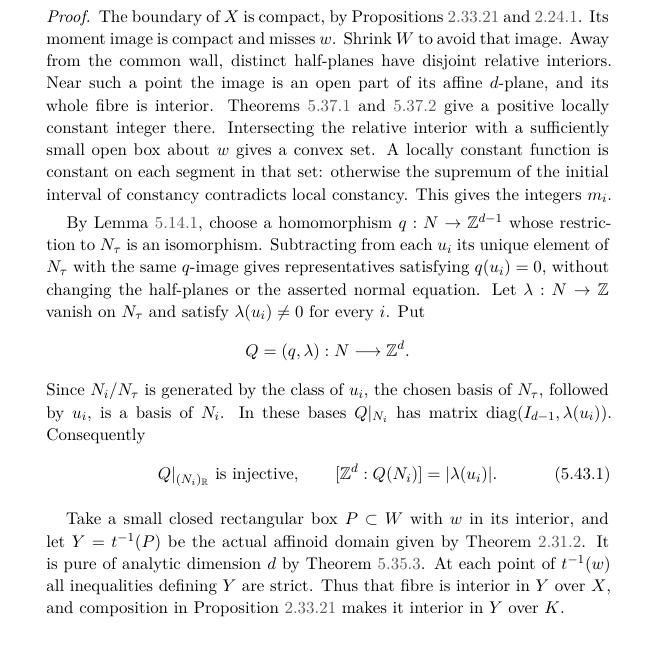
The boundary of $X$ is compact, by
Propositions~\ref{fnd:affinoidinteriorcalculus} and
\ref{fnd:boundedspectrumcompact}. Its moment image is compact
and misses $w$. Shrink $W$ to avoid that image. Away from the
common wall, distinct half-planes have disjoint relative interiors.
Near such a point the image is an open part of its affine
$d$-plane, and its whole fibre is interior. Theorems
\ref{v036:flatgermweight} and~\ref{v036:flatgermlocalconstancy}
give a positive locally constant integer there. Intersecting the
relative interior with a sufficiently small open box about $w$
gives a convex set. A locally constant function is constant on
each segment in that set: otherwise the supremum of the initial
interval of constancy contradicts local constancy. This gives
the integers $m_i$.

By Lemma~\ref{cand:elementarylatticesplitting}, choose a homomorphism
$q:N\to\mathbb Z^{d-1}$ whose restriction to $N_\tau$ is an
isomorphism. Subtracting from each $u_i$ its unique element of
$N_\tau$ with the same $q$-image gives representatives satisfying
$q(u_i)=0$, without changing the half-planes or the asserted
normal equation. Let $\lambda:N\to\mathbb Z$ vanish on
$N_\tau$ and satisfy $\lambda(u_i)\ne0$ for every $i$. Put
\[
                  Q=(q,\lambda):N\longrightarrow\mathbb Z^d.
\]
Since $N_i/N_\tau$ is generated by the class of $u_i$, the
chosen basis of $N_\tau$, followed by $u_i$, is a basis of $N_i$.
In these bases $Q|_{N_i}$ has matrix
$\operatorname{diag}(I_{d-1},\lambda(u_i))$. Consequently
\begin{equation}
\label{v037:eq:wallindex}
 Q|_{(N_i)_{\mathbb R}}\text{ is injective},\qquad
 [\mathbb Z^d:Q(N_i)]=|\lambda(u_i)|.
\end{equation}

Take a small closed rectangular box $P\subset W$ with $w$ in
its interior, and let $Y=t^{-1}(P)$ be the actual affinoid domain
given by Theorem~\ref{fnd:generalizedrationaluniversal}.
It is pure of analytic dimension $d$ by
Theorem~\ref{v036:analytic:domainpurity}. At each point of
$t^{-1}(w)$ all inequalities defining $Y$ are strict. Thus
that fibre is interior in $Y$ over $X$, and composition in
Proposition~\ref{fnd:affinoidinteriorcalculus} makes it interior
in $Y$ over $K$.

The whole level of $Q\circ t|_Y$ at $s_0=Qw$ is $t^{-1}(w)$.
Indeed, for $v-w=b+a u_i\in C_i$, with
$b\in(N_\tau)_{\mathbb R}$ and $a\geq0$, the equation
$Q(v-w)=0$ first gives $a\lambda(u_i)=0$ and then $q(b)=0$.
Thus $a=b=0$. Theorem~\ref{v036:analytic:finitecollar}, applied
to the monomial units with exponent matrix $Q$ on $Y$, gives a
closed box $P'$ about $s_0$ and an actual finite map
\[
 Z=(Q\circ t|_Y)^{-1}(P')\longrightarrow\mathbb T_{P'}.
\]
Its Gauss-fibre dimension is a fixed positive integer $\delta$
on $P'$. Every point of $Z$ is interior in $Y$ over $K$.

For a sufficiently small $\varepsilon>0$, both
$s_\pm=s_0\pm\varepsilon e_d$ lie in the interior of $P'$.
The moment values in $Y$ over $s_+$ are exactly
\[
 v_i^+=w+\frac{\varepsilon}{\lambda(u_i)}u_i,
                       \qquad\lambda(u_i)>0,
\]
and those over $s_-$ are exactly
\[
 v_i^-=w-\frac{\varepsilon}{\lambda(u_i)}u_i,
                       \qquad\lambda(u_i)<0.
\]
To see this, the first $d-1$ coordinate equations give $b=0$,
and the last gives the displayed coefficient of $u_i$.
Choose $\varepsilon$ so that all these finitely many points
belong to the interior of $P$; the local image hypothesis then
also proves their existence. Distinct half-planes give distinct
points on each side.

Every whole moment fibre at these values in $X$ belongs to $Y$.
The projected levels avoid the absolute boundary of $Y$, since
they belong to $Z\subset\operatorname{Int}(Y/K)$. Proposition
\ref{v035:analytic:projectedfibrefactors} therefore decomposes
each actual level algebra into the product of its whole moment
fibre algebras, before reduction. Theorem
\ref{v036:analytic:finitecollar} identifies these level algebras
with the exact-radius restrictions of the same finite algebra
over $\mathbb T_{P'}$. Their Gauss fields are the same weighted
completions of the target Laurent rational function field.
Consequently their Gauss dimensions are both $\delta$, and the
product decompositions give
\[
 \delta=\sum_{\lambda(u_i)>0}\delta_Q(v_i^+),\qquad
 \delta=\sum_{\lambda(u_i)<0}\delta_Q(v_i^-).
\]
By Theorem~\ref{v036:flatgermweight} and
\eqref{v037:eq:wallindex}, these identities read
\[
 \sum_{\lambda(u_i)>0}m_i\lambda(u_i)
       =\sum_{\lambda(u_i)<0}m_i(-\lambda(u_i)).
\]
Hence $\lambda(\sum_i m_i u_i)=0$ for every such $\lambda$.

These integral covectors separate points of the free quotient
$N/N_\tau$. Explicitly, in a basis of that quotient use covectors
with coordinates $(1,a,a^2,\ldots,a^{h-1})$, where
$h=\operatorname{rank}(N/N_\tau)$ and $a\in\mathbb Z$.
Their values on any fixed nonzero vector are a nonzero polynomial
in $a$, with finitely many roots. If $\sum_i m_i u_i$ had nonzero
class, choose an integer $a$ avoiding the roots for that class
and for all the nonzero classes of the $u_i$. The resulting
covector would contradict the preceding equality. Thus the
normal equation holds in $N/N_\tau$.
\end{proof}
Typeset reader excerpt
Typed proof inputs
- NAG-001496 · selected whole
- NAG-001577 · selected whole
- NAG-001704 · selected whole
- NAG-002179 · selected whole
- NAG-002257 · selected whole
- NAG-002293 · selected whole
- NAG-002295 · selected whole
- NAG-002306 · selected whole
- NAG-002307 · selected whole
- NAG-001496 · selected whole (requires)
- NAG-001577 · selected whole (requires)
- NAG-001704 · selected whole (requires)
- NAG-002179 · selected whole (requires)
- NAG-002257 · selected whole (requires)
- NAG-002293 · selected whole (requires)
- NAG-002295 · selected whole (requires)
- NAG-002306 · selected whole (requires)
- NAG-002307 · selected whole (requires)
Reader cross-references
Proof map
Verified map inputs · NAG-002376
AND · joint registered proof inputs
- NAG-001496 · Compactness of the bounded spectrum · accepted whole
- NAG-001577 · Bounded and geometric rational factorization · accepted whole
- NAG-001704 · Presentation calculus for relative interior · accepted whole
- NAG-002179 · Primitive vectors and saturated lattices · accepted whole
- NAG-002257 · The factors of a finite projected level · accepted whole
- NAG-002293 · Purity of affinoid domains · accepted whole
- NAG-002295 · A finite polyannulus neighborhood of a level · accepted whole
- NAG-002306 · Positive intrinsic weights at arbitrary real flat germs · accepted whole
- NAG-002307 · Local constancy on an interior flat germ · accepted whole
NAG-002376 · The normal equation at a polyhedral wall · Chapter argument