NAG-002257 · Accepted whole
The factors of a finite projected level
5 Tropicalization, multiplicities and balancing
Open in the English reader · PDF page 938
Statement · exact TeX
\begin{proposition}[The factors of a finite projected level]
\label{v035:analytic:projectedfibrefactors}
Let $f_1,\ldots,f_n\in B^\times$ define
\[
 t:X\longrightarrow\mathbb R^n,
 \qquad t(x)=(-\log|f_1(x)|,\ldots,-\log|f_n(x)|).
\]
Let $Q=(q_{ji})\in M_{d\times n}(\mathbb Z)$ and
$w'\in\mathbb R^d$. Suppose
\[
 \begin{gathered}
 w'\notin Q(t(\partial_KX)),\\
 Q^{-1}(w')\cap t(X)=\{w_1,\ldots,w_s\}
 \end{gathered}
\]
is finite. Put $g_j=\prod_i f_i^{q_{ji}}$ and
$r_j=\exp(-w'_j)$. Then the actual algebras of the fibres
$t^{-1}(w_i)$ give a bounded product decomposition
\[
                    B_r\simeq\prod_{i=1}^s B_{w_i}.
\]
Each $B_{w_i}$ is finite over $A_r$ with its canonical module
norm. For every $\xi\in\mathbb T_r$, with
$H=\mathcal H(\xi)$, these are actual finite analytic fibre
algebras and
\[
 \dim_H(B_r\widehat\otimes_{A_r}H)
   =\sum_{i=1}^s
      \dim_H(B_{w_i}\widehat\otimes_{A_r}H).
\]
The empty finite set has zero product algebra and degree zero.
\end{proposition}
Full selected proof · exact TeX
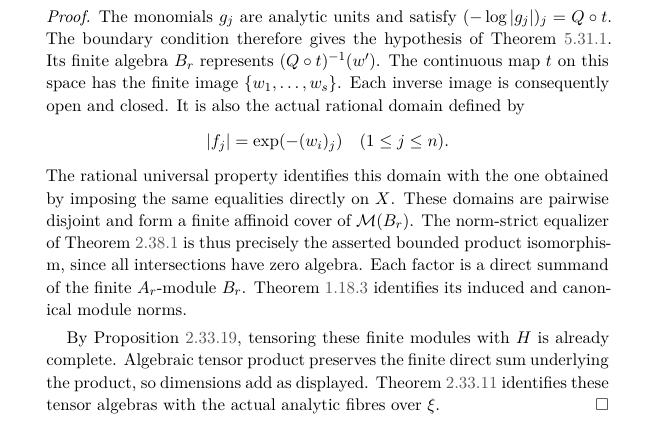
\begin{proof}
The monomials $g_j$ are analytic units and satisfy
$(-\log|g_j|)_j=Q\circ t$. The boundary condition therefore
gives the hypothesis of Theorem~\ref{v035:analytic:levelisfinite}.
Its finite algebra $B_r$ represents $(Q\circ t)^{-1}(w')$.
The continuous map $t$ on this space has the finite image
$\{w_1,\ldots,w_s\}$. Each inverse image is consequently open
and closed. It is also the actual rational domain defined by
\[
                |f_j|=\exp(-(w_i)_j)\quad(1\leq j\leq n).
\]
The rational universal property identifies this domain with the
one obtained by imposing the same equalities directly on $X$.
These domains are pairwise disjoint and form a finite affinoid
cover of $\mathcal M(B_r)$. The norm-strict equalizer of
Theorem~\ref{fnd:generalizedaffinoidcovercech} is thus precisely
the asserted bounded product isomorphism, since all intersections
have zero algebra. Each factor is a direct summand of the finite
$A_r$-module $B_r$. Theorem~\ref{fnd:generalizedfinitemodules}
identifies its induced and canonical module norms.

By Proposition~\ref{fnd:generalizedfinitebasechange}, tensoring
these finite modules with $H$ is already complete. Algebraic
tensor product preserves the finite direct sum underlying the
product, so dimensions add as displayed.
Theorem~\ref{fnd:allpointaffinoidfibres} identifies these tensor
algebras with the actual analytic fibres over $\xi$.
\end{proof}
Standing context 1 · exact TeX
Let $K$ be complete for its given real-valued non-Archimedean
absolute value. The first two results allow the trivial valuation
and generalized affinoid algebras. For an affinoid space $X$, write
\[
 \partial_KX=X\setminus\operatorname{Int}(X/\mathcal M(K)).
\]
For a tuple $r=(r_1,\ldots,r_d)$ of positive real numbers put
\[
 A_r=K\{r^{-1}T,rS\}/(T_iS_i-1)_{i=1}^d,
 \qquad \mathbb T_r=\mathcal M(A_r).
\]
Thus $\mathbb T_r$ is the exact-radius polytorus $|T_i|=r_i$.
All quotient ideals below are actual algebraic ideals, and all
tensor products with a hat are separated completed tensor products.
Typeset reader excerpt
Typed proof inputs
- NAG-001561 · selected whole (sealed native whole)
- NAG-001572 · selected whole (sealed native whole)
- NAG-001577 · selected whole (sealed native whole)
- NAG-001578 · selected whole (sealed native whole)
- NAG-001692 · selected whole (sealed native whole)
- NAG-001693 · selected whole (sealed native whole)
- NAG-001702 · selected whole (sealed native whole)
- NAG-001831 · selected whole, export unavailable (sealed native whole)
- NAG-002256 · selected whole (earlier original whole proof in this batch)
- NAG-001561 · selected whole
- NAG-001561 · selected whole (requires)
- NAG-001572 · selected whole
- NAG-001572 · selected whole (requires)
- NAG-001577 · selected whole
- NAG-001577 · selected whole (requires)
- NAG-001578 · selected whole
- NAG-001578 · selected whole (requires)
- NAG-001692 · selected whole
- NAG-001692 · selected whole (requires)
- NAG-001693 · selected whole
- NAG-001693 · selected whole (requires)
- NAG-001702 · selected whole
- NAG-001702 · selected whole (requires)
- NAG-001831 · selected whole, export unavailable
- NAG-001831 · selected whole, export unavailable (requires)
- NAG-002256 · selected whole
- NAG-002256 · selected whole (requires)
Reader cross-references
Proof map
Verified map inputs · NAG-002257
AND · joint registered proof inputs
- NAG-001561 · Canonical norms and exactness for finite modules · accepted whole Exact source window 140–142
- NAG-001572 · Nonemptiness and the unit-ideal test · accepted whole Exact source window 136–140
- NAG-001577 · Bounded and geometric rational factorization · accepted whole Exact source window 130–135
- NAG-001578 · Joint presentations and completed pushouts · accepted whole Exact source window 130–135
- NAG-001692 · Affinoid fibres at all Berkovich points · accepted whole Exact source window 148–149
- NAG-001693 · Rational domains under complete-extension base change · accepted whole Exact source window 130–135
- NAG-001702 · General finite base change · accepted whole Exact source window 144–147
- NAG-001831 · Result 2.38.1 · accepted whole; PDF destination Exact source window 136–142
- NAG-002256 · Boundary avoidance gives an actual finite algebra · accepted whole Exact source window 124–127
NAG-002257 · The factors of a finite projected level · Chapter argument