NAG-002378 · Accepted whole
The analytic weights on a given polyhedral image
5 Tropicalization, multiplicities and balancing
Open in the English reader · PDF page 1008
Statement · exact TeX
\begin{theorem}[The analytic weights on a given polyhedral image]
\label{v037:analytic:polyhedralcycle}
Let $\Omega\subset N_{\mathbb R}$ be open and convex, with
$\Omega\cap t(\partial_KX)=\varnothing$. Suppose a finite pure
$d$-dimensional integral affine polyhedral complex $\mathcal C$
satisfies
\[
                   t(X)\cap\Omega=|\mathcal C|\cap\Omega.
\]
Discard cells not meeting $\Omega$. Each $d$-cell $\sigma$ has
a well-defined positive integer $m_\sigma$: it is $m_{X,f}(v)$
for any $v\in\operatorname{relint}(\sigma)\cap\Omega$.
For every $(d-1)$-cell $\tau$ meeting $\Omega$ these integers obey
\[
             \sum_{\sigma\supset\tau}m_\sigma u_{\sigma/\tau}=0
                          \quad\text{in }N/N_\tau.
\]
Thus they define a positive integral balanced $d$-cycle on
$\Omega$. It is unchanged by a common polyhedral refinement or
by an affinoid restriction containing all moment fibres over
$\Omega$ and satisfying the same hypotheses.
\end{theorem}
Full selected proof · exact TeX
\begin{proof}
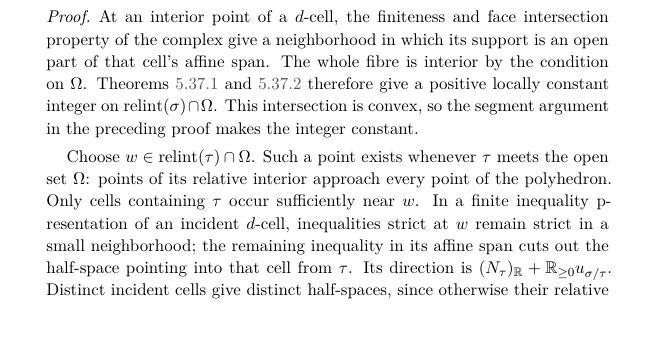
At an interior point of a $d$-cell, the finiteness and face
intersection property of the complex give a neighborhood in
which its support is an open part of that cell's affine span.
The whole fibre is interior by the condition on $\Omega$.
Theorems~\ref{v036:flatgermweight} and
\ref{v036:flatgermlocalconstancy} therefore give a positive locally
constant integer on $\operatorname{relint}(\sigma)\cap\Omega$.
This intersection is convex, so the segment argument in the
preceding proof makes the integer constant.

Choose $w\in\operatorname{relint}(\tau)\cap\Omega$. Such a point
exists whenever $\tau$ meets the open set $\Omega$: points of its
relative interior approach every point of the polyhedron. Only
cells containing $\tau$ occur sufficiently near $w$. In a finite
inequality presentation of an incident $d$-cell, inequalities
strict at $w$ remain strict in a small neighborhood; the remaining
inequality in its affine span cuts out the half-space pointing
into that cell from $\tau$. Its direction is
$(N_\tau)_{\mathbb R}+\mathbb R_{\geq0}u_{\sigma/\tau}$.
Distinct incident cells give distinct half-spaces, since otherwise
their relative interiors would intersect. Theorem
\ref{v037:analytic:wallbalance} now gives the displayed equation.
For $d=0$ there is no normal equation to check.

On a subdivision, the generic interior of each new $d$-cell
has the same whole fibres and tangent lattice as its old cell,
so its weight is the old weight. Lemma
\ref{cand:polyhedralrefinementproduct} identifies the resulting
cycles under common refinement. For an affinoid restriction as
in the statement, Theorem~\ref{v036:flatgermlocalconstancy}
identifies the actual fibre algebras, tangent lattices and weights.
The same argument on a common refinement proves the asserted
equality of cycles.
\end{proof}
Typeset reader excerpt
Typed proof inputs
- NAG-002180 · selected whole
- NAG-002306 · selected whole
- NAG-002307 · selected whole
- NAG-002376 · selected whole
- NAG-002180 · selected whole (requires)
- NAG-002306 · selected whole (requires)
- NAG-002307 · selected whole (requires)
- NAG-002376 · selected whole (requires)
Reader cross-references
Proof map
Verified map inputs · NAG-002378
AND · joint registered proof inputs
- NAG-002180 · Refinement and products of balanced complexes · accepted whole
- NAG-002306 · Positive intrinsic weights at arbitrary real flat germs · accepted whole
- NAG-002307 · Local constancy on an interior flat germ · accepted whole
- NAG-002376 · The normal equation at a polyhedral wall · accepted whole
NAG-002378 · The analytic weights on a given polyhedral image · Chapter argument