NAG-002395 · Accepted whole
Finite affinoid domains and idempotents
5 Tropicalization, multiplicities and balancing
Open in the English reader · PDF page 1022
Statement · exact TeX
\begin{lemma}[Finite affinoid domains and idempotents]
\label{v037:localization:finiteclopen}
Let $A\to B$ represent a generalized affinoid domain
$U\subseteq\mathcal M(A)$. Suppose that $B$ is finite over $A$
and that its given norm is equivalent to its canonical finite-module
norm. There is a unique idempotent $e\in A$ such that the restriction
map identifies $B$ with $eA=A/(1-e)A$, boundedly in both directions.
Moreover,
\[
 U=\{x:|e(x)|=1\},\qquad
 A\simeq eA\times(1-e)A.
\]
The set $U$ is open and closed, and the displayed product is a bounded
isomorphism with bounded inverse. These assertions include the empty
domain, for which $e=0$.
\end{lemma}
Full selected proof · exact TeX
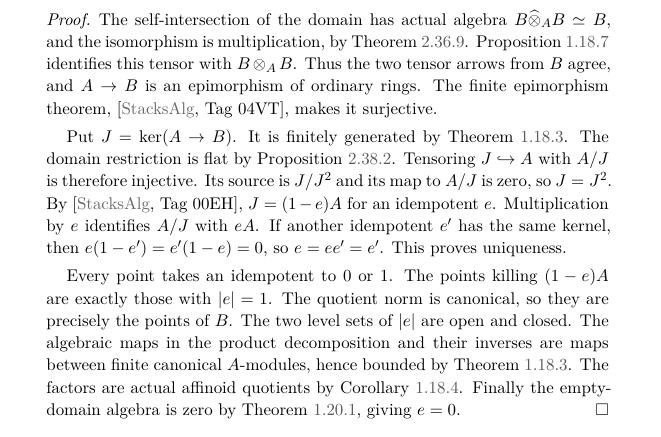
\begin{proof}
The self-intersection of the domain has actual algebra
$B\widehat\otimes_A B\simeq B$, and the isomorphism is multiplication,
by Theorem~\ref{fnd:generalizeddomainbasechange}.
Proposition~\ref{fnd:generalizedfinitetensor} identifies this tensor
with $B\otimes_A B$. Thus the two tensor arrows from $B$ agree, and
$A\to B$ is an epimorphism of ordinary rings. The finite epimorphism
theorem, \cite[Tag 04VT]{StacksAlg}, makes it surjective.

Put $J=\ker(A\to B)$. It is finitely generated by
Theorem~\ref{fnd:generalizedfinitemodules}. The domain restriction is
flat by Proposition~\ref{fnd:generalizeddomainflatness}. Tensoring
$J\hookrightarrow A$ with $A/J$ is therefore injective. Its source
is $J/J^2$ and its map to $A/J$ is zero, so $J=J^2$.
By \cite[Tag 00EH]{StacksAlg}, $J=(1-e)A$ for an idempotent $e$.
Multiplication by $e$ identifies $A/J$ with $eA$. If another
idempotent $e'$ has the same kernel, then
$e(1-e')=e'(1-e)=0$, so $e=ee'=e'$. This proves uniqueness.

Every point takes an idempotent to $0$ or $1$. The points killing
$(1-e)A$ are exactly those with $|e|=1$. The quotient norm is
canonical, so they are precisely the points of $B$. The two level
sets of $|e|$ are open and closed. The algebraic maps in the product
decomposition and their inverses are maps between finite canonical
$A$-modules, hence bounded by
Theorem~\ref{fnd:generalizedfinitemodules}. The factors are actual
affinoid quotients by Corollary~\ref{fnd:generalizedaffinoidquotients}.
Finally the empty-domain algebra is zero by
Theorem~\ref{fnd:generalizedpointunitcriterion}, giving $e=0$.
\end{proof}
Typeset reader excerpt
Typed proof inputs
- CLAUSE:NAG-001832:ordinary_single_domain_flatness · selected scope, text unavailable (sealed exact native clause)
- NAG-001561 · selected whole (sealed native whole)
- NAG-001562 · selected whole (sealed native whole)
- NAG-001565 · selected whole (sealed native whole)
- NAG-001572 · selected whole (sealed native whole)
- NAG-001846 · selected whole (sealed native whole)
- STACKS-00EH · named external application (existing frozen Stacks authority and named consumer)
- STACKS-04VT · named external application (existing frozen Stacks authority and named consumer)
- APP-STACKS-00EH@NAG-002395:1965 · named external application
- APP-STACKS-00EH@NAG-002395:1965 · named external application (requires)
- APP-STACKS-04VT@NAG-002395:1530 · named external application
- APP-STACKS-04VT@NAG-002395:1530 · named external application (requires)
- CLAUSE:NAG-001832:ordinary_single_domain_flatness · selected scope, text unavailable
- CLAUSE:NAG-001832:ordinary_single_domain_flatness · selected scope, text unavailable (requires)
- NAG-001561 · selected whole
- NAG-001561 · selected whole (requires)
- NAG-001562 · selected whole
- NAG-001562 · selected whole (requires)
- NAG-001565 · selected whole
- NAG-001565 · selected whole (requires)
- NAG-001572 · selected whole
- NAG-001572 · selected whole (requires)
- NAG-001846 · selected whole
- NAG-001846 · selected whole (requires)
Named external registrations
Reader cross-references
Proof map
Verified map inputs · NAG-002395
AND · joint registered proof inputs
- NAG-001561 · Canonical norms and exactness for finite modules · accepted whole Exact source windows 37–41, 50–54
- NAG-001562 · Actual quotients by arbitrary ideals · accepted whole Exact source window 47–56
- NAG-001565 · Finite tensors with generalized affinoid targets · accepted whole Exact source window 32–33
- NAG-001572 · Nonemptiness and the unit-ideal test · accepted whole Exact source window 55–56
- NAG-001846 · Affinoid domains under arbitrary affinoid base change · accepted whole Exact source window 29–31
Unlinked source pointers
These pointers have no operative linked edge in this map.
APP-STACKS-00EH@NAG-002395:1965APP-STACKS-04VT@NAG-002395:1530CLAUSE:NAG-001832:ordinary_single_domain_flatnessSTACKS-00EHSTACKS-04VT
NAG-002395 · Finite affinoid domains and idempotents · Chapter argument