NAG-002406 · Accepted whole
Faithfulness after adjoining analytic units
5 Tropicalization, multiplicities and balancing
Open in the English reader · PDF page 1030
Statement · exact TeX
\begin{theorem}[Faithfulness after adjoining analytic units]
\label{v037:integration:globalchartfaithfulness}
Let $X$ be any generalized affinoid space, and let $f,g$
be finite unit tuples. Write
\[
 S=t_f(X),\qquad \widehat S=t_{(f,g)}(X),\qquad
                          \pi:\widehat S\longrightarrow S.
\]
Restrict a smooth ambient superform to every tangential
face of these actual finite polyhedral sets. These
restrictions are independent of subdivision. Such a
form on $S$ has all tangential restrictions zero if
and only if its pullback has all tangential restrictions
zero on $\widehat S$.

Tangential equality is preserved by restriction from
an affinoid space to any affinoid domain, using the
restricted unit coordinates.
\end{theorem}
Full selected proof · exact TeX
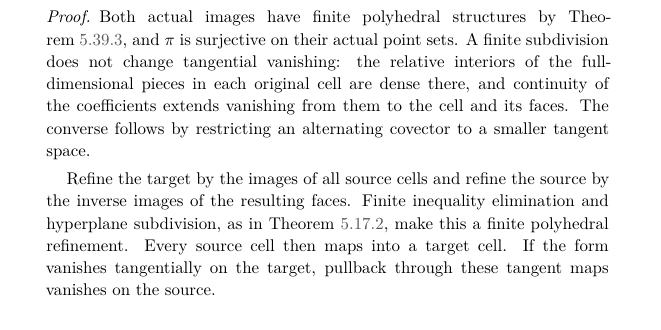
\begin{proof}
Both actual images have finite polyhedral structures by
Theorem~\ref{v037:globaltrop:finiteimage}, and $\pi$ is
surjective on their actual point sets. A finite subdivision
does not change tangential vanishing: the relative interiors
of the full-dimensional pieces in each original cell
are dense there, and continuity of the coefficients
extends vanishing from them to the cell and its faces.
The converse follows by restricting an alternating
covector to a smaller tangent space.

Refine the target by the images of all source cells and
refine the source by the inverse images of the resulting
faces. Finite inequality elimination and hyperplane
subdivision, as in
Theorem~\ref{cand:balancedpolyhedralpushforward}, make
this a finite polyhedral refinement. Every source cell
then maps into a target cell. If the form vanishes
tangentially on the target, pullback through these
tangent maps vanishes on the source.

For the converse, fix a target cell $\tau$ of dimension
$r$. Its relative interior is covered by the images
of the finitely many source cells mapping into it.
Remove their image faces of dimension less than $r$.
The remaining subset of $\operatorname{relint}(\tau)$
is dense: in its affine span, a line direction outside
finitely many proper linear subspaces meets the
corresponding proper affine spans in at most finitely
many points. Such a direction is obtained by the
polynomial vectors $(1,b,\ldots,b^{r-1})$ avoiding
finitely many roots; for $r=0$ no exclusion is needed.
At a point $v$ of this dense set some source cell
$\sigma$ has an image of dimension $r$ containing $v$
in its relative interior.

There is a preimage $u$ of $v$ in
$\operatorname{relint}(\sigma)$. To verify this elementary
convex assertion, choose $u_0$ in that relative interior.
A small ball in its affine span lies in $\sigma$;
its linear image contains a small ball in the image
span, since a surjective map of finite-dimensional
real vector spaces has a linear right inverse.
Thus $\pi(u_0)$ is in the relative interior of the
image. Since $v$ is also there, for some $\varepsilon>0$
the point $v'=v+\varepsilon(v-\pi(u_0))$ still belongs
to that image. Choose $u'\in\sigma$ over $v'$. Then
\[
                         u=\frac{u'+\varepsilon u_0}{1+\varepsilon}
\]
maps to $v$ and is interior in $\sigma$, because the
positive coefficient of $u_0$ brings a scaled open ball
with it.

The tangent map from $\sigma$ onto $\tau$ is surjective.
Its pullback on each exterior cotangent factor is
injective, by a linear right inverse. Vanishing of the
joint pullback at $u$ therefore forces the tangential
value of the original form at $v$ to be zero. Density
and continuity prove vanishing throughout $\tau$.
This applies to every cell, including lower-dimensional
maximal cells of the actual image, and proves the converse.

Finally the moment image of an affinoid domain is a
finite polyhedral subset of the old image, again by
Theorem~\ref{v037:globaltrop:finiteimage}. Refine both
complexes by all their defining hyperplanes. Each
new cell of the subset lies in a cell of the old
complex, so its tangent space is a subspace of that
cell's tangent space. Restriction preserves tangential
vanishing and hence tangential equality.
\end{proof}
Typeset reader excerpt
Typed proof inputs
- NAG-002188 · selected whole (selected native whole at 700)
- NAG-002358 · selected whole (selected native whole at 700)
Reader cross-references
Proof map
Verified map inputs · NAG-002406
AND · joint registered proof inputs
- NAG-002188 · Balanced pushforward · accepted whole Exact source window 173–225
- NAG-002358 · Global polyhedrality and the tropicalized boundary · accepted whole Exact source windows 163–171, 226–232
NAG-002406 · Faithfulness after adjoining analytic units · Chapter argument