NAG-002358 · Accepted whole
Global polyhedrality and the tropicalized boundary
5 Tropicalization, multiplicities and balancing
Open in the English reader · PDF page 984
Statement · exact TeX
\begin{theorem}[Global polyhedrality and the tropicalized boundary]
\label{v037:globaltrop:finiteimage}
Let $X$ be a nonempty generalized affinoid space of
analytic dimension $d$ over $K$, and let $t$ be the
moment map of any finite tuple of analytic units.
The actual image $t(X)$ is the support of a finite integral
affine polyhedral complex of dimension at most $d$.
The actual boundary image $t(\partial_KX)$ is likewise
finite polyhedral, of dimension at most $d-1$; it is
empty when $d=0$.

If $X$ is pure of analytic dimension $d$, every point of
$t(X)\setminus t(\partial_KX)$ has the pure $d$-dimensional
local fan of Theorem~\ref{v037:analytic:interiorlocalstar}.
\end{theorem}
Full selected proof · exact TeX
\begin{proof}
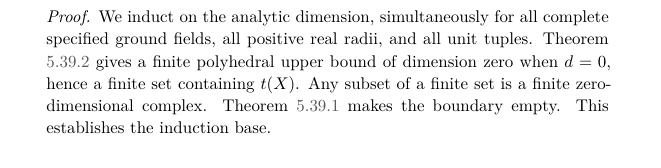
We induct on the analytic dimension, simultaneously for
all complete specified ground fields, all positive real
radii, and all unit tuples. Theorem
\ref{v037:globaltrop:upperbound} gives a finite polyhedral
upper bound of dimension zero when $d=0$, hence a finite
set containing $t(X)$. Any subset of a finite set is a
finite zero-dimensional complex. Theorem
\ref{v037:globaltrop:boundarycover} makes the boundary empty.
This establishes the induction base.

Assume the assertion for every analytic dimension less
than $d$. First suppose $X$ is pure of dimension $d$.
Use Theorem~\ref{v037:globaltrop:boundarycover} to cover
its actual boundary by the finitely many actual affinoid
fibres $X_j$ over their specified fields $H_j$, each of
dimension at most $d-1$. The restrictions of all original
moment functions remain analytic units there. The
homeomorphisms and residue-field identifications in that
theorem preserve their absolute values. By induction,
\[
                       B=t(\partial_KX)=\bigcup_j t(X_j)
\]
is a finite union of integral affine polytopes of dimension
at most $d-1$. In particular it admits a finite complex
structure of that dimension.

Put $S=t(X)$. By Theorem~\ref{v037:globaltrop:upperbound},
choose a finite complex $\mathcal P$ of dimension at most
$d$ whose support contains $S$. The upper-bound construction
uses bounded boxes, so all its cells may be taken to be
polytopes. Since $B\subset S$, cutting by the defining
hyperplanes of both complexes gives a common refinement
of $\mathcal P$ in which $B$ is a subcomplex.

For a $d$-cell $\sigma$ of this refinement, its relative
interior misses $B$. The set
$S\cap\operatorname{relint}(\sigma)$ is relatively closed
because $S$ is compact. It is also relatively open.
Indeed, near one of its points no other cell of the
finite complex meets that point, so the actual moment
image is contained in the affine span of $\sigma$.
The whole moment fibre is interior, since its value
does not belong to $B$. Theorem
\ref{v036:flatgermlocalconstancy}, with the saturated
rank-$d$ tangent lattice of $\sigma$, fills a neighbourhood
in that affine plane. This proves relative openness.
The relative interior of $\sigma$ is convex and therefore
connected, by the line-segment open-and-closed argument
used in Theorem~\ref{v037:analytic:interiorlocalstar}.
Thus the intersection is either empty or all of
$\operatorname{relint}(\sigma)$.

Select the cells for which it is nonempty and let $T$ be
their union with all their faces. Closedness of $S$ shows
$T\subset S$. We claim $S=B\cup T$.
If $v\in S\setminus(B\cup T)$, choose a neighbourhood
missing the closed sets $B$ and $T$. The whole fibre at
$v$ is interior, so Theorem
\ref{v037:analytic:interiorlocalstar} presents $S$ there
by a pure $d$-dimensional translated fan. A relatively
open part of a $d$-cone in this fan cannot lie in the
finitely many affine spans of the lower-dimensional
cells of $\mathcal P$. To check this, choose a line
direction in its span outside the finitely many proper
direction subspaces; each remaining proper affine span
meets a line in that direction at at most one point.
Such a direction exists: in a basis of the $d$-plane,
the vectors $(1,b,\ldots,b^{d-1})$, for integers $b$,
avoid each fixed proper linear subspace except at finitely
many $b$, by applying a nonzero linear equation for that
subspace.
Consequently arbitrarily close to $v$ there is a point
of $S$ in the relative interior of a $d$-cell of
$\mathcal P$. That cell is selected, contradicting the
chosen neighbourhood's disjointness from $T$.
This proves the claim. The finite union $B\cup T$ is
polyhedral of dimension at most $d$.

For a general $X=\mathcal M(A)$ of dimension $d$, the
Noetherian algebra $A$ has finitely many minimal primes,
by Theorem~\ref{fnd:generalizedfinitemodules} and
\cite[Tag 00FR]{StacksAlg}. The actual quotient affinoids of
Corollary~\ref{fnd:generalizedaffinoidquotients}
$\mathcal M(A/\mathfrak p)$ cover $X$, because every
analytic prime kernel contains a minimal prime,
\cite[Tag 00E0(4)]{StacksAlg}. Each quotient is a domain,
and is pure of its analytic dimension. This dimension
is at most $d$: its points have the same completed
residue fields as their images in $X$, so apply
Theorem~\ref{fnd:affinoidabhyankarmaximum}.
The pure case just proved handles the components of
dimension $d$, and induction handles the others.
Their finite union of moment images proves the assertion
for $t(X)$. The boundary assertion for this general $X$
follows directly from its own finite Gauss-fibre cover
and the induction hypothesis, exactly as in the pure
case. No purity after a coefficient extension is used.

Finally, the stated local purity off the boundary image
is precisely Theorem~\ref{v037:analytic:interiorlocalstar},
whose full-fibre hypothesis holds at every such value.
\end{proof}
Typeset reader excerpt
Typed proof inputs
- CLAUSE:NAG-002307:set_filling · selected scope
- NAG-001496 · selected whole
- NAG-001561 · selected whole
- NAG-001562 · selected whole
- NAG-001591 · selected whole
- NAG-002353 · selected whole
- NAG-002356 · selected whole
- NAG-002357 · selected whole
- STACKS-00E0 · named external application
- STACKS-00FR · named external application
- CLAUSE:NAG-002307:set_filling · selected scope (requires)
- NAG-001496 · selected whole (requires)
- NAG-001561 · selected whole (requires)
- NAG-001562 · selected whole (requires)
- NAG-001591 · selected whole (requires)
- NAG-002353 · selected whole (requires)
- NAG-002356 · selected whole (requires)
- NAG-002357 · selected whole (requires)
- STACKS-00E0 · named external application (requires)
- STACKS-00FR · named external application (requires)
Reader cross-references
Proof map
Verified map inputs · NAG-002358
AND · joint registered proof inputs
- CLAUSE:NAG-002307:set_filling · set filling · selected scope
- NAG-001496 · Compactness of the bounded spectrum · accepted whole
- NAG-001561 · Canonical norms and exactness for finite modules · accepted whole
- NAG-001562 · Actual quotients by arbitrary ideals · accepted whole
- NAG-001591 · Dimension as a maximum over analytic points · accepted whole
- NAG-002353 · The local tropical star of a whole interior fibre · accepted whole
- NAG-002356 · A finite Gauss-fibre cover of the analytic boundary · accepted whole
- NAG-002357 · Finite polyhedral upper bounds without an interior hypothesis · accepted whole
Unlinked source pointers
These pointers have no operative linked edge in this map.
STACKS-00E0STACKS-00FR
NAG-002358 · Global polyhedrality and the tropicalized boundary · Chapter argument