NAG-002353 · Accepted whole
The local tropical star of a whole interior fibre
5 Tropicalization, multiplicities and balancing
Open in the English reader · PDF page 977
Statement · exact TeX
\begin{theorem}[The local tropical star of a whole interior fibre]
\label{v037:analytic:interiorlocalstar}
Let $X=\mathcal M(B)$ be nonempty and pure of analytic dimension
$d$ over a complete non-Archimedean field $K$ with its specified
absolute value. Let $f_1,\ldots,f_n\in B^\times$, put $t=t_f$,
and suppose
\[
       w\in t(X),\qquad F_w=t^{-1}(w)
                                  \subset\operatorname{Int}(X/K).
\]
Choose a complete nontrivially valued isometric extension $L/K$
and elements $a_i\in L^\times$ with $|a_i|=e^{-w_i}$.
Let $D_w$ be the actual algebra of $F_w$, put
$D=(D_w)_L$, and set $h_i=f_i/a_i$.
There is an actual admissible model $D_0\subset D$, finite over
$L^\circ\langle T_1^{\pm1},\ldots,T_n^{\pm1}\rangle$ by
$T_i\mapsto h_i$. For any such model set
\[
 Z=\operatorname{Spec}\operatorname{im}\left(
    \widetilde L[T^{\pm1}]
       \longrightarrow D_0/L^{\circ\circ}D_0\right).
\]
Then $C=\operatorname{Trop}(Z)$ is the support of a finite pure
$d$-dimensional rational polyhedral fan, and there is an open
neighbourhood $V$ of $w$ such that
\[
                    t(X)\cap V=(w+C)\cap V.
\]
Its support $C$ is independent of the extension, normalizing
elements, and compatible model. The theorem allows the trivial
absolute value on $K$, arbitrary real $w$, and nonreduced $B$.
\end{theorem}
Full selected proof · exact TeX
\begin{proof}
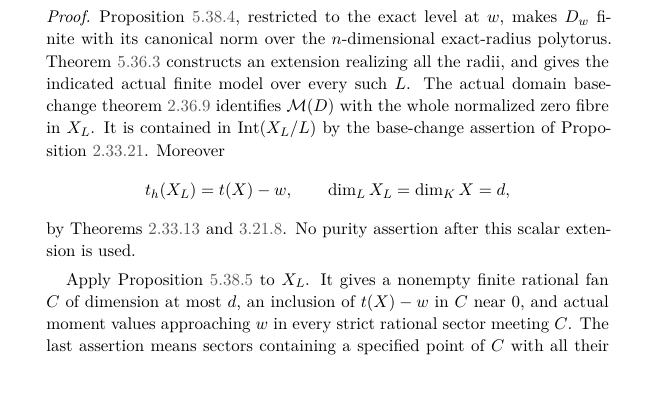
Proposition~\ref{v037:analytic:wholemomentcollar}, restricted to
the exact level at $w$, makes $D_w$ finite with its canonical
norm over the $n$-dimensional exact-radius polytorus.
Theorem~\ref{v036:gaussmodeldescent} constructs an extension
realizing all the radii, and gives the indicated actual finite
model over every such $L$.
The actual domain base-change theorem
\ref{fnd:generalizeddomainbasechange} identifies $\mathcal M(D)$
with the whole normalized zero fibre in $X_L$.
It is contained in $\operatorname{Int}(X_L/L)$ by the base-change
assertion of Proposition~\ref{fnd:affinoidinteriorcalculus}.
Moreover
\[
 t_h(X_L)=t(X)-w,\qquad \dim_LX_L=\dim_KX=d,
\]
by Theorems~\ref{fnd:scalarextensionspectralsurjective}
and~\ref{fnd:analyticdimensionindependence}.
No purity assertion after this scalar extension is used.

Apply Proposition~\ref{v037:analytic:residualfan} to $X_L$.
It gives a nonempty finite rational fan $C$ of dimension at most
$d$, an inclusion of $t(X)-w$ in $C$ near $0$, and actual moment
values approaching $w$ in every strict rational sector meeting
$C$. The last assertion means sectors containing a specified
point of $C$ with all their defining inequalities strict.
The boundary $\partial_KX$ is compact, by
Propositions~\ref{fnd:affinoidinteriorcalculus}
and~\ref{fnd:boundedspectrumcompact}. Its moment image is compact
and avoids $w$. Choose $\varepsilon>0$ such that in the open
Euclidean ball $B_\varepsilon(w)$ one has
\[
 t(X)\cap B_\varepsilon(w)\subset w+C,
 \qquad t(\partial_KX)\cap B_\varepsilon(w)=\varnothing.
\]

Fix a maximal cone $\sigma$ of this fan and put $r=\dim\sigma$.
The set
\[
 E_\sigma=t(X)\cap
       \bigl(w+\operatorname{relint}\sigma\bigr)
                     \cap B_\varepsilon(w)
\]
is nonempty. If $\sigma=\{0\}$ this follows from $w\in t(X)$.
Otherwise choose a nonzero rational vector
$u\in\operatorname{relint}\sigma$.
There is a strict rational sector containing $u$ which meets
$C$ only in $\operatorname{relint}\sigma$.
To see this, choose an integral linear form $\ell$ with
$\ell(u)>0$ and use the slice $\ell(v)=1$.
In this slice a sufficiently small rational open box around
$u/\ell(u)$ avoids the finitely many other cones and the proper
faces of $\sigma$. Its defining inequalities, after multiplication
by the positive $\ell(v)$ and clearing denominators, together
with $\ell(v)>0$, define the required strict sector.
Sector lifting from the preceding proposition, followed by
$t_h(X_L)=t(X)-w$, gives points of $E_\sigma$ arbitrarily close
to $w$.

Take $v\in E_\sigma$ and put
$N_\sigma=\mathbf Z^n\cap\operatorname{span}_{\mathbf R}\sigma$.
This is saturated of rank $r$: a rational basis of the span
becomes integral after clearing denominators. Since the fan is finite and
$v-w$ belongs to the relative interior of a maximal cone, the
moment image in a sufficiently small neighbourhood of $v$ lies
in $v+(N_\sigma)_{\mathbf R}$.
Choose a closed rectangular box $P_v$ in that neighbourhood,
with $v$ in its interior, and put $Y_v=t^{-1}(P_v)$.
Choose an integral projection
$Q:\mathbf Z^n\to\mathbf Z^r$ that is injective on
$N_\sigma$, using Lemma~\ref{cand:elementarylatticesplitting}.
Its monomials are analytic units on $Y_v$.
The entire level of $Q\circ t|_{Y_v}$ at $Qv$ is exactly
$F_v=t^{-1}(v)$, since $Q$ is injective on this affine plane.

Every point of $F_v$ is interior over $K$, because the chosen
ball avoids $t(\partial_KX)$. The defining inequalities of
$Y_v$ are strict on $F_v$, so its actual rational presentation
puts $F_v\subset\operatorname{Int}(Y_v/X)$.
Composition in Proposition~\ref{fnd:affinoidinteriorcalculus}
therefore gives $F_v\subset\operatorname{Int}(Y_v/K)$.
Theorem~\ref{v035:analytic:levelisfinite} now makes the actual
algebra of $F_v$ finite over the $r$-dimensional exact-radius
polytorus at $Qv$.
The rational universal property
\ref{fnd:generalizedrationaluniversal} identifies this level
algebra with the original full fibre algebra in $X$.
By Theorem~\ref{v036:analytic:domainpurity} its analytic dimension
is $d$. Lemma~\ref{v037:analytic:finiteimage} and
Proposition~\ref{v036:analytic:polyannulusdegree} give
\[
                                  d\leq r.
\]
The residual fan bound gives $r\leq d$. Thus every maximal
cone has dimension $d$.

At every point of $E_\sigma$, the hypotheses of
Theorem~\ref{v036:flatgermlocalconstancy} are now satisfied over
the original field: $X$ is pure of analytic dimension $d$,
the whole fibre is interior, and the local image lies in the
rank-$d$ saturated tangent plane. That theorem makes
$E_\sigma$ relatively open in
\[
 U_\sigma=\bigl(w+\operatorname{relint}\sigma\bigr)
                                      \cap B_\varepsilon(w).
\]
It is relatively closed there because $t(X)$ is compact.
The set $U_\sigma$ is convex and nonempty.
Starting at a point of $E_\sigma$, join it to any point of
$U_\sigma$ by its line segment. The inverse image of
$E_\sigma$ on $[0,1]$ is open and closed and contains $0$.
If it were not all of $[0,1]$, the supremum of the initial
interval it contains would contradict either its closedness
or its openness. Thus $E_\sigma=U_\sigma$.
This applies also to the zero-dimensional case, where
$U_\sigma=\{w\}$.
The relative interiors of the maximal cones are dense in their
union. Closedness of $t(X)$ therefore fills all their faces
inside the ball. Together with the opposite inclusion already
proved, this yields
\[
          t(X)\cap B_\varepsilon(w)
                    =(w+C)\cap B_\varepsilon(w).
\]

Finally, two choices of normalizers, extension, or model give
conical supports with the same germ at $0$ by this equality.
Multiplying any vector by a sufficiently small positive real
number puts it in that common neighbourhood. Homogeneity of the
two supports then makes them equal everywhere.
\end{proof}
Typeset reader excerpt
Typed proof inputs
- CLAUSE:NAG-002307:set_filling · selected scope
- NAG-001496 · selected whole
- NAG-001577 · selected whole
- NAG-001664 · selected whole
- NAG-001693 · selected whole
- NAG-001694 · selected whole
- NAG-001704 · selected whole
- NAG-001846 · selected whole
- NAG-002179 · selected whole
- NAG-002256 · selected whole
- NAG-002293 · selected whole
- NAG-002294 · selected whole
- NAG-002302 · selected whole
- NAG-002350 · selected whole
- NAG-002351 · selected whole
- NAG-002352 · selected whole
- CLAUSE:NAG-002307:set_filling · selected scope (requires)
- NAG-001496 · selected whole (requires)
- NAG-001577 · selected whole (requires)
- NAG-001664 · selected whole (requires)
- NAG-001693 · selected whole (requires)
- NAG-001694 · selected whole (requires)
- NAG-001704 · selected whole (requires)
- NAG-001846 · selected whole (requires)
- NAG-002179 · selected whole (requires)
- NAG-002256 · selected whole (requires)
- NAG-002293 · selected whole (requires)
- NAG-002294 · selected whole (requires)
- NAG-002302 · selected whole (requires)
- NAG-002350 · selected whole (requires)
- NAG-002351 · selected whole (requires)
- NAG-002352 · selected whole (requires)
Reader cross-references
- cand:elementarylatticesplitting
- fnd:affinoidinteriorcalculus
- fnd:analyticdimensionindependence
- fnd:boundedspectrumcompact
- fnd:generalizeddomainbasechange
- fnd:scalarextensionspectralsurjective
- v035:analytic:levelisfinite
- v036:analytic:domainpurity
- v036:analytic:polyannulusdegree
- v036:gaussmodeldescent
- v037:analytic:finiteimage
- v037:analytic:residualfan
- v037:analytic:wholemomentcollar
Proof map
Verified map inputs · NAG-002353
AND · joint registered proof inputs
- CLAUSE:NAG-002307:set_filling · set filling · selected scope
- NAG-001496 · Compactness of the bounded spectrum · accepted whole
- NAG-001577 · Bounded and geometric rational factorization · accepted whole
- NAG-001664 · Intrinsic analytic dimension and scalar extension · accepted whole
- NAG-001693 · Rational domains under complete-extension base change · accepted whole
- NAG-001694 · Surjectivity after an arbitrary complete extension · accepted whole
- NAG-001704 · Presentation calculus for relative interior · accepted whole
- NAG-001846 · Affinoid domains under arbitrary affinoid base change · accepted whole
- NAG-002179 · Primitive vectors and saturated lattices · accepted whole
- NAG-002256 · Boundary avoidance gives an actual finite algebra · accepted whole
- NAG-002293 · Purity of affinoid domains · accepted whole
- NAG-002294 · Gauss degrees over a closed polyannulus · accepted whole
- NAG-002302 · Integral models computing an arbitrary-radius degree · accepted whole
- NAG-002350 · The actual image of a finite affinoid map · accepted whole
- NAG-002351 · A finite analytic image around a whole moment fibre · accepted whole
- NAG-002352 · A residual fan bounds and meets the actual germ · accepted whole
NAG-002353 · The local tropical star of a whole interior fibre · Chapter argument