NAG-002294 · Accepted whole
Gauss degrees over a closed polyannulus
5 Tropicalization, multiplicities and balancing
Open in the English reader · PDF page 954
Statement · exact TeX
\begin{proposition}[Gauss degrees over a closed polyannulus]
\label{v036:analytic:polyannulusdegree}
The algebra $A_P$ is an integral domain of analytic dimension $d$,
and every $\eta_s$ has kernel zero. Let $D$ be a finite
$A_P$-algebra with its canonical affinoid norm. Then
\[
 \dim_{H_s}(D\widehat\otimes_{A_P}H_s)
   =\dim_{\operatorname{Frac}(A_P)}
         (D\otimes_{A_P}\operatorname{Frac}(A_P))
\]
for every $s\in P$. In particular this integer is independent of
$s$.

If $D\ne0$ is pure of analytic dimension $d$, then every minimal
prime of $D$ contracts to zero in $A_P$, the displayed integer is
positive, and $\mathcal M(D)\to\mathbb T_P$ is surjective. Every
point above $\eta_s$ satisfies $d_K(x)=d$.
\end{proposition}
Full selected proof · exact TeX
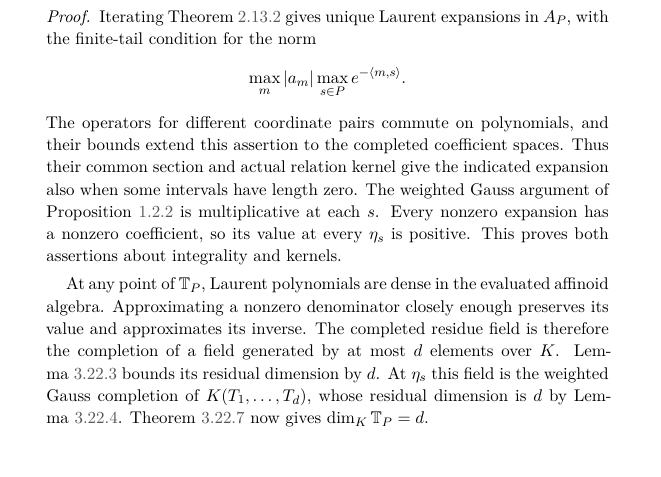
\begin{proof}
Iterating Theorem~\ref{fnd:laurentcoefficientnormalform} gives unique
Laurent expansions in $A_P$, with the finite-tail condition for
the norm
\[
                  \max_m |a_m|\max_{s\in P}
                                  e^{-\langle m,s\rangle}.
\]
The operators for different coordinate pairs commute on
polynomials, and their bounds extend this assertion to the
completed coefficient spaces. Thus their common section and
actual relation kernel give the indicated expansion also when
some intervals have length zero. The weighted Gauss argument of
Proposition~\ref{fnd:gaussnorm} is multiplicative at each $s$.
Every nonzero expansion has a nonzero coefficient, so its value
at every $\eta_s$ is positive. This proves both assertions about
integrality and kernels.

At any point of $\mathbb T_P$, Laurent polynomials are dense in
the evaluated affinoid algebra. Approximating a nonzero denominator
closely enough preserves its value and approximates its inverse.
The completed residue field is therefore the completion of a
field generated by at most $d$ elements over $K$.
Lemma~\ref{fnd:valuedfieldabhyankar} bounds its residual dimension
by $d$. At $\eta_s$ this field is the weighted Gauss completion of
$K(T_1,\ldots,T_d)$, whose residual dimension is $d$ by
Lemma~\ref{fnd:gaussvaluedfielddimension}. Theorem
\ref{fnd:affinoidabhyankarmaximum} now gives
$\dim_K\mathbb T_P=d$.

The kernel-zero map $A_P\to H_s$ extends to its fraction field.
Since $D$ is finite, Proposition~\ref{fnd:generalizedfinitetensor}
identifies the completed tensor in the statement with the ordinary
tensor. Extension of a finite-dimensional vector space from
$\operatorname{Frac}(A_P)$ to $H_s$ preserves its dimension. This
proves the displayed equality, without a flatness assumption on
$D$.

Suppose now that $D\ne0$ is pure of analytic dimension $d$, and
fix a minimal prime $\mathfrak q$ of $D$. Set $E=D/\mathfrak q$.
Choose a free-radius extension $L/K$ making $A_P$ and $E$ strict.
Then $E_L$ is integral by
Lemma~\ref{v036:analytic:freecomponents}, and has Krull dimension
$d$ by Theorem~\ref{fnd:analyticdimensionindependence}. The same
statements hold for $(A_P)_L$. The finite-module comparison in
Theorem~\ref{fnd:freeextensionfaithfullyflat} preserves the finite
module presentation, so $E_L$ is finite over $(A_P)_L$.
If the kernel $J$ of this map were nonzero, any prime chain in
$(A_P)_L/J$ could be extended by the zero prime of the domain
$(A_P)_L$. Hence $\dim((A_P)_L/J)\leq d-1$. The finite injection
$(A_P)_L/J\hookrightarrow E_L$ is integral by
\cite[Tag 00GK]{StacksAlg}, so \cite[Tag 00OK]{StacksAlg} gives a
contradiction. Thus $J=0$. The isometric scalar embedding then
shows that $A_P\to E$ is injective as well. This holds for every
minimal prime, and in particular $A_P\to D$ is injective.

The generic algebra is consequently nonzero, proving positivity.
For an arbitrary $y\in\mathbb T_P$ with kernel $\mathfrak p$,
lying over for the integral injection $A_P\hookrightarrow D$,
\cite[Tag 00GQ]{StacksAlg}, makes
$D\otimes_{A_P}\kappa(\mathfrak p)$ nonzero. Extending this vector
space to $\mathcal H(y)$ preserves nonzeroness. The finite tensor
comparison and Theorem~\ref{fnd:generalizedpointunitcriterion}
therefore give a point of the actual analytic fibre, identified
by Theorem~\ref{fnd:allpointaffinoidfibres}. This proves
surjectivity. Finally Lemma~\ref{fnd:finitemorphismresiduefinite}
and the Gauss residual-dimension calculation give $d_K(x)=d$ at
every point above $\eta_s$.
\end{proof}
Standing context 1 · exact TeX
For a nonempty closed rectangular box
$P=\prod_{j=1}^d[\alpha_j,\beta_j]\subset\mathbb R^d$, allow
$\alpha_j=\beta_j$ and put
\[
 \ell_j=e^{-\beta_j},\qquad u_j=e^{-\alpha_j},\qquad
 A_P=K\{u^{-1}T,\ell S\}/(T_jS_j-1)_j.
\]
Its spectrum $\mathbb T_P$ is the closed polyannulus
$\ell_j\leq|T_j|\leq u_j$. For $s\in P$, let $\eta_s$ be its
Gauss point, with
$|\sum_m a_mT^m|_{\eta_s}=\max_m|a_m|e^{-\langle m,s\rangle}$,
and put $H_s=\mathcal H(\eta_s)$.
Typeset reader excerpt
Typed proof inputs
- NAG-000182 · selected whole (sealed native whole)
- NAG-001553 · selected whole (sealed native whole)
- NAG-001557 · selected whole (sealed native whole)
- NAG-001562 · selected whole (sealed native whole)
- NAG-001565 · selected whole (sealed native whole)
- NAG-001566 · selected whole (sealed native whole)
- NAG-001572 · selected whole (sealed native whole)
- NAG-001587 · selected whole, export unavailable (sealed native whole)
- NAG-001588 · selected whole (sealed native whole)
- NAG-001590 · selected whole (sealed native whole)
- NAG-001591 · selected whole (sealed native whole)
- NAG-001664 · selected whole (sealed native whole)
- NAG-001692 · selected whole (sealed native whole)
- NAG-002291 · selected whole (sealed native whole)
- STACKS-00GK · named external application (existing frozen Stacks authority and named consumer)
- STACKS-00GQ · named external application (existing frozen Stacks authority and named consumer)
- STACKS-00OK · named external application (existing frozen Stacks authority and named consumer)
- APP-STACKS-00GK@NAG-002294:12245 · named external application
- APP-STACKS-00GK@NAG-002294:12245 · named external application (requires)
- APP-STACKS-00GK@NAG-002294:12544 · named external application
- APP-STACKS-00GK@NAG-002294:12544 · named external application (requires)
- APP-STACKS-00GQ@NAG-002294:12609 · named external application
- APP-STACKS-00GQ@NAG-002294:12609 · named external application (requires)
- APP-STACKS-00OK@NAG-002294:12245 · named external application
- APP-STACKS-00OK@NAG-002294:12245 · named external application (requires)
- NAG-000182 · selected whole
- NAG-000182 · selected whole (requires)
- NAG-001553 · selected whole
- NAG-001553 · selected whole (requires)
- NAG-001557 · selected whole
- NAG-001557 · selected whole (requires)
- NAG-001562 · selected whole
- NAG-001562 · selected whole (requires)
- NAG-001565 · selected whole
- NAG-001565 · selected whole (requires)
- NAG-001566 · selected whole
- NAG-001566 · selected whole (requires)
- NAG-001572 · selected whole
- NAG-001572 · selected whole (requires)
- NAG-001587 · selected whole, export unavailable
- NAG-001587 · selected whole, export unavailable (requires)
- NAG-001588 · selected whole
- NAG-001588 · selected whole (requires)
- NAG-001590 · selected whole
- NAG-001590 · selected whole (requires)
- NAG-001591 · selected whole
- NAG-001591 · selected whole (requires)
- NAG-001664 · selected whole
- NAG-001664 · selected whole (requires)
- NAG-001692 · selected whole
- NAG-001692 · selected whole (requires)
- NAG-002291 · selected whole
- NAG-002291 · selected whole (requires)
Named external registrations
Reader cross-references
Proof map
Verified map inputs · NAG-002294
AND · joint registered proof inputs
- NAG-000182 · Multiplicativity of the weighted Gauss norm · accepted whole Exact source window 231–245
- NAG-001553 · The actual multi-Laurent relation quotient · accepted whole Exact source window 220–234
- NAG-001557 · Simultaneous strictification of closed presentations · accepted whole Exact source window 259–265
- NAG-001562 · Actual quotients by arbitrary ideals · accepted whole Exact source window 257–259
- NAG-001565 · Finite tensors with generalized affinoid targets · accepted whole Exact source windows 279–283, 249–255
- NAG-001566 · Free-radius extension is algebraically faithfully flat · accepted whole Exact source window 263–272
- NAG-001572 · Nonemptiness and the unit-ideal test · accepted whole Exact source window 280–283
- NAG-001587 · Result 3.22.3 · accepted whole; PDF destination Exact source window 237–242
- NAG-001588 · Residual dimension of a Gauss field · accepted whole Exact source window 243–245
- NAG-001590 · Completed residue fields of a finite morphism · accepted whole Exact source window 284–286
- NAG-001591 · Dimension as a maximum over analytic points · accepted whole Exact source window 245–247
- NAG-001664 · Intrinsic analytic dimension and scalar extension · accepted whole Exact source window 261–265
- NAG-001692 · Affinoid fibres at all Berkovich points · accepted whole Exact source window 282–284
- NAG-002291 · Components under a free-radius extension · accepted whole Exact source window 260–263
Unlinked source pointers
These pointers have no operative linked edge in this map.
APP-STACKS-00GK@NAG-002294:12245APP-STACKS-00GK@NAG-002294:12544APP-STACKS-00GQ@NAG-002294:12609APP-STACKS-00OK@NAG-002294:12245STACKS-00GKSTACKS-00GQSTACKS-00OK
NAG-002294 · Gauss degrees over a closed polyannulus · Chapter argument