NAG-002435 · Accepted whole
A separating rational Gauss germ
Open in the English reader · PDF page 813
Statement · exact TeX
\begin{lemma}[A separating rational Gauss germ]
\label{v038:f5:separatinggaussgerm}
Let $K$ be as above, put $k=\widetilde K$, and let $C/K$ be a
smooth projective geometrically connected curve. Suppose
$v\in C^{\an}$ has residue field $l=\widetilde{\mathcal H(v)}$
separably generated of transcendence degree one over $k$.
For every separating transcendental element $\bar t\in l$
there is a rational function $t\in K(C)$, defined at $v$, such
that $|t(v)|=1$, its residue is $\bar t$, and the induced map
to the analytic affine line is \textup{\'etale} on an ordinary
neighbourhood of $v$. Moreover $K(C)/K(t)$ is finite separable,
$v$ maps to the unit Gauss point, and
\[
               H_t\longrightarrow \mathcal H(v)
\]
is finite, where $H_t$ is the unit Gauss completion of $K(t)$.
In particular $l/k(\bar t)$ is finite separable.
\end{lemma}
Full selected proof · exact TeX
\begin{proof}
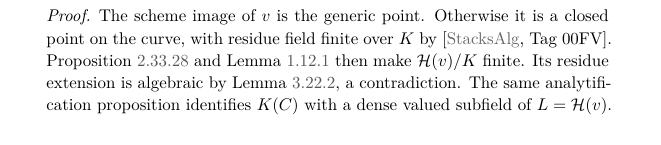
The scheme image of $v$ is the generic point. Otherwise it is a
closed point on the curve, with residue field finite over $K$ by
\cite[Tag 00FV]{StacksAlg}. Proposition~\ref{fnd:analytificationvaluedfibres}
and Lemma~\ref{fnd:finiteextensionnorms} then make
$\mathcal H(v)/K$ finite. Its residue extension is algebraic by
Lemma~\ref{fnd:valuedfielddimensioncalculus}, a contradiction.
The same analytification proposition identifies $K(C)$ with a
dense valued subfield of $L=\mathcal H(v)$.

Choose $t_0\in K(C)$ of norm one with residue $\bar t$.
By \cite[Tag 054L]{StacksAlg}, a smooth affine chart at the
generic point has a rational \textup{\'etale} coordinate $s$.
Its invertible Jacobian subsystem expresses all differentials
in terms of $ds$, and gives $\Omega_{K(C)/K}=K(C)\,ds$.
Fix $0\ne\pi\in K^{\circ\circ}$. For sufficiently large $N$,
\[
                            t=t_0+\pi^Ns
\]
still has residue $\bar t$. We can also require $dt\ne0$:
at most one of the distinct scalars $\pi^N$ can make
$dt_0+\pi^Nds$ vanish.

The residue transcendence shows that $t$ is transcendental over
$K$. The finitely generated field $F=K(C)$ is algebraic over
$K(t)$ and hence finite over it. The universal property of
derivations gives
$\Omega_{F/K(t)}=\Omega_{F/K}/Fdt=0$.
On an affine open where $t$ is regular, the associated map to
the affine line is of finite presentation: present its algebra
as a quotient of a polynomial algebra over $K[T]$ and apply
the Noetherian assertion \cite[Tag 00FO]{StacksAlg} to its kernel.
The generic local map is a field extension, flat by the ideal
criterion \cite[Tag 00HD]{StacksAlg}. By parts (4), (1) and (6)
of \cite[Tag 02GU]{StacksAlg}, the map is \textup{\'etale} at
the generic point and $F/K(t)$ is finite separable.
Its \textup{\'etale} locus is an algebraic open containing the
scheme image of $v$. Proposition~\ref{fnd:analytificationzariskiopens}
and Theorem~\ref{fnd:analytificationetalepreservation} give the
asserted ordinary analytic neighbourhood.

For a nonzero polynomial $Q\in K[T]$, divide by a coefficient
of largest absolute value and reduce at $v$. The nonzero reduced
polynomial cannot vanish at the transcendental $\bar t$, so
\[
                         |Q(t)|=\max_i|Q_i|.
\]
This is the unit Gauss norm. Completion embeds $H_t$ isometrically
in $L$. The image of $F\otimes_{K(t)}H_t\to L$ is a finite-dimensional
$H_t$-subalgebra of a field. It is a field: multiplication by any
nonzero element is an injective, hence surjective, endomorphism
of that finite-dimensional vector space.
By Lemma~\ref{fnd:finiteextensionnorms} it is complete and closed
in $L$. It contains the dense field $F$, so it equals $L$.
Finally, residue-independent lifts are linearly independent over
$H_t$, as in Proposition~\ref{v038:f5:unitdegreeunramified}.
Thus $[l:k(\bar t)]\leq[L:H_t]<\infty$; separability was part
of the choice of the separating element.
\end{proof}
Standing context 1 · exact TeX
All valued fields in this section are complete for their specified
nontrivial real-valued non-Archimedean absolute values. For a valued
field $H$, write $H^\circ$, $H^{\circ\circ}$ and $\widetilde H$
for its valuation ring, maximal ideal and residue field. The trace is
the trace of the finite-dimensional multiplication operator.
Typeset reader excerpt
Typed proof inputs
- NAG-001450 · selected whole (selected native whole)
- NAG-001586 · selected whole, export unavailable (selected native whole)
- NAG-001708 · selected whole (selected native whole)
- NAG-001712 · selected whole (selected native whole)
- NAG-001736 · selected whole (selected native whole)
- NAG-002434 · selected whole (selected native whole)
Reader cross-references
Proof map
Verified map inputs · NAG-002435
AND · joint registered proof inputs
- NAG-001450 · Finite-dimensional norms and finite field extensions · accepted whole Exact source windows 189–195, 143–150
- Use completeness of the actual finite valued field over H_t and density of F. Both are for this original absolute value.
- Identify the actual completed valued field over the scheme point, with dense generic function field in the generic case and algebraic residue extension in the finite closed-point case.
- NAG-001586 · Result 3.22.2 · accepted whole; PDF destination Exact source window 143–150
- Identify the actual completed valued field over the scheme point, with dense generic function field in the generic case and algebraic residue extension in the finite closed-point case.
- NAG-001708 · Principal opens and global analytification · accepted whole Exact source window 178–181
- Analytify the actual Zariski étale locus as an ordinary open, preserving the étale map.
- NAG-001712 · Residue fields, algebraic fibres and surjectivity · accepted whole Exact source window 143–150
- Identify the actual completed valued field over the scheme point, with dense generic function field in the generic case and algebraic residue extension in the finite closed-point case.
- NAG-001736 · Result 2.35.2 · accepted whole Exact source window 178–181
- Analytify the actual Zariski étale locus as an ordinary open, preserving the étale map.
- NAG-002434 · Unchanged value group and a unit degree · accepted whole Exact source window 196–199
- Only the residue-independent-lifts calculation in the cited proof is reused; the theorem's equal-degree hypothesis is unnecessary for this calculation. Residual separability is the input defining the chosen separating element.
NAG-002435 · A separating rational Gauss germ · Chapter argument