NAG-002469 · Accepted whole
Localization at a common Shilov value
5 Tropicalization, multiplicities and balancing
Open in the English reader · PDF page 1081
Statement · exact TeX
\begin{lemma}[Localization at a common Shilov value]
\label{v038:faithful:peaklocalization}
Let $L$ be complete and nontrivially valued, and let $B_0$
be an admissible $L^\circ$-algebra with reduced
special fibre, and put $B=B_0[1/\pi]$. Suppose
$g_1,\ldots,g_t\in B$ and $b_1,\ldots,b_t\in L^\times$
satisfy
\[
                 |g_j(\xi)|=|b_j|
                      \quad(\xi\in\Gamma_B, 1\leq j\leq t).
\]
Put $u_j=g_j/b_j$. Then $u_j\in B_0$, and
\[
 B'_0=B_0\langle V_1,\ldots,V_t\rangle/
                                (u_jV_j-1:1\leq j\leq t)
\]
is an admissible model of the domain $|g_j|=|b_j|$ for all
$j$. Its reduction is
$\widetilde B[1/\bar u_1\cdots\bar u_t]$, and this open
meets every irreducible component, including every geometric
component. Its Shilov points are the original Shilov points,
regarded in the restricted domain. In particular a smooth
special fibre remains smooth after this localization.
\end{lemma}
Full selected proof · exact TeX
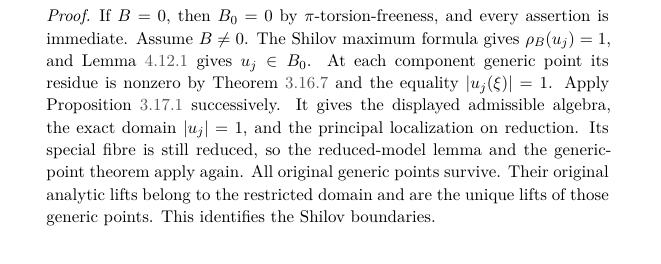
\begin{proof}
If $B=0$, then $B_0=0$ by $\pi$-torsion-freeness, and every
assertion is immediate. Assume $B\ne0$.
The Shilov maximum formula gives $\rho_B(u_j)=1$, and
Lemma~\ref{cand:reducedspecialcanonical} gives $u_j\in B_0$.
At each component generic point its residue is nonzero by
Theorem~\ref{fnd:canonicalgenericshilov} and the equality
$|u_j(\xi)|=1$. Apply
Proposition~\ref{fnd:formalprincipalopenflat} successively.
It gives the displayed admissible algebra, the exact domain
$|u_j|=1$, and the principal localization on reduction.
Its special fibre is still reduced, so the reduced-model
lemma and the generic-point theorem apply again.
All original generic points survive. Their original analytic
lifts belong to the restricted domain and are the unique
lifts of those generic points. This identifies the Shilov
boundaries.

After any field extension of the residue field, each minimal
prime contracts to an original minimal prime by
\cite[Tags 00HD, 00HS]{StacksAlg}. None can therefore contain
any $\bar u_j$. Thus the localization retains every geometric
component as well. Finally, restriction to an open preserves
smoothness, as in \cite[Tag 036U]{StacksAlg}.
\end{proof}
Typeset reader excerpt
Typed proof inputs
- NAG-001905 · selected whole (sealed native whole)
- NAG-001918 · selected whole (sealed native whole)
- NAG-001931 · selected whole (sealed native whole)
- NAG-001943 · selected whole (sealed native whole)
- NAG-002035 · selected whole (already routed exact whole awaiting separate selection)
- NAG-001905 · selected whole
- NAG-001905 · selected whole (requires)
- NAG-001918 · selected whole
- NAG-001918 · selected whole (requires)
- NAG-001931 · selected whole
- NAG-001931 · selected whole (requires)
- NAG-001943 · selected whole
- NAG-001943 · selected whole (requires)
- NAG-002035 · selected whole
- NAG-002035 · selected whole (requires)
Reader cross-references
Proof map
Verified map inputs · NAG-002469
AND · joint registered proof inputs
- NAG-001905 · The affinoid Shilov boundary · accepted whole
- NAG-001918 · Affinoid generic fibres and integral presentations · accepted whole
- NAG-001931 · Generic points of strict canonical reduction · accepted whole
- NAG-001943 · Principal formal opens and flat restriction · accepted whole
- NAG-002035 · A reduced special fibre determines the unit ball · accepted whole
Exact named external applications
- APP:STACKS-00HD@NAG-002469:actual_residual_field_tensor_flat
- The actual residual coordinate algebra after field extension is free by a field basis and passes the finite-ideal flatness criterion
- APP:STACKS-00HS@NAG-002469:geometric_minimal_prime_contraction
- Actual flat going down forces each geometric minimal prime to contract to an original minimal prime
- APP:STACKS-036U@NAG-002469:smooth_principal_open_restriction
- Proof-level smooth precomposition by the actual principal open immersion, restricted to the given smooth chart.
NAG-002469 · Localization at a common Shilov value · Chapter argument