NAG-002511 · Accepted whole
Module base change at a complete Gauss field
C Native scalar extension and finite restriction of constants
Open in the English reader · PDF page 1761
Statement · exact TeX
\begin{lemma}[Module base change at a complete Gauss field]
\label{f9cand:gauss-module}
Let $D$ be a finite canonical $R_{K,r}$-algebra and $P$ a finite
$D$-module, with its canonical norm. Then
$D_L=D\wt_K L=D\otimes_{R_{K,r}}R_{L,r}$ and
$P_L=P\wt_K L=P\otimes_{R_{K,r}}R_{L,r}$, with bounded inverse
comparisons. There is a canonical isomorphism
\begin{equation}\label{eq:gauss-module}
 P_L\otimes_{R_{L,r}}H_{L,r}
 \simeq
 (P\otimes_{R_{K,r}}H_{K,r})\otimes_{H_{K,r}}H_{L,r}.
\end{equation}
The native vector-space dimension is unchanged. If
$E=D\otimes_{R_{K,r}}H_{K,r}=\prod_j E_j$ and
$Q=P\otimes_{R_{K,r}}H_{K,r}$, then
\begin{equation}\label{eq:gauss-lengths}
 \dim_{H_{K,r}}Q
   =\sum_j\len_{E_j}Q_j\,[E_j/\mathfrak m_j:H_{K,r}].
\end{equation}
The corresponding formula after extension has the same total.
\end{lemma}
Full selected proof · exact TeX
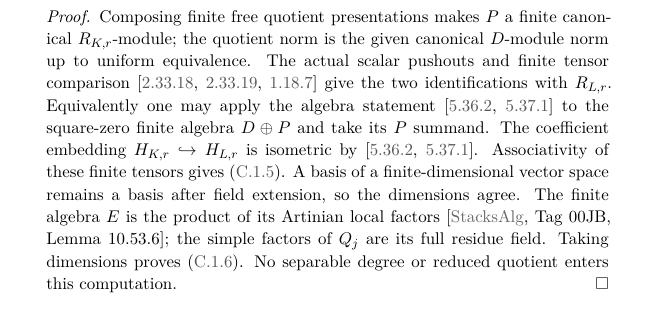
\begin{proof}
Composing finite free quotient presentations makes $P$ a finite
canonical $R_{K,r}$-module; the quotient norm is the given canonical
$D$-module norm up to uniform equivalence. The actual scalar pushouts
and finite tensor comparison [\ref{fnd:generalizedfinitealgebras}, \ref{fnd:generalizedfinitebasechange}, \ref{fnd:generalizedfinitetensor}] give the two
identifications with $R_{L,r}$. Equivalently one may apply the
algebra statement [\ref{v036:gaussbasechange}, \ref{v036:flatgermweight}] to the square-zero finite algebra
$D\oplus P$ and take its $P$ summand.
The coefficient embedding $H_{K,r}\hookrightarrow H_{L,r}$ is isometric
by [\ref{v036:gaussbasechange}, \ref{v036:flatgermweight}]. Associativity of these finite tensors gives
\eqref{eq:gauss-module}. A basis of a finite-dimensional vector space
remains a basis after field extension, so the dimensions agree.
The finite algebra $E$ is the product of its Artinian local factors
\cite[Tag 00JB, Lemma 10.53.6]{StacksAlg}; the simple factors of $Q_j$ are its full residue
field. Taking dimensions proves \eqref{eq:gauss-lengths}.
No separable degree or reduced quotient enters this computation.
\end{proof}
Standing context 1 · exact TeX
\def\len{\operatorname{length}}
\def\Min{\operatorname{Min}}
\def\Int{\operatorname{Int}}
\def\supp{\operatorname{supp}}
\def\Frac{\operatorname{Frac}}
\def\OO{\mathcal O}
\def\HH{\mathcal H}
\def\wt{\widehat\otimes}
\def\bb{\mathbf}
\section{Scalar extension and restriction of constants for ordinary integration}
Throughout, $K$ is complete for its specified real-valued non-Archimedean
absolute value, and $L/K$ is a complete isometric extension. Trivial
valuation and arbitrary positive affinoid radii are allowed. Write
$p:X_L\to X$ for actual completed scalar extension. All moment coordinates
Standing context 2 · exact TeX
\subsection{The entire Gauss module}
For a positive real polyradius $r$, let
\[
 R_{K,r}=K\{r^{-1}T,rU\}/(T_iU_i-1),\qquad
 H_{K,r}=\widehat{\Frac(R_{K,r})}
\]
for the multiplicative Laurent Gauss norm. Empty tuples give $R=H=K$.
Typeset reader excerpt
Typed proof inputs
- APP-STACKS-00D2@NAG-002511:original-proof · named external application (new exact application of frozen Stacks authority)
- APP-STACKS-00JB@NAG-002511:original-proof · named external application (new exact application of frozen Stacks authority)
- NAG-001561 · selected whole (sealed native whole)
- NAG-001565 · selected whole (sealed native whole)
- NAG-001686 · selected whole (sealed native whole)
- NAG-001701 · selected whole (sealed native whole)
- NAG-001702 · selected whole (sealed native whole)
- NAG-002301 · selected whole (ordered native whole proposal)
- STACKS-00D2 · named external application (new exact application of frozen Stacks authority)
- STACKS-00JB · named external application (new exact application of frozen Stacks authority)
- APP-STACKS-00D2@NAG-002511:original-proof · named external application
- APP-STACKS-00D2@NAG-002511:original-proof · named external application (requires)
- APP-STACKS-00JB@NAG-002511:original-proof · named external application
- APP-STACKS-00JB@NAG-002511:original-proof · named external application (requires)
- NAG-001561 · selected whole
- NAG-001561 · selected whole (requires)
- NAG-001565 · selected whole
- NAG-001565 · selected whole (requires)
- NAG-001686 · selected whole
- NAG-001686 · selected whole (requires)
- NAG-001701 · selected whole
- NAG-001701 · selected whole (requires)
- NAG-001702 · selected whole
- NAG-001702 · selected whole (requires)
- NAG-002301 · selected whole
- NAG-002301 · selected whole (requires)
Reader cross-references
Proof map
Verified map inputs · NAG-002511
AND · joint registered proof inputs
- NAG-001561 · Canonical norms and exactness for finite modules · accepted whole Exact source window 250–254
- NAG-001565 · Finite tensors with generalized affinoid targets · accepted whole Exact source window 252–259
- NAG-001686 · Finite modules and faithful scalar extension · accepted whole Exact source window 250–254
- NAG-001701 · Finite algebras with their canonical norm · accepted whole Exact source window 250–254
- NAG-001702 · General finite base change · accepted whole Exact source window 252–256
- NAG-002301 · Scalar extension of a finite Gauss fibre · accepted whole Exact source window 257–259
Unlinked source pointers
These pointers have no operative linked edge in this map.
APP-STACKS-00D2@NAG-002511:original-proofAPP-STACKS-00JB@NAG-002511:original-proofSTACKS-00D2STACKS-00JB
NAG-002511 · Module base change at a complete Gauss field · Chapter argument