NAG-002531 · Accepted whole
Effective coherent and line-bundle descent
Proper direct image on historical ordinary compact tests
Open in the English reader · PDF page 1955
Statement · exact TeX
\begin{theorem}[Effective coherent and line-bundle descent]\label{f9ds:coherentdescent}
Pullback along $p$ gives an equivalence between $\Coh(X_G)$ and coherent
descent data on $Y/X$. It restricts to an equivalence of line bundles
with descent data. The descent construction commutes with affinoid
restriction and tensor products.
\end{theorem}
Full selected proof · exact TeX
\begin{proof}
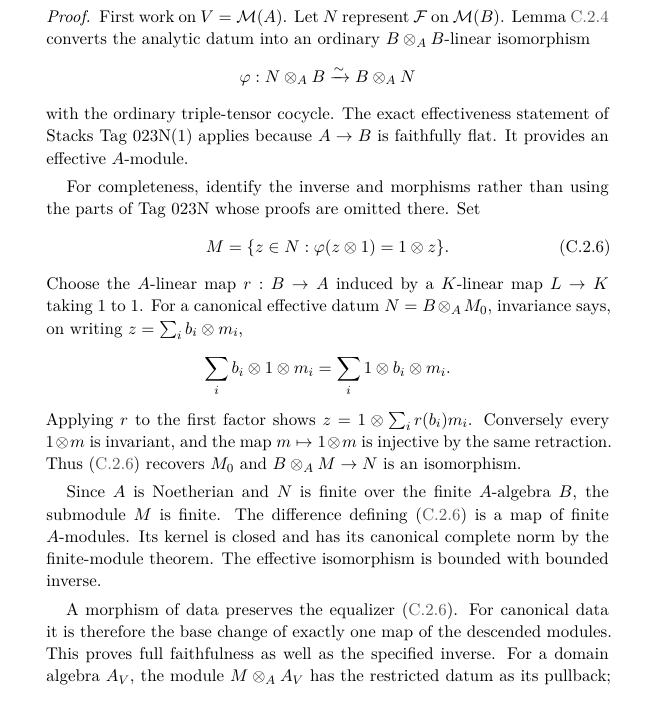
First work on $V=\cM(A)$. Let $N$ represent $\cF$ on $\cM(B)$.
Lemma~\ref{f9ds:finitebridge} converts the analytic datum into an ordinary
$B\otimes_A B$-linear isomorphism
\[
 \varphi:N\otimes_A B\xrightarrow{\sim}B\otimes_A N
\]
with the ordinary triple-tensor cocycle. The exact effectiveness statement
of Stacks Tag~023N(1) applies because $A\to B$ is faithfully flat.
It provides an effective $A$-module.

For completeness, identify the inverse and morphisms rather than using
the parts of Tag~023N whose proofs are omitted there. Set
\begin{equation}\label{eq:invariants}
 M=\{z\in N:\varphi(z\otimes1)=1\otimes z\}.
\end{equation}
Choose the $A$-linear map $r:B\to A$ induced by a $K$-linear map
$L\to K$ taking $1$ to $1$. For a canonical effective datum
$N=B\otimes_A M_0$, invariance says, on writing
$z=\sum_i b_i\otimes m_i$,
\[
 \sum_i b_i\otimes1\otimes m_i
       =\sum_i1\otimes b_i\otimes m_i.
\]
Applying $r$ to the first factor shows
$z=1\otimes\sum_i r(b_i)m_i$. Conversely every $1\otimes m$ is
invariant, and the map $m\mapsto1\otimes m$ is injective by the same
retraction. Thus \eqref{eq:invariants} recovers $M_0$ and
$B\otimes_A M\to N$ is an isomorphism.

Since $A$ is Noetherian and $N$ is finite over the finite $A$-algebra
$B$, the submodule $M$ is finite. The difference defining
\eqref{eq:invariants} is a map of finite $A$-modules. Its kernel is
closed and has its canonical complete norm by the finite-module theorem.
The effective isomorphism is bounded with bounded inverse.

A morphism of data preserves the equalizer \eqref{eq:invariants}.
For canonical data it is therefore the base change of exactly one map
of the descended modules. This proves full faithfulness as well as the
specified inverse. For a domain algebra $A_V$, the module
$M\otimes_A A_V$ has the restricted datum as its pullback; the just
proved uniqueness identifies it with the equalizer constructed there.
Thus no unsupported commutation of a kernel with arbitrary completion
is used. Coherent equivalence and these canonical restriction maps glue
the construction on ordinary affinoid neighbourhoods of $X$.
On overlaps the isomorphisms agree by full faithfulness. Tensor products
are compatible by associativity and the same uniqueness.

It remains to check line bundles. An invertible coherent module on an
affinoid corresponds to an invertible finite module: tensor it with its
dual, and use affinoid coherent equivalence to identify evaluation and
coevaluation. The resulting finite dual-basis identity makes its module
finite projective. Explicitly, if coevaluation is
$\sum_i u_i\otimes\lambda_i$, then
$u=\sum_i\lambda_i(u)u_i$ splits a surjection from a finite free module.

Thus, for a line bundle upstairs, $N$ is finite projective over $B$,
hence finite projective over $A$, because $B$ is finite free over $A$.
The identification $N=B\otimes_A M$ and the retraction $r$ make $M$
an $A$-module direct summand of $N$. Consequently $M$ is finite
projective over $A$. For every prime $\mathfrak p$ of $A$ choose a prime
of the nonzero finite algebra $B\otimes_A\kappa(\mathfrak p)$.
After its residue-field extension, $M\otimes_A\kappa(\mathfrak p)$
has dimension one, because $N$ has rank one. The same dimension is
therefore one before that field extension. This proves rank one at
every prime.

The associated coherent module has flat ordinary stalks; by
\tagref{NAG-001753} it is free on ordinary neighbourhoods. Its rank is
one, as may also be checked after evaluation in $\HH(x)$.
This proves the assertion for line bundles.
\end{proof}
Typeset reader excerpt
Typed proof inputs
- NAG-001561 · selected whole (finite descent exact consumer binding)
- NAG-001624 · selected whole (finite descent exact consumer binding)
- NAG-001752 · selected whole (finite descent exact consumer binding)
- NAG-001753 · selected whole (finite descent exact consumer binding)
- NAG-002529 · selected whole (finite descent exact consumer binding)
Reader cross-references
Proof map
Verified map inputs · NAG-002531
AND · joint registered proof inputs
- NAG-001561 · Canonical norms and exactness for finite modules · accepted whole Exact source window 168
- Kernel a finite A-module with canonical complete norm and bounded identifications.
- NAG-001624 · Kiehl and Theorem B on the analytic G-site · accepted whole Exact source window 178
- Exact equivalence and actual restriction maps of finite modules and G-site coherent sheaves.
- NAG-001752 · Coherent direct image under a finite morphism · accepted whole Exact source window 174
- Finite coefficient base change for the indicated actual restrictions.
- NAG-001753 · A flat coherent ordinary stalk is locally free · accepted whole Exact source window 203
- Apply precisely to the actual flat coherent ordinary stalk, after finite projectivity.
- NAG-002529 · The finite tensor bridge · accepted whole Exact source window 137
- Transfers the full double and triple diagrams into the actual ordinary tensor products.
NAG-002531 · Effective coherent and line-bundle descent · Chapter argument