NAG-002557 · Accepted whole
Determinants after a DVR slice
Proper direct image on historical ordinary compact tests
Open in the English reader · PDF page 1974
Statement · exact TeX
\begin{corollary}[Determinants after a DVR slice]
\label{f9nm:dvrslice}
Let $(R,\mathfrak m,k)$ be Noetherian local, let $S$ be a finite
free commutative $R$-algebra of rank $n\ge1$, and let
$f_1,\ldots,f_c\in\mathfrak m$ be an $R$-regular sequence
(the empty sequence is allowed). Put $I=(f_1,\ldots,f_c)$,
and assume $A=R/I$ is a DVR. For $b\in S$, assume its image
$\bar b$ is a non-zero-divisor in $B=S/IS$, and assume
$B/\bar bB\ne0$. Put
$D=\det_R(m_b:S\to S)$. Then
\begin{align}\label{eq:slicelength}
 \length_R R/(I,D)
 &=\ord_A(\bar D)\\
 &=\sum_{\mathfrak q\in\Max S}
 [\kappa(\mathfrak q):k]\,
 \length_{S_{\mathfrak q}}
            S_{\mathfrak q}/(I,b)S_{\mathfrak q}.\notag
\end{align}
All lengths are finite. The sequence $(f_1,\ldots,f_c,D)$ is
regular in $R$. On every local factor where the final quotient is
nonzero, $(f_1,\ldots,f_c,b)$ is regular in $S_{\mathfrak q}$.
Thus these are ordinary local complete-intersection lengths whenever
this ring data describe the chosen geometric intersection.
\end{corollary}
Full selected proof · exact TeX
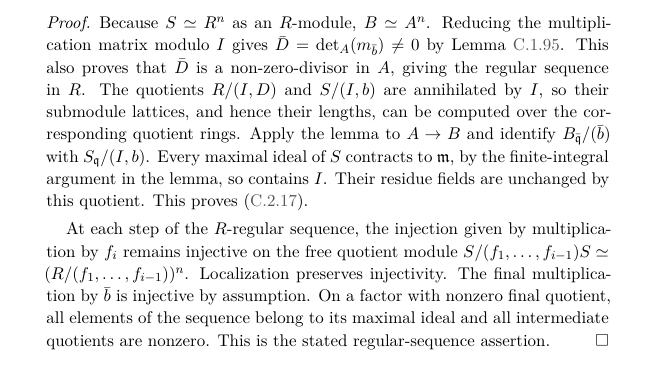
\begin{proof}
Because $S\simeq R^n$ as an $R$-module, $B\simeq A^n$.
Reducing the multiplication matrix modulo $I$ gives
$\bar D=\det_A(m_{\bar b})\ne0$ by
Lemma~\ref{f9nm:dvrlength}. This also proves that $\bar D$ is a
non-zero-divisor in $A$, giving the regular sequence in $R$.
The quotients $R/(I,D)$ and $S/(I,b)$ are annihilated by $I$,
so their submodule lattices, and hence their lengths, can be
computed over the corresponding quotient rings. Apply the lemma
to $A\to B$ and identify $B_{\bar{\mathfrak q}}/(\bar b)$ with
$S_{\mathfrak q}/(I,b)$. Every maximal ideal of $S$ contracts to
$\mathfrak m$, by the finite-integral argument in the lemma, so
contains $I$. Their residue fields are unchanged by this quotient.
This proves \eqref{eq:slicelength}.

At each step of the $R$-regular sequence, the injection given by
multiplication by $f_i$ remains injective on the free quotient
module $S/(f_1,\ldots,f_{i-1})S\simeq
(R/(f_1,\ldots,f_{i-1}))^n$. Localization preserves injectivity.
The final multiplication by $\bar b$ is injective by assumption.
On a factor with nonzero final quotient, all elements of the
sequence belong to its maximal ideal and all intermediate quotients
are nonzero. This is the stated regular-sequence assertion.
\end{proof}
Typeset reader excerpt
Typed proof inputs
- NAG-002552 · selected whole
Reader cross-references
Proof map
Verified map inputs · NAG-002557
Registered proof input
- NAG-002552 · A finite algebra over a DVR · accepted whole Exact source window 37–60
- Exact actual finite-free DVR local length and residue weights.
NAG-002557 · Determinants after a DVR slice · Chapter argument