NAG-002572 · Accepted whole
The whole-fibre weight is one; F8GP-4
G Stable inertia and original-field models
Open in the English reader · PDF page 2020
Statement · exact TeX
\begin{lemma}[The whole-fibre weight is one; F8GP-4]\label[lemma]{lem:weight}
For every \(S\), the \(h\)-moment chain of \(V_{0,S}\) is
\[
             \Trop_{h,V_{0,S}}(\mathcal O_{V_{0,S}})
                         =\mathcal P|_{\{t\circ F\leq S\}}.
 \tag{3.2}
\]
Each full-dimensional product cell that survives truncation has
weight one. Lower-dimensional pieces contribute no \(n\)-chain.
\end{lemma}
Full selected proof · exact TeX
\begin{proof}
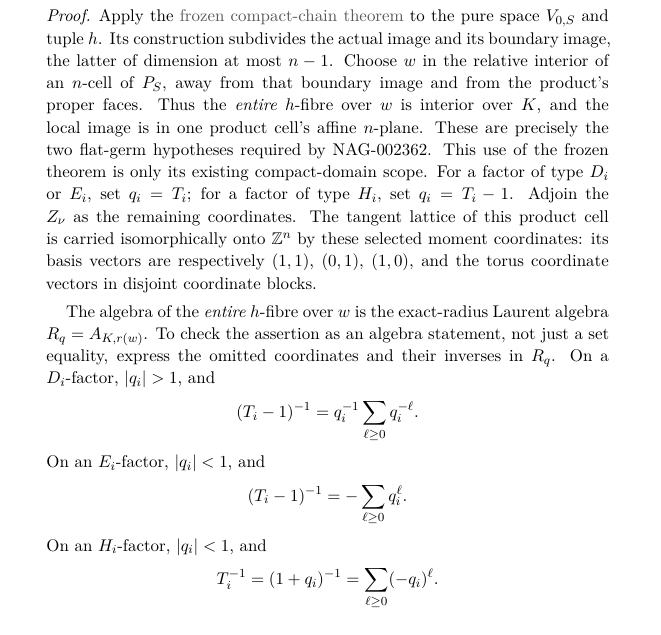
Apply the \hyperref[fnd:nag002405:global-finite-module-chain-weights]{frozen compact-chain theorem} to the pure space \(V_{0,S}\)
and tuple \(h\). Its construction subdivides the actual image and its
boundary image, the latter of dimension at most \(n-1\).
Choose \(w\) in the relative interior of an \(n\)-cell of \(P_S\),
away from that boundary image and from the product's proper faces.
Thus the \emph{entire} \(h\)-fibre over \(w\) is interior over \(K\),
and the local image is in one product cell's affine \(n\)-plane.
These are precisely the two flat-germ hypotheses required by
NAG-002362. This use of the frozen theorem is only its existing
compact-domain scope.
For a factor of type \(D_i\) or \(E_i\), set \(q_i=T_i\);
for a factor of type \(H_i\), set \(q_i=T_i-1\).
Adjoin the \(Z_\nu\) as the remaining coordinates.
The tangent lattice of this product cell is carried isomorphically
onto \(\Z^n\) by these selected moment coordinates: its basis vectors
are respectively \((1,1)\), \((0,1)\), \((1,0)\), and the torus
coordinate vectors in disjoint coordinate blocks.

The algebra of the \emph{entire} \(h\)-fibre over \(w\) is the
exact-radius Laurent algebra \(R_q=A_{K,r(w)}\).
To check the assertion as an algebra statement, not just a set
equality, express the omitted coordinates and their inverses in
\(R_q\). On a \(D_i\)-factor, \(|q_i|>1\), and
\[
 (T_i-1)^{-1}=q_i^{-1}\sum_{\ell\geq0}q_i^{-\ell}.
\]
On an \(E_i\)-factor, \(|q_i|<1\), and
\[
 (T_i-1)^{-1}=-\sum_{\ell\geq0}q_i^\ell.
\]
On an \(H_i\)-factor, \(|q_i|<1\), and
\[
 T_i^{-1}=(1+q_i)^{-1}=\sum_{\ell\geq0}(-q_i)^\ell.
\]
These series converge in the exact-radius norm. The simultaneous
level relations give bounded homomorphisms in both directions;
they fix all coordinate generators and hence are inverse.
All inequalities defining \(V_{0,S}\) have fixed values on this
whole fibre, so no factor or sheet is removed by them.

The choice of \(w\) does not require \(t\circ F<S\).
If \(t\circ F\) is constant on an \(n\)-cell and equals \(S\),
that whole cell is part of the actual image \(P_S\).
The frozen boundary-image dimension bound still permits the same
generic interior-fibre choice on it. No equality-level cell is removed.

For the selected transverse coordinates, the lattice divisor is
one and the actual Gauss algebra is
\[
 R_q\widehat\otimes_{R_q}H_q=H_q.
\]
Its dimension over \(H_q\) is one. The frozen module-weight theorem
therefore gives weight one at \(w\).
This determines the coefficient of every surviving \(n\)-cell.
The \hyperref[fnd:nag002405:global-finite-module-chain-weights]{finite-chain theorem}, subdivision independence, and
\cref{lem:image} give (3.2).
\end{proof}
Typeset reader excerpt
Typed proof inputs
- NAG-002570 · selected whole
- NAG-002571 · selected whole
- NAG-002572 · selected whole
- NAG-002573 · selected whole
Reader cross-references
Proof map
Verified map inputs · NAG-002572
AND · joint registered proof inputs
- NAG-002570 · Actual source image; F8GP-2 · accepted whole
- NAG-002571 · Purity and regularity; F8GP-3 · accepted whole
- NAG-002573 · A proper finite polyhedral pushforward; F8GP-5 · accepted whole
NAG-002572 · The whole-fibre weight is one; F8GP-4 · Chapter argument