NAG-002586 · Accepted whole
Whole fibres outside finitely many walls
Proper direct image on historical ordinary compact tests
Open in the English reader · PDF page 1843
Statement · exact TeX
\begin{lemma}[Whole fibres outside finitely many walls]
\label{mpw:torusoverlap}
Let $s_0\in\operatorname{int}(P)$ and let $O$ be an ordinary open
neighbourhood of $\eta_{s_0}$ in $\mathbb T_P$. There are an open
Euclidean neighbourhood $B_0\subset\operatorname{int}(P)$ of $s_0$
and a finite union $H$ of proper affine hyperplanes, with integral
normals, such that
\[
                   \mathbb T_s\subset O\qquad(s\in B_0\setminus H).
\]
This includes every analytic point of each exact-radius polytorus.
\end{lemma}
Full selected proof · exact TeX
\begin{proof}
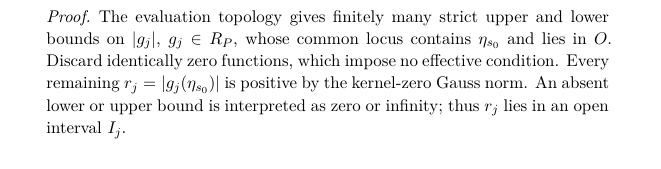
The evaluation topology gives finitely many strict upper and lower
bounds on $|g_j|$, $g_j\in R_P$, whose common locus contains
$\eta_{s_0}$ and lies in $O$. Discard identically zero functions,
which impose no effective condition. Every remaining
$r_j=|g_j(\eta_{s_0})|$ is positive by the kernel-zero Gauss norm.
An absent lower or upper bound is interpreted as zero or infinity;
thus $r_j$ lies in an open interval $I_j$.

Choose finite Laurent polynomials $p_j=\sum_m c_{jm}T^m$ whose
uniform errors on $\mathbb T_P$ are less than
$\epsilon_j<r_j$, using Banach-norm density. Combine equal
exponents and remove zero coefficients. Then
$|p_j(\eta_{s_0})|=r_j$. The finite maximum
\[
                  G_j(s)=\max_m|c_{jm}|e^{-\langle m,s\rangle}
\]
is continuous. Shrink $B_0$ until $G_j(s)\in I_j$ and
$G_j(s)>\epsilon_j$ for every $j$. Let $H$ contain the equality
hyperplane for every pair of distinct exponent terms in every
$p_j$. These are finitely many proper hyperplanes with integral
normals; a monomial contributes none.

For $s\notin H$ there is a unique largest term in each $p_j$ at
every point $y\in\mathbb T_s$. The strong triangle inequality gives
$|p_j(y)|=G_j(s)$. The approximation error is smaller, so
$|g_j(y)|=G_j(s)\in I_j$. Every point satisfies all the selected
bounds and belongs to $O$.
\end{proof}
Typeset reader excerpt
Typed proof inputs
- NAG-000182 · selected whole (sealed whole native proof)
- NAG-001496 · selected whole (sealed whole native proof)
- NAG-002294 · selected whole (sealed whole native proof)
- NAG-000182 · selected whole
- NAG-000182 · selected whole (requires)
- NAG-001496 · selected whole
- NAG-001496 · selected whole (requires)
- NAG-002294 · selected whole
- NAG-002294 · selected whole (requires)
Proof map
Verified map inputs · NAG-002586
AND · joint registered proof inputs
- NAG-000182 · Multiplicativity of the weighted Gauss norm · accepted whole
- NAG-001496 · Compactness of the bounded spectrum · accepted whole
- NAG-002294 · Gauss degrees over a closed polyannulus · accepted whole
NAG-002586 · Whole fibres outside finitely many walls · Chapter argument