NAG-002595 · Accepted whole
One whole degree is not one cone weight
I Descent of the polarized mixed tower
Open in the English reader · PDF page 2098
Statement · exact TeX
\begin{proposition}[One whole degree is not one cone weight]
\label{mpw:nonflatobstruction}
For every $d\geq1$ there is an interior analytic point with a pure
$d$-dimensional pointed fan and an entire moment-fibre algebra
finite with its canonical norm for two projections injective on
every top-cone lattice, for which the whole-fibre Gauss degree
divided by the index on a specified cone has different values.
The intrinsic cone weights do exist in this example; the two
whole degrees measure projected sums, not individual cone weights.
\end{proposition}
Full selected proof · exact TeX
\begin{proof}
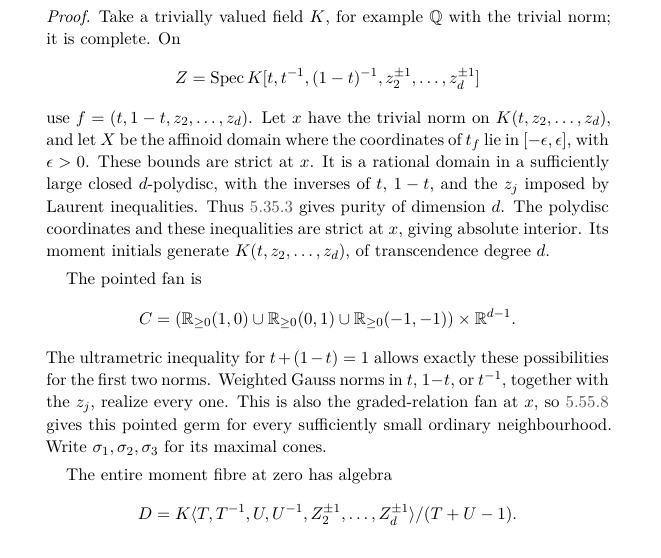
Take a trivially valued field $K$, for example $\mathbb Q$ with
the trivial norm; it is complete. On
\[
 Z=\operatorname{Spec}K[t,t^{-1},(1-t)^{-1},
                              z_2^{\pm1},\ldots,z_d^{\pm1}]
\]
use $f=(t,1-t,z_2,\ldots,z_d)$. Let $x$ have the trivial norm
on $K(t,z_2,\ldots,z_d)$, and let $X$ be the affinoid domain
where the coordinates of $t_f$ lie in $[-\epsilon,\epsilon]$,
with $\epsilon>0$. These bounds are strict at $x$. It is a
rational domain in a sufficiently large closed $d$-polydisc,
with the inverses of $t$, $1-t$, and the $z_j$ imposed by
Laurent inequalities. Thus \Dep{v036:analytic:domainpurity}
gives purity of dimension $d$. The polydisc coordinates and
these inequalities are strict at $x$, giving absolute interior.
Its moment initials generate $K(t,z_2,\ldots,z_d)$, of
transcendence degree $d$.

The pointed fan is
\[
 C=(\mathbb R_{\geq0}(1,0)\cup\mathbb R_{\geq0}(0,1)
       \cup\mathbb R_{\geq0}(-1,-1))\times\mathbb R^{d-1}.
\]
The ultrametric inequality for $t+(1-t)=1$ allows exactly these
possibilities for the first two norms. Weighted Gauss norms in
$t$, $1-t$, or $t^{-1}$, together with the $z_j$, realize every
one. This is also the graded-relation fan at $x$, so
\Dep{v038:pointed:fullstabilization} gives this pointed germ for
every sufficiently small ordinary neighbourhood.
Write $\sigma_1,\sigma_2,\sigma_3$ for its maximal cones.

The entire moment fibre at zero has algebra
\[
 D=K\langle T,T^{-1},U,U^{-1},Z_2^{\pm1},\ldots,Z_d^{\pm1}\rangle
                                          /(T+U-1).
\]
For a trivial norm restricted series are finite sums; this is the
coordinate ring of $Z$ with its trivial Banach norm. No analytic
point or component of the fibre is omitted.

For positive integers $a,b$ set
\[
 Q_{a,b}(u,v,\lambda)=(au+bv,\lambda),\qquad S=T^a(1-T)^b.
\]
The three saturated cone lattices have indices $a,b,a+b$;
each restriction of $Q_{a,b}$ is injective. The exact target is
$R=K\langle S^{\pm1},Z_2^{\pm1},\ldots,Z_d^{\pm1}\rangle$.
There is an actual algebra identification
\[
                  D=R[T]/(T^a(1-T)^b-S).
\]
Indeed the relation makes both $T$ and $1-T$ invertible, with
\[
 T^{-1}=S^{-1}T^{a-1}(1-T)^b,\qquad
 (1-T)^{-1}=S^{-1}T^a(1-T)^{b-1}.
\]
The polynomial is monic up to a unit and has degree $a+b$.
Polynomial division gives the basis $1,T,\ldots,T^{a+b-1}$.
The given norm and the canonical finite-module norm are both
trivial, so this is also a bounded analytic identification.
The entire Gauss fibre consequently has degree
\[
                              \delta_{a,b}=a+b.
\]

There are genuine full finite collars as well. Use the same monic
presentation over a target polyannulus in $(S,Z)$; it is
norm-admissible finite by \Dep{fnd:generalizedfinitealgebras}.
If $|t|<1$, then $|S|=|t|^a$; if $|1-t|<1$, then
$|S|=|1-t|^b$; and if $|t|>1$, then $|S|=|t|^{a+b}$.
The remaining case has both norms one. Hence for a sufficiently
small target logarithmic box its entire inverse image lies in
$X$, with strict defining bounds. The finite analytification theorem
\Dep{fnd:analytificationfiniteclosed}, followed by actual domain
base change, identifies this full inverse image with the constructed
finite analytic algebra. The obstruction is not a
failure of norm-admissible finiteness.

On $\sigma_1$, both $Q_{1,1}$ and $Q_{1,2}$ have index one;
their whole-fibre degrees are $2$ and $3$. Thus the proposed
quotients differ. The actual generic weight of each cone is one:
on $\sigma_1$ its entire fibre is the exact polytorus in $(t,z)$,
because $|t|<1$ forces $|1-t|=1$. Projection to $(t,z)$ has
degree and index one, and \Dep{v036:flatgermweight} gives weight
one. Use $(1-t,z)$ on $\sigma_2$ and $(t,z)$ on $\sigma_3$.

For a small positive target first weight $s$, the full projected
level has two original moment weights
\[
                     (s/a,0,\lambda),\quad (0,s/b,\lambda),
\]
with contributions $a$ and $b$. At a negative first weight only
$\sigma_3$ contributes, with index $a+b$. These explain the
whole degree $a+b$. Thickening by $\epsilon'^h=0$ multiplies
all degrees and all cone weights by $h$ with unchanged support;
its generic nilpotent length has not disappeared.
\end{proof}
Typeset reader excerpt
Typed proof inputs
- NAG-000182 · selected whole (explicit current dependencies)
- NAG-001554 · selected whole (explicit current dependencies)
- NAG-001576 · selected whole (explicit current dependencies)
- NAG-001628 · selected whole (explicit current dependencies)
- NAG-001692 · selected whole (explicit current dependencies)
- NAG-001701 · selected whole (explicit current dependencies)
- NAG-001702 · selected whole (explicit current dependencies)
- NAG-001704 · selected whole (explicit current dependencies)
- NAG-001710 · selected whole (explicit current dependencies)
- NAG-001846 · selected whole (explicit current dependencies)
- NAG-002293 · selected whole (explicit current dependencies)
- NAG-002306 · selected whole (explicit current dependencies)
- NAG-002362 · selected whole (explicit current dependencies)
- NAG-002452 · selected whole (explicit current dependencies)
- NAG-002455 · selected whole (explicit current dependencies)
Proof map
Verified map inputs · NAG-002595
AND · joint registered proof inputs
- NAG-000182 · Multiplicativity of the weighted Gauss norm · accepted whole
- NAG-001554 · Closed presentations after adjoining coefficients · accepted whole
- NAG-001576 · Points of an arbitrary-radius rational presentation · accepted whole
- NAG-001628 · Interior of an affinoid domain · accepted whole
- NAG-001692 · Affinoid fibres at all Berkovich points · accepted whole
- NAG-001701 · Finite algebras with their canonical norm · accepted whole
- NAG-001702 · General finite base change · accepted whole
- NAG-001704 · Presentation calculus for relative interior · accepted whole
- NAG-001710 · Finite maps and closed immersions under analytification · accepted whole
- NAG-001846 · Affinoid domains under arbitrary affinoid base change · accepted whole
- NAG-002293 · Purity of affinoid domains · accepted whole
- NAG-002306 · Positive intrinsic weights at arbitrary real flat germs · accepted whole
- NAG-002362 · Weights of finite modules on an interior flat germ · accepted whole
- NAG-002452 · Finite tropical witnesses for homogeneous graded relations · accepted whole
- NAG-002455 · Stabilization and purity of pointed tropical germs · accepted whole
NAG-002595 · One whole degree is not one cone weight · Chapter argument