NAG-002607 · Accepted whole
The component missing from the graph
Proper direct image on historical ordinary compact tests
Open in the English reader · PDF page 1892
Statement · exact TeX
\begin{proposition}[The component missing from the graph]
\label{cand:f5sub:explicitcommonmodel}
For (4), a projective semistable common model is obtained by
first blowing up \((T,\pi)\), and then, in the chart \(T=\pi z\),
blowing up the two disjoint special-point ideals
\((z,\pi)\) and \((z-1,\pi)\), extended by the unit ideal elsewhere.
The resulting \(\mathcal Z\) has component vertices
\[
 \zeta_{0,1},\quad w=\zeta_{0,|\pi|}=\zeta_{\pi,|\pi|},
 \quad\zeta_{0,|\pi|^2},\quad\zeta_{\pi,|\pi|^2}.
\]
The component at \(w\) is a geometric projective line attached
to the other three components at \(0,1,\infty\).
The map \(\mathcal Z\to\mathcal G\) contracts that entire component
to the origin of (6).
\end{proposition}
Full selected proof · exact TeX
\begin{proof}
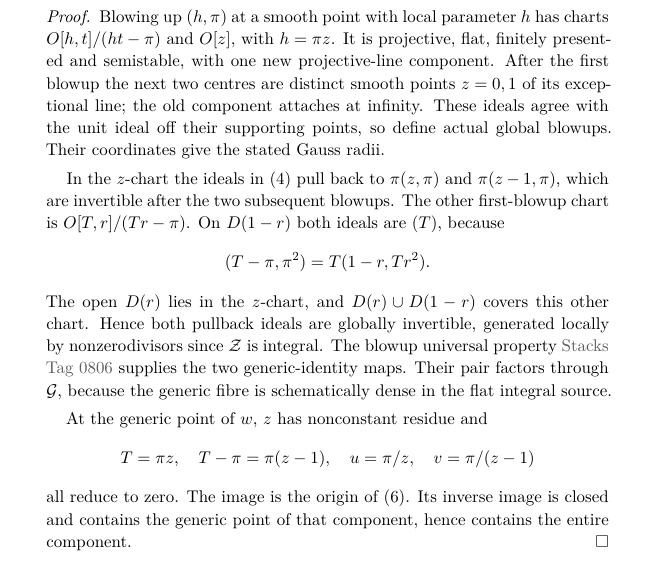
Blowing up \((h,\pi)\) at a smooth point with local parameter \(h\)
has charts \(O[h,t]/(ht-\pi)\) and \(O[z]\), with \(h=\pi z\).
It is projective, flat, finitely presented and semistable, with
one new projective-line component.
After the first blowup the next two centres are distinct smooth
points \(z=0,1\) of its exceptional line; the old component
attaches at infinity. These ideals agree with the unit ideal
off their supporting points, so define actual global blowups.
Their coordinates give the stated Gauss radii.

In the \(z\)-chart the ideals in (4) pull back to
\(\pi(z,\pi)\) and \(\pi(z-1,\pi)\), which are invertible after
the two subsequent blowups.
The other first-blowup chart is \(O[T,r]/(Tr-\pi)\).
On \(D(1-r)\) both ideals are \((T)\), because
\[
                    (T-\pi,\pi^2)=T(1-r,Tr^2).
\]
The open \(D(r)\) lies in the \(z\)-chart, and
\(D(r)\cup D(1-r)\) covers this other chart.
Hence both pullback ideals are globally invertible, generated
locally by nonzerodivisors since \(\mathcal Z\) is integral.
The blowup universal property \stacks{0806} supplies the
two generic-identity maps. Their pair factors through
\(\mathcal G\), because the generic fibre is schematically
dense in the flat integral source.

At the generic point of \(w\), \(z\) has nonconstant residue and
\[
 T=\pi z,\quad T-\pi=\pi(z-1),\quad
                   u=\pi/z,\quad v=\pi/(z-1)
\]
all reduce to zero. The image is the origin of (6).
Its inverse image is closed and contains the generic point
of that component, hence contains the entire component.
\end{proof}
Typeset reader excerpt
Typed proof inputs
- NAG-002606 · selected whole
Proof map
Verified map inputs · NAG-002607
Registered proof input
- NAG-002606 · Normalization does not repair the generic graph · accepted whole
- The same two-generator chart computation gives three smooth-point blowups. The two additional disjoint centres lie on the first exceptional line at 0 and 1, with the old component attached at infinity.
- Check the two actual pulled-back ideals on the z-chart and its complementary opens. They are locally generated by nonzerodivisors, so the exact blowup universal property gives both generic identity maps; the generic density gives the actual graph factorization.
- At the generic point of the middle line every graph coordinate reduces to zero. Its full component maps to that closed point.
NAG-002607 · The component missing from the graph · Chapter argument