NAG-002614 · Accepted whole
Invariant branches and integral length do not suffice
Proper direct image on historical ordinary compact tests
Open in the English reader · PDF page 1860
Statement · exact TeX
\begin{corollary}[Invariant branches and integral length do not suffice]
\label{cand:f5tame:integrallength}
Take \(e=2,n=2,a=b=1\), with residue characteristic different
from two. Then (8) fixes both branches setwise and every
point of its geometric skeleton. Its length measured by
\(v(\pi)=1\) is \(1\in v(K^\times)\), but its given semilinear
chart has no effective descent. The quotient has multiplicity
two along each component image.
\end{corollary}
Full selected proof · exact TeX
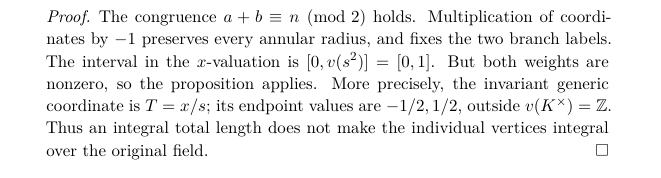
\begin{proof}
The congruence \(a+b\equiv n\pmod2\) holds. Multiplication of
coordinates by \(-1\) preserves every annular radius, and fixes
the two branch labels. The interval in the \(x\)-valuation is
\([0,v(s^2)]=[0,1]\). But both weights are nonzero, so the
proposition applies. More precisely, the invariant generic
coordinate is \(T=x/s\); its endpoint values are
\(-1/2,1/2\), outside \(v(K^\times)=\mathbb Z\).
Thus an integral total length does not make the individual
vertices integral over the original field.
\end{proof}
Typeset reader excerpt
Typed proof inputs
- NAG-002613 · selected whole (exact native dependency)
Proof map
Verified map inputs · NAG-002614
Registered proof input
- NAG-002613 · Branch characters and the quotient of a node · accepted whole Exact source window 301–302
NAG-002614 · Invariant branches and integral length do not suffice · Chapter argument