NAG-002616 · Accepted whole
The midpoint's residual action is nontrivial
F Descent of an algebraized polarized tower
Open in the English reader · PDF page 1988
Statement · exact TeX
\begin{proposition}[The midpoint's residual action is nontrivial]
\label{cand:f5tame:midpointresidualaction}
Let \(\mathcal Y/O'\) be the three-vertex projective model
constructed in the audited midpoint proof by symmetric insertion
in \(TU=t=b^2\). The canonical action fixing \(T,U\) and sending
\(b\) to \(-b\) extends to \(\mathcal Y\). On the new residual
component it acts as
\[
             \overline u\longmapsto-\overline u,
             \qquad u=T/b .
 \tag{14}
\]
Its two branch ends \(0,\infty\) are fixed. For
\(\alpha\in k^\times\), the geometric residual-direction disc
labelled \(\alpha\) is carried to that labelled \(-\alpha\).
Thus the invariant midpoint and its fixed branch ends do not
carry trivial residual-scheme or tube action. This gives a
residual-action obstruction to effective descent of this
\emph{given} model with its fixed generic identification.
\end{proposition}
Full selected proof · exact TeX
\begin{proof}
The audited symmetric insertion uses the ideal \((T,U,b)\)
on the node chart. This ideal is invariant under the stated
action, so its Rees algebra and blowup inherit the action;
on the rest of the projective model the original coefficient
action already exists. These actions agree on overlaps.
The accepted symmetric blowup charts, used in the passing proof,
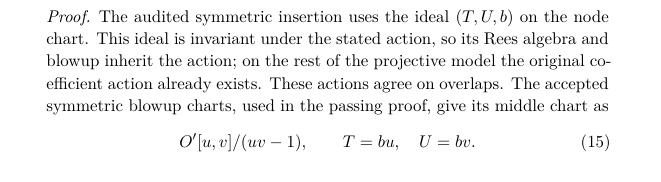
give its middle chart as
\[
       O'[u,v]/(uv-1),\qquad T=bu,\quad U=bv.
 \tag{15}
\]
Here \(\sigma(u)=-u\), \(\sigma(v)=-v\).
The two adjacent node charts add the missing ends \(0,\infty\)
of this residual \(\mathbb P^1_k\), proving (14) on the
whole component. Since \(\operatorname{char}(k)=0\), it is a
nontrivial scheme automorphism.

The full tube description in \dep{cand:f5sub:tubedata}
identifies the smooth residual direction \(\alpha\ne0,\infty\)
with
\[
       |T/b-\widehat\alpha|<1 .
\]
Here one may use the constant lift \(\widehat\alpha=\alpha\in k\).
The action fixes this lift and changes \(T/b\) to \(-T/b\).
It therefore carries this disc to the disc for \(-\alpha\),
which is distinct because \(\alpha\ne0\) and the residue
characteristic is zero.

Every actual base change from \(O\) has identity inertia on
its special fibre, because \(O'/\mathfrak m'=O/\mathfrak m=k\)
and the coefficient action on \(k\) is the identity.
An isomorphism giving descent with the prescribed generic
identification would transport that action to the displayed
action on \(\mathcal Y\). Indeed extensions of a fixed generic
action to a flat separated model are unique: their equalizer
is closed by separatedness, and its defining ideal vanishes
after inverting the nonzero elements of \(O'\), so vanishes
by flatness. This contradicts (14). This argument diagnoses
the residual mechanism of the already audited obstruction;
it does not replace that earlier proof or assert a new
model-existence theorem.
\end{proof}
Typeset reader excerpt
Typed proof inputs
- NAG-001798 · selected whole (selected native whole)
- NAG-002099 · selected whole (selected native whole)
- NAG-002599 · selected whole (selected native whole)
- NAG-002601 · selected whole (earlier candidate whole if selected)
- NAG-002604 · selected whole (selected native whole)
Reader cross-references
Proof map
Verified map inputs · NAG-002616
AND · joint registered proof inputs
- NAG-001798 · Tubes of locally closed strata · accepted whole
- NAG-002099 · A symmetric subdivision of a nodal annulus · accepted whole
- NAG-002599 · An original-ring symmetric insertion · accepted whole
- NAG-002601 · The full tubes of a subdivision · accepted whole
- NAG-002604 · An invariant midpoint over a dense value group · accepted whole
NAG-002616 · The midpoint's residual action is nontrivial · Chapter argument