NAG-002621 · Accepted whole
Whole projected levels in a common union of neighbourhoods
I Descent of the polarized mixed tower
Open in the English reader · PDF page 2101
Statement · exact TeX
\begin{lemma}[Whole projected levels in a common union of neighbourhoods]
\label{mso:unionoverlap}
For each $j$, let $U_{1j},U_{2j}\subset V_j$ be ordinary affinoid
neighbourhoods of $x_j$.
There are ordinary affinoid neighbourhoods
$W_j\subset U_{1j}\cap U_{2j}$ of $x_j$, open real neighbourhoods
$B_i\subset\operatorname{int}(P_i)$ of $u_i^0$, and finite unions
$H_i$ of proper integral-normal affine hyperplanes in $\mathbb R^d$
such that
\begin{equation}
\label{mso:unionretention}
 \{y\in X:Q_it(y)=u\}
     \subset\bigcup_{j=1}^r\operatorname{Int}_{\rm top}(W_j,X)
             \qquad(u\in B_i\setminus H_i).
\end{equation}
This includes every analytic point of each projected tropical level.
Its intersections with the $W_j$ form a disjoint finite affinoid
cover and hence give a bounded product decomposition of its
actual algebra and its finite coefficient modules.
\end{lemma}
Full selected proof · exact TeX
\begin{proof}
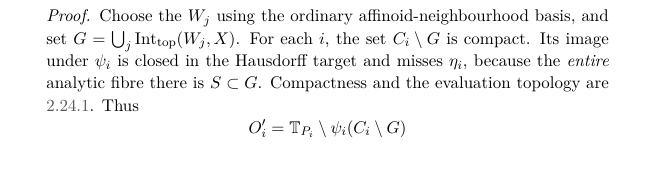
Choose the $W_j$ using the ordinary affinoid-neighbourhood basis,
and set $G=\bigcup_j\operatorname{Int}_{\rm top}(W_j,X)$.
For each $i$, the set $C_i\setminus G$ is compact.
Its image under $\psi_i$ is closed in the Hausdorff target and
misses $\eta_i$, because the \emph{entire} analytic fibre there
is $S\subset G$. Compactness and the evaluation topology are
\Dep{fnd:boundedspectrumcompact}.
Thus
\[
 O_i'=\mathbb T_{P_i}\setminus\psi_i(C_i\setminus G)
\]
is an ordinary open neighbourhood of $\eta_i$ with full inverse
image inside $G$.
Apply the exact reviewed lemma \Dep{mpw:torusoverlap} to $O_i'$.
It puts the entire target polytorus $\mathbb T_u$ inside $O_i'$
for $u\in B_i\setminus H_i$.
Saturation of $C_i$ then gives \eqref{mso:unionretention}.

The level is an actual affinoid, with algebra
\[
 B_i(u)=\mathcal O(C_i)
           \widehat\otimes_{\mathcal O(\mathbb T_{P_i})}R_i(u),
\]
where $R_i(u)=\mathcal O(\mathbb T_u)$.
It is a canonical finite $R_i(u)$-module by
\Dep{fnd:generalizedfinitebasechange}.
Intersections with the $W_j$ are actual affinoid domains by
\Dep{fnd:generalizeddomainbasechange} and
\Dep{fnd:generalizeddomainintersections}.
They cover by \eqref{mso:unionretention} and are disjoint because
$W_j\subset O_j$.
Apply \Dep{fnd:generalizedaffinoidcovercech} to this finite cover.
All pairwise intersections have zero algebra, so its norm-strict
degree-zero equalizer is a bounded isomorphism
from $B_i(u)$ to the product of the restriction algebras.
For a finite module the same theorem gives the corresponding
module product. The characteristic idempotents are actual
elements of $B_i(u)$, and each factor has the quotient
finite-module topology. No reduction or selection of a maximal
ideal has occurred.
\end{proof}
Typeset reader excerpt
Typed proof inputs
- NAG-001496 · selected whole (explicit current dependencies)
- NAG-001565 · selected whole (explicit current dependencies)
- NAG-001609 · selected whole (explicit current dependencies)
- NAG-001702 · selected whole (explicit current dependencies)
- NAG-001831 · selected whole, export unavailable (explicit current dependencies)
- NAG-001846 · selected whole (explicit current dependencies)
- NAG-001847 · selected whole (explicit current dependencies)
- NAG-002586 · selected whole (explicit current dependencies)
Proof map
Verified map inputs · NAG-002621
AND · joint registered proof inputs
- NAG-001496 · Compactness of the bounded spectrum · accepted whole
- NAG-001565 · Finite tensors with generalized affinoid targets · accepted whole
- NAG-001609 · Local calculus of analytic domains · accepted whole
- NAG-001702 · General finite base change · accepted whole
- NAG-001831 · Result 2.38.1 · accepted whole; PDF destination
- NAG-001846 · Affinoid domains under arbitrary affinoid base change · accepted whole
- NAG-001847 · Intersections and restrictions of affinoid domains · accepted whole
- NAG-002586 · Whole fibres outside finitely many walls · accepted whole
NAG-002621 · Whole projected levels in a common union of neighbourhoods · Chapter argument