NAG-002635 · Accepted whole
Finite heights, restriction of scalars, and norms
Open in the English reader · PDF page 1677
Statement and full selected proof · exact TeX
\begin{proposition}[Finite heights, restriction of scalars, and norms]
\label{f9lh:artinheight}
For a generator $s$ of $P$, define
\begin{equation}\label{eq:hzero}
 h_{C,M}(P,h,s)=-\sum_p w_p(M)\log\|s(p)\|_h .
\end{equation}
If $C\to D$ is a map of finite commutative $K$-algebras, $N$ is
a finite $D$-module, and the metric and section are pulled back, then
\[
 h_{D,N}(D\otimes_C P,q^*h,1\otimes s)
                    =h_{C,\operatorname{Res}_C N}(P,h,s).
\]
If $D$ is locally free of constant rank $n$ over $C$ and
$N=D\otimes_C M$, the right side is $n h_{C,M}(P,h,s)$.

The $K$-line
\[
 {\mathcal N}_M(P)
     =\det_K(P\otimes_C M)\otimes\det_K(M)^\vee
\]
has a metric characterized, for every generator $e$ of $P$, by
\[
                  \|\mathcal N_M(e)\|
                        =\prod_p\|e(p)\|^{w_p(M)} .
\]
It is well-defined, and
$h_{C,M}(P,h,s)=-\log\|\mathcal N_M(s)\|$.
For $M=C$ it is the determinant norm line $\operatorname{Nm}_{C/K}(P)$.
For $h'=e^{-u}h$,
\[
 h_{C,M}(P,h',s)-h_{C,M}(P,h,s)=\sum_p w_p(M)u(p),\qquad
 |\Delta h|\leq\|u\|_\infty\dim_K M .
\]
Moreover \eqref{eq:hzero} equals the frozen $K$-analytic integral
of the smooth function $-\log\|s\|$ on $\mathcal M(C)$ with coefficient
module $M$.
\end{proposition}
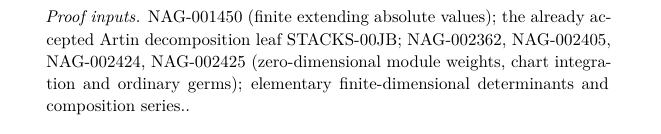
\FNineProofInputs{NAG-001450 (finite extending absolute values);
the already accepted Artin decomposition leaf STACKS-00JB;
NAG-002362, NAG-002405, NAG-002424, NAG-002425 (zero-dimensional
module weights, chart integration and ordinary germs);
elementary finite-dimensional determinants and composition series.}
\begin{proof}
A multiplicative seminorm on $C$ kills its nilpotents. Its kernel
selects one local factor and its maximal ideal, and the induced norm
on the finite field $E_p$ is unique by NAG-001450. These are precisely
the points of $\mathcal M(C)$ with its canonical finite topology. The
idempotent factors are open and closed. On each factor a function
on this finite point set is constant, hence is an ordinary smooth
moment function.

Every invertible $C$-module has a generator: it is free on each
local factor, and the finitely many local generators combine using
the idempotents. If $a\in C^\times$, a composition series of $M_p$
is stable under multiplication by $a$. Each simple quotient is
$E_p$ with multiplication by its residue $a(p)$. A basis respecting
the series gives block triangular matrices and hence
\begin{equation}\label{eq:detabs}
 |\det_K(m_a\mid M)|
   =\prod_p|\operatorname{Nm}_{E_p/K}(a(p))|^{\length_{C_p}M_p}
   =\prod_p|a(p)|^{w_p(M)}.
\end{equation}
For completeness, the last equality does not count separable
embeddings. If $b\in E_p^\times$ has minimal polynomial $f$,
the characteristic polynomial of multiplication by $b$ on $E_p$
is $f^{[E_p:K(b)]}$, by a $K(b)$-basis.
A finite splitting extension for $f$ is obtained by adjoining roots
successively. Each root has the same absolute value as $b$:
the corresponding embedding of $K(b)$ into that finite extension
pulls back an extending absolute value, unique by NAG-001450.
Taking the product of all roots \emph{with their multiplicities}
gives $|\operatorname{Nm}_{E_p/K}b|=|b|^{[E_p:K]}$, including inseparability.

Replacing a generator $e$ by $ae$ multiplies $\mathcal N_M(e)$
by $\det_K(m_a\mid M)$ and multiplies the proposed norm by exactly
its absolute value, by \eqref{eq:detabs}. Thus the prescription
defines a norm on the $K$-line and gives the asserted identity for
$s$. If $M=0$, both determinant lines have their canonical unit
and all sums are zero; the same argument applies.

For restriction of scalars, the $p$-part of $N$ is the direct sum
of the $D$-local parts lying over $p$. Its $K$-dimension is the sum
of theirs. Uniqueness of extending absolute values makes the pulled-back
metric at each such point have exactly the norm of $s(p)$.
Grouping the finite sum proves the projection formula.
A locally free rank-$n$ $D$ over the Artin semilocal $C$ is free
of that rank, by choosing bases on each factor. Hence
$D\otimes_C M\simeq M^n$ as $C$-modules, giving the rank formula.
Subtracting the two log norms proves the variation and its bound.

Finally, compute the frozen integral separately on the clopen
factors. For the empty moment tuple on $C_p$ the rank-zero
tangent lattice has index one, the Gauss field is $K$, and the
full finite algebra is $C_p$. The module weight of NAG-002362
is therefore $\dim_K M_p$. The global-chain construction
\hyperref[fnd:nag002405:global-finite-module-chain-weights]{NAG-002405} supplies this chart and its interior whole-fibre
weight; in dimension zero its boundary image is empty.
Rank-zero polyhedral integration evaluates the constant at the
single point. NAG-002425 identifies that chart sum with the
ordinary compact integral. This gives exactly \eqref{eq:hzero}.
\end{proof}
Typeset reader excerpt
Typed proof inputs
- CLAUSE:NAG-002405:global_finite_module_chain_weights · selected scope (explicit current dependencies)
- NAG-001450 · selected whole (explicit current dependencies)
- NAG-002362 · selected whole (explicit current dependencies)
- NAG-002424 · selected whole (explicit current dependencies)
- NAG-002425 · selected whole (explicit current dependencies)
Proof map
Verified map inputs · NAG-002635
AND · joint registered proof inputs
- CLAUSE:NAG-002405:global_finite_module_chain_weights · global finite module chain weights · selected scope
- NAG-001450 · Finite-dimensional norms and finite field extensions · accepted whole
- NAG-002362 · Weights of finite modules on an interior flat germ · accepted whole
- NAG-002424 · The sheaf of ordinary smooth moment forms · accepted whole
- NAG-002425 · Integration of compactly supported smooth moment forms · accepted whole
NAG-002635 · Finite heights, restriction of scalars, and norms · Chapter argument