NAG-002424 · Accepted whole
The sheaf of ordinary smooth moment forms
5 Tropicalization, multiplicities and balancing
Open in the English reader · PDF page 1045
Statement · exact TeX
\begin{theorem}[The sheaf of ordinary smooth moment forms]
\label{v037:forms:germsheaf}
The relation in Definition~\ref{v037:forms:ordinarysmoothgerm}
is an equivalence relation. The spaces
$\mathcal A_X^{p,q}$ form sheaves on the ordinary topology,
with well-defined wedge product, $J$, $d'$ and $d''$.
These operations satisfy the usual exterior-algebra rules,
\[
          (d')^2=(d'')^2=0,\qquad d'd''+d''d'=0.
\]
Every analytic morphism between good Hausdorff spaces over
the specified field induces a functorial pullback on these
sheaves, commuting with all these operations.

For any affinoid domain $V\subseteq U$, a section on $U$
determines finite moment-chart data on $V$, canonically up
to common refinement and tangential equality. This assignment
commutes with further affinoid restriction and all the
displayed operations. If the section has zero germ at every
point of $V$, the induced finite chart data are zero.
The same assertions hold on a finite union of affinoid
domains contained in $U$.
\end{theorem}
Full selected proof · exact TeX
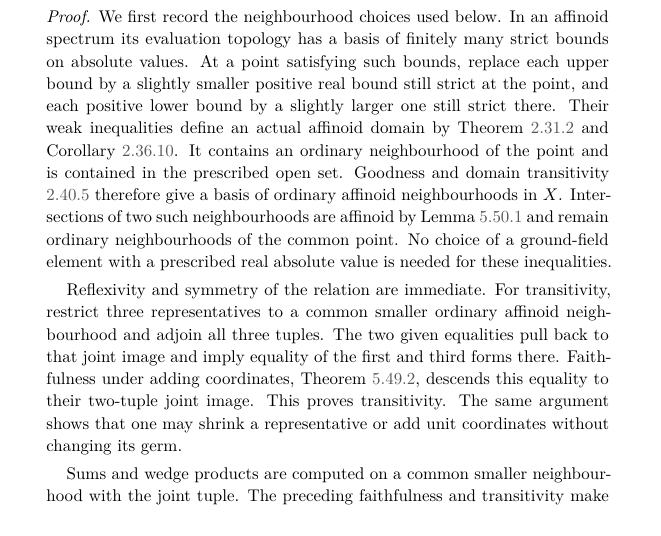
\begin{proof}
We first record the neighbourhood choices used below.
In an affinoid spectrum its evaluation topology has a
basis of finitely many strict bounds on absolute values.
At a point satisfying such bounds, replace each upper
bound by a slightly smaller positive real bound still
strict at the point, and each positive lower bound by
a slightly larger one still strict there. Their weak
inequalities define an actual affinoid domain by
Theorem~\ref{fnd:generalizedrationaluniversal} and
Corollary~\ref{fnd:generalizeddomainintersections}.
It contains an ordinary neighbourhood of the point
and is contained in the prescribed open set. Goodness
and domain transitivity
\ref{fnd:generalnetdomaincalculus} therefore give a
basis of ordinary affinoid neighbourhoods in $X$.
Intersections of two such neighbourhoods are affinoid
by Lemma~\ref{v037:integration:separatedintersections}
and remain ordinary neighbourhoods of the common point.
No choice of a ground-field element with a prescribed
real absolute value is needed for these inequalities.

Reflexivity and symmetry of the relation are immediate.
For transitivity, restrict three representatives to a
common smaller ordinary affinoid neighbourhood and
adjoin all three tuples. The two given equalities pull
back to that joint image and imply equality of the
first and third forms there. Faithfulness under adding
coordinates, Theorem~\ref{v037:integration:globalchartfaithfulness},
descends this equality to their two-tuple joint image.
This proves transitivity. The same argument shows that
one may shrink a representative or add unit coordinates
without changing its germ.

Sums and wedge products are computed on a common smaller
neighbourhood with the joint tuple. The preceding
faithfulness and transitivity make the result independent
of the representatives. Apply $J$, $d'$ and $d''$ to
the ambient forms. Lemma~\ref{v037:forms:finitecoverfaithfulness}
shows that these operations preserve all the germ
relations, so they descend. Their algebraic identities
can be checked on the coefficients and constant
one-form generators of a representative. Equality of
mixed partial derivatives follows from the real calculus
proved in Lemma~\ref{v037:integration:polyhedralcalculus}:
the two iterated fundamental-theorem expressions for a
rectangular second difference are equal; dividing by
the two side lengths and letting them tend to zero
identifies the continuous mixed derivatives. With the
anticommuting one-form generators, the stated differential
identities and the graded product rules follow.

The sheaf axiom is pointwise. Families agreeing on
overlaps give one family of germs, and its local
representatives are the given local representatives.
This proves both existence and uniqueness of gluing.
All the operations commute with restriction, as their
representative constructions do.

Let $h:Y\to X$ be such a morphism and let $y\in Y$.
Choose a representative $(V,f,\alpha)$ at $h(y)$ and
an ordinary affinoid neighbourhood $W$ of $y$ mapping
into $V$. Continuity of $h$ and the affinoid basis
give $W$. The analytic-domain universal property
\ref{fnd:generalnetmorphismgluing} makes the restriction
an actual morphism $W\to V$. Use
$(W,h^*f,\alpha)$ as the pulled-back representative.
Its actual moment image is contained in $t_f(V)$.
Both sets are finite polyhedral by
Theorem~\ref{v037:globaltrop:finiteimage}.
Tangential vanishing restricts to any finite polyhedral
subset: a common subdivision puts each of its cells
inside a cell of the larger set, where restriction
of alternating covectors preserves zero.
Thus an equality on a smaller target germ gives an
equality on a smaller source germ. This proves
well-defined pullback. Composition is checked on the
pulled-back unit functions, and the ambient form is
unchanged in these coordinates. Pullback consequently
commutes with the displayed operations and is functorial.

Now let $V\subseteq U$ be affinoid and let $\alpha$
be a section on $U$. At every point of $V$ choose
a representing neighbourhood $W$ and then an affinoid
neighbourhood $W'$ contained in the ordinary interior
of $W$. The preceding basis construction permits this
choice. Finitely many of the ordinary interiors of
these $W'$ cover the compact set $V$, by
Proposition~\ref{fnd:boundedspectrumcompact}.
The intersections $V\cap W'$ are affinoid domains by
Lemma~\ref{v037:integration:separatedintersections}.
Restrict the chosen tuples and ambient forms to them.

These representatives agree on every entire overlap.
Indeed, each point of an overlap lies in the ordinary
interiors of the two original representing neighbourhoods
$W$, so equality of its germs supplies a smaller ordinary
affinoid neighbourhood on which the joint forms agree.
Finitely many such neighbourhoods cover the compact
overlap by their interiors. Intersect them with the
overlap and apply
Lemma~\ref{v037:forms:finitecoverfaithfulness} to the
fixed joint tuple there. It upgrades the local
equalities to tangential equality on the whole joint
image of the overlap. Thus the restricted representatives
are finite moment-chart data on $V$.

The same argument applied to two choices shows that
they agree on the finite common refinement by all
pairwise intersections. It proves independence and
compatibility with further restriction. The operations
are computed on these same refinements, so commute
with the assignment. If every germ on $V$ is zero,
apply the overlap argument to each presenting chart
and the zero representative. A finite cover suffices
by compactness, and
Lemma~\ref{v037:forms:finitecoverfaithfulness} makes
each entire chart representative tangentially zero.

For a finite union of affinoid domains, perform the
construction on its finitely many members. The same
compact-overlap argument proves compatibility and
independence on their union. This also proves the
zero-germ assertion there. Its analytic-domain structure
is supplied by the finite closed-cover quasi-net in
Lemma~\ref{fnd:quasinetcalculus} and the analytic-domain
definition \ref{fnd:generalnetanalyticdomain}.
\end{proof}
Typeset reader excerpt
Typed proof inputs
- NAG-001496 · selected whole (selected native whole at 700)
- NAG-001577 · selected whole (selected native whole at 700)
- NAG-001609 · selected whole (selected native whole at 700)
- NAG-001612 · selected whole (selected native whole at 700)
- NAG-001620 · selected whole (selected native whole at 700)
- NAG-001847 · selected whole (selected native whole at 700)
- NAG-002358 · selected whole (selected native whole at 700)
- NAG-002389 · selected whole (selected native whole at 700)
- NAG-002406 · selected whole (earlier original in this reviewer packet)
- NAG-002411 · selected whole (selected native whole at 700)
- NAG-002422 · selected whole (earlier original in this reviewer packet)
Reader cross-references
- fnd:boundedspectrumcompact
- fnd:generalizeddomainintersections
- fnd:generalnetanalyticdomain
- fnd:generalnetdomaincalculus
- fnd:generalnetmorphismgluing
- v037:forms:finitecoverfaithfulness
- v037:globaltrop:finiteimage
- v037:integration:globalchartfaithfulness
- v037:integration:polyhedralcalculus
- v037:integration:separatedintersections
Proof map
Verified map inputs · NAG-002424
AND · joint registered proof inputs
- NAG-001496 · Compactness of the bounded spectrum · accepted whole Exact source window 189–229
- NAG-001577 · Bounded and geometric rational factorization · accepted whole Exact source window 109–128
- NAG-001609 · Local calculus of analytic domains · accepted whole Exact source window 109–128
- NAG-001612 · Local extension and gluing of morphisms · accepted whole Exact source window 161–187
- NAG-001620 · Quasi-nets and analytic domains · accepted whole Exact source window 230–234
- NAG-001847 · Intersections and restrictions of affinoid domains · accepted whole Exact source window 109–128
- NAG-002358 · Global polyhedrality and the tropicalized boundary · accepted whole Exact source window 161–187
- NAG-002389 · The real polyhedral integration calculation · accepted whole Exact source window 130–160
- NAG-002406 · Faithfulness after adjoining analytic units · accepted whole Exact source windows 130–160, 161–187
- NAG-002411 · Affinoid intersections in a separated good space · accepted whole Exact source windows 189–229, 109–128
- NAG-002422 · Tangential equality on a finite affinoid cover · accepted whole Exact source windows 189–229, 130–160
NAG-002424 · The sheaf of ordinary smooth moment forms · Chapter argument