NAG-002641 · Accepted whole
Norm and bounded metric variation
I Descent of the polarized mixed tower
Open in the English reader · PDF page 2123
Statement · exact TeX
\begin{proposition}[Norm and bounded metric variation]
\label{f9lh:normvariation}
Assume $X$ is compact, $\dim X=\dim Y=d$ purely, and
$q_*\cO_Y$ is ordinary-locally free of constant rank $n$.
Let $h_0,h'_0$ be continuous metrics on the same line $L_0$,
with $h'_0=e^{-u}h_0$ and $u\in\mathcal B(X)$.
Let $\theta$ be a positive ordinary smooth top form on $X$,
in particular the positive wedge of smooth curvature forms
specified in Section 1. Then
\[
                       (h'_0)^N=e^{-nu}h_0^N
\]
and
\begin{equation}\label{ex68:height:eq:normsquare}
 V_{Y,\cO_Y}(q^*u;q^*\theta)
        =V_{X,\cO_X}(nu;\theta)
        =nV_{X,\cO_X}(u;\theta).
\end{equation}
The absolute value of each expression is at most
$n\|u\|_\infty m_{X,\cO_X}(\theta)$.
For smooth $u$, the equalities hold without the positivity
hypothesis; the stated bound and uniform extension use positivity.
\end{proposition}
Full selected proof · exact TeX
\begin{proof}
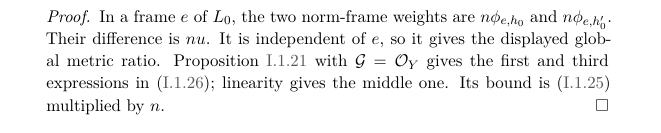
In a frame $e$ of $L_0$, the two norm-frame weights are
$n\phi_{e,h_0}$ and $n\phi_{e,h'_0}$. Their difference is $nu$.
It is independent of $e$, so it gives the displayed global metric
ratio. Proposition~\ref{f9lh:boundedprojection} with
$\mathcal G=\cO_Y$ gives the first and third expressions in
\eqref{ex68:height:eq:normsquare}; linearity gives the middle one.
Its bound is \eqref{ex68:height:eq:bound} multiplied by $n$.
\end{proof}
Typeset reader excerpt
Typed proof inputs
- NAG-002539 · selected whole (explicit current dependencies)
- NAG-002554 · selected whole (explicit current dependencies)
- NAG-002638 · selected whole (explicit current dependencies)
Reader cross-references
Proof map
Verified map inputs · NAG-002641
AND · joint registered proof inputs
- NAG-002539 · Norm projection · accepted whole
- NAG-002554 · Compatibility on the pulled-back metric class · accepted whole
- NAG-002638 · Coherent bounded projection · accepted whole
NAG-002641 · Norm and bounded metric variation · Chapter argument