NAG-002554 · Accepted whole
Compatibility on the pulled-back metric class
I Descent of the polarized mixed tower
Open in the English reader · PDF page 2118
Statement · exact TeX
\begin{theorem}[Compatibility on the pulled-back metric class]
\label{f9nm:metricintersection}
Use the finite locally free analytic map and the metrized line
$\cM$ of Section 1.
\begin{enumerate}
\item The projection-compatible metric on $\Nm_q(q^*\cM)$ is
continuous. If the metric on $\cM$ is ordinary moment-smooth, so is
this metric. In the norm frame corresponding to $e^{\otimes n}$,
its weight is exactly $n\phi_e$.
\item For $s=b\,q^*e$, the determinant section satisfies
\eqref{ex68:norm:eq:section}. Wherever $N(b)$ is an analytic unit,
\begin{equation}\label{ex68:norm:eq:metricpotential}
       -\log\|\Nm_q(s)\|=-\log|N(b)|+n\phi_e.
\end{equation}
In the smooth case this is an ordinary smooth moment function on
that locus. The line, section, metric and this formula commute with
analytic base change between good Hausdorff spaces, with the full
finite inverse image and its actual norm retained.
\item Fix $x\in U$ such that the ordinary local ring
$A=\cO_{X,x}$ is a DVR. Write $k=\kappa(x)$ for its ordinary residue
field. Suppose the coefficient germ $b_y\in\cO_{Y,y}$ is a
non-zero-divisor for every $y\in q^{-1}(x)$. Then the local
Cartier multiplicity of the determinant section is
\begin{equation}\label{ex68:norm:eq:analyticlength}
 \ord_x\Nm_q(s)
 =\sum_{y\in q^{-1}(x)}
    [\kappa(y):\kappa(x)]\,
       \length_{\cO_{Y,y}}(\cO_{Y,y}/b_y\cO_{Y,y}).
\end{equation}
The field degrees here are those of the ordinary local residue
fields, not a count of analytic points or embeddings. The lengths
include every nilpotent layer. This local multiplicity is independent
of the chosen metric and frame.
\end{enumerate}
The section $s$ need not be the pullback of a downstairs section.
The DVR and non-zero-divisor hypotheses in part (3) are additional;
they are not assertions about all analytic points or arbitrary base
changes.
\end{theorem}
Full selected proof · exact TeX
\begin{proof}
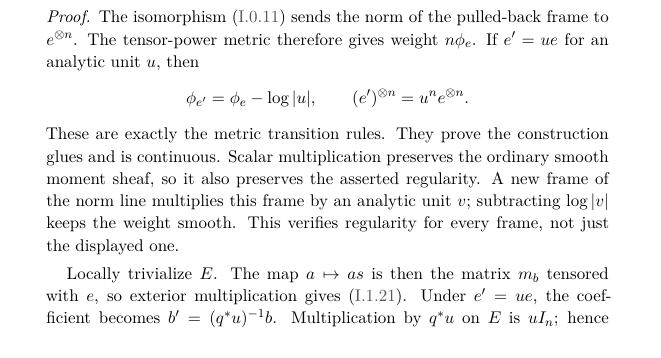
The isomorphism \eqref{eq:ex68:f9ds:norm-projection} sends the norm of the pulled-back
frame to $e^{\otimes n}$. The tensor-power metric therefore gives
weight $n\phi_e$. If $e'=u e$ for an analytic unit $u$, then
\[
 \phi_{e'}=\phi_e-\log|u|,\qquad
                (e')^{\otimes n}=u^n e^{\otimes n}.
\]
These are exactly the metric transition rules. They prove the
construction glues and is continuous. Scalar multiplication preserves
the ordinary smooth moment sheaf, so it also preserves the asserted
regularity. A new frame of the norm line multiplies this frame by
an analytic unit $v$; subtracting $\log|v|$ keeps the weight smooth.
This verifies regularity for every frame, not just the displayed one.

Locally trivialize $E$. The map $a\mapsto as$ is then the matrix
$m_b$ tensored with $e$, so exterior multiplication gives
\eqref{ex68:norm:eq:section}. Under $e'=ue$, the coefficient becomes
$b'=(q^*u)^{-1}b$. Multiplication by $q^*u$ on $E$ is $uI_n$;
hence $N(b')=u^{-n}N(b)$. The displayed determinant section and
\eqref{ex68:norm:eq:metricpotential} are therefore independent of $e$.
For example, the two changes in the right side are
$+n\log|u|$ and $-n\log|u|$, which cancel.
Where $N(b)$ is a unit, its negative logarithm is the one-coordinate
linear moment representative $t\mapsto t$ for that unit. The
frozen sheaf theorem consequently proves the last regularity claim.

Finite coherent direct image commutes with analytic base change by
\texttt{NAG-001752}. On an affinoid base change, the new finite
algebra is the full ordinary tensor with its canonical complete
finite-module norm, not its reduction. The matrix of multiplication
and its determinant are the base changes of the old matrix and
determinant. The reviewed projection isomorphism has the same
compatibility. Pullback of metric weights is composition on points,
and ordinary smooth pullback is provided by \texttt{NAG-002424}.
Thus both constructions have weight $n$ times the pulled-back
$\phi_e$, proving the claimed isometry and section compatibility.
No claim that DVR orders are unchanged by base change is made.

For the local identity, frozen \texttt{NAG-001735} gives the actual
ordinary-stalk decomposition
\[
 B=(q_*\cO_Y)_x\simeq
                  \prod_{y\in q^{-1}(x)}\cO_{Y,y}.
\]
The module $B$ is free of rank $n$ over $A$ by hypothesis. Each
factor is finite over $A$, and the decomposition includes the whole
fibre. The assumptions on $b_y$ say precisely that multiplication
by $b$ is injective on this product. Lemma~\ref{f9nm:dvrlength}
therefore applies. The germ of $N(b)$ is its determinant, and
$\length_A A/(N(b))=\ord_A N(b)$ is the local Cartier multiplicity
at the DVR. The Artinian factors in the lemma are exactly the
nonzero quotients of the displayed local-ring factors. This proves
\eqref{ex68:norm:eq:analyticlength} with the stated residue fields. Changing
the frame multiplies $N(b)$ by a unit, whose order is zero. The
metric enters only the regular term $n\phi_e$ in
\eqref{ex68:norm:eq:metricpotential}, not the determinant or any quotient ring.
\end{proof}
Typeset reader excerpt
Typed proof inputs
- NAG-001735 · selected whole (explicit current dependencies)
- NAG-001752 · selected whole (explicit current dependencies)
- NAG-002424 · selected whole (explicit current dependencies)
- NAG-002537 · selected whole (explicit current dependencies)
- NAG-002539 · selected whole (explicit current dependencies)
- NAG-002552 · selected whole (explicit current dependencies)
Reader cross-references
Proof map
Verified map inputs · NAG-002554
AND · joint registered proof inputs
- NAG-001735 · Separating the branches of a finite morphism · accepted whole
- NAG-001752 · Coherent direct image under a finite morphism · accepted whole
- NAG-002424 · The sheaf of ordinary smooth moment forms · accepted whole
- NAG-002537 · Rank of the finite direct image · accepted whole
- NAG-002539 · Norm projection · accepted whole
- NAG-002552 · A finite algebra over a DVR · accepted whole
NAG-002554 · Compatibility on the pulled-back metric class · Chapter argument