NAG-002648 · Accepted whole
Residual identity suffices in the nondiscrete class
Proper direct image on historical ordinary compact tests
Open in the English reader · PDF page 1893
Statement · exact TeX
\begin{theorem}[Residual identity suffices in the nondiscrete class]
\label{cand:f5res:residualidentity}
Assume (K) and the stated flatness and semilinear action on \(B'\).
If the additive quotient \(C=B'/O'[(B')^G]\) is a finitely
generated \(S=O'[(B')^G]\)-module, then the following are equivalent:
\begin{enumerate}
\item \(G\) acts identically on the full special-fibre algebra
      \(B'/\mathfrak m'B'\);
\item the given semilinear algebra has effective descent over \(O\);
\item the multiplication map (5) is an isomorphism;
\item for every \(0\leq i<e\),
\[
  s^{-i}\{b\in B':\sigma(b)=\zeta^i b\}
                =I_i(B')^G
       \quad\hbox{inside }K\otimes_O(B')^G .
 \tag{6}
\]
\end{enumerate}
The finiteness assumption on \(C\) holds whenever \(B'\) is of
finite type over \(O'\). In particular, the equivalence applies
to every flat finitely presented nodal affine chart in (K).
For such a chart the invariant algebra \(B\) is flat, finitely
presented and nodal over \(O\), and (5) gives its effective
descent with the prescribed action.
No split-branch, diagonal-coordinate, or discrete-value-group
hypothesis is added.
\end{theorem}
Full selected proof · exact TeX
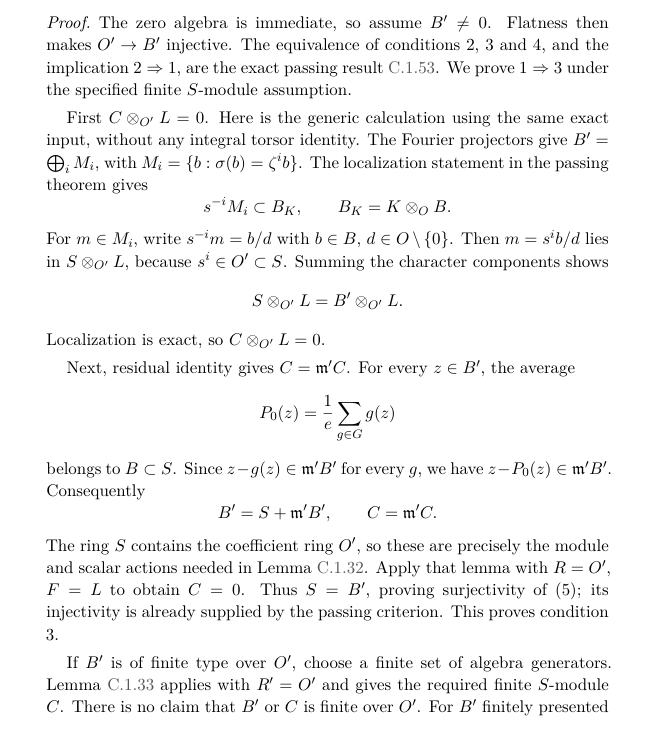
\begin{proof}
The zero algebra is immediate, so assume \(B'\ne0\).
Flatness then makes \(O'\to B'\) injective.
The equivalence of conditions 2, 3 and 4, and the implication
\(2\Rightarrow1\), are the exact passing result
\dep{cand:f5tame:charactercriterion}. We prove \(1\Rightarrow3\)
under the specified finite \(S\)-module assumption.

First \(C\otimes_{O'}L=0\). Here is the generic calculation using
the same exact input, without any integral torsor identity.
The Fourier projectors give
\(B'=\bigoplus_i M_i\), with
\(M_i=\{b:\sigma(b)=\zeta^i b\}\).
The localization statement in the passing theorem gives
\[
                 s^{-i}M_i\subset B_K,\qquad
                 B_K=K\otimes_O B .
\]
For \(m\in M_i\), write \(s^{-i}m=b/d\) with
\(b\in B\), \(d\in O\setminus\{0\}\). Then
\(m=s^i b/d\) lies in \(S\otimes_{O'}L\), because
\(s^i\in O'\subset S\). Summing the character components shows
\[
                   S\otimes_{O'}L=B'\otimes_{O'}L .
\]
Localization is exact, so \(C\otimes_{O'}L=0\).

Next, residual identity gives \(C=\mathfrak m'C\).
For every \(z\in B'\), the average
\[
                  P_0(z)=\frac1e\sum_{g\in G}g(z)
\]
belongs to \(B\subset S\). Since \(z-g(z)\in\mathfrak m'B'\)
for every \(g\), we have
\(z-P_0(z)\in\mathfrak m'B'\). Consequently
\[
                  B'=S+\mathfrak m'B',
                  \qquad C=\mathfrak m'C .
\]
The ring \(S\) contains the coefficient ring \(O'\), so these
are precisely the module and scalar actions needed in
Lemma~\ref{cand:f5res:finiteverticalmodule}.
Apply that lemma with \(R=O'\), \(F=L\) to obtain \(C=0\).
Thus \(S=B'\), proving surjectivity of (5); its injectivity
is already supplied by the passing criterion. This proves
condition 3.

If \(B'\) is of finite type over \(O'\), choose a finite set of
algebra generators. Lemma~\ref{cand:f5res:finitedefect} applies
with \(R'=O'\) and gives the required finite \(S\)-module \(C\).
There is no claim that \(B'\) or \(C\) is finite over \(O'\).
For \(B'\) finitely presented and nodal, the flatness, finite
presentation and nodality of \(B\) follow from the persistence
part of \dep{cand:f5tame:charactercriterion}, now that the actual
base-change map is an isomorphism.
\end{proof}
Typeset reader excerpt
Typed proof inputs
- NAG-002610 · selected whole (selected native whole)
- NAG-002646 · selected whole (selected native whole)
- NAG-002647 · selected whole (selected native whole)
Reader cross-references
Proof map
Verified map inputs · NAG-002648
AND · joint registered proof inputs
- NAG-002610 · Character modules give an exact integral test · accepted whole Exact source windows 73–97, 123–126
- Use the selected full Kummer class to obtain the existing implications, injectivity, character localization and generic vanishing of the additive defect. No integral torsor identity.
- Use the persistence part only after the multiplication isomorphism, for the actual flat finitely presented nodal chart.
- NAG-002646 · A finite vertical module with zero closed fibre vanishes · accepted whole Exact source window 99–117
- The actual finite defect is an S-module, zero generically, and equal to m' times itself by the averaging of residual differences. Apply finite vertical vanishing over the rank-one valuation ring to this exact S-module.
- NAG-002647 · Finite type makes the additive descent defect finite · accepted whole Exact source window 119–122
- A finite type algebra gives a finite additive defect over its coefficient-generated invariant subalgebra. Neither algebra nor defect is required finite over O'.
NAG-002648 · Residual identity suffices in the nondiscrete class · Chapter argument