NAG-002682 · Accepted whole
Affine overlaps descend as open immersions
Proper direct image on historical ordinary compact tests
Open in the English reader · PDF page 1896
Statement · exact TeX
\begin{proposition}[Affine overlaps descend as open immersions]
\label{cand:f5glue:overlaps}
Let \(Y'\) be separated, flat and locally of finite presentation
over \(O'\), with a semilinear \(G\)-action which is the identity
on \(Y'_k\). Let \(U'_1,\ldots,U'_r\) be invariant affine
opens. For every nonempty subset \(I\subset\{1,\ldots,r\}\), set
\[
 U'_I=\bigcap_{i\in I}U'_i,\qquad
 A'_I=\Gamma(U'_I,\mathcal O_{Y'}),\qquad
 A_I=(A'_I)^G,\qquad U_I=\operatorname{Spec}A_I.
 \tag{3}
\]
Empty intersections are allowed as schemes, with coordinate
ring zero. Then:
\begin{enumerate}
\item \(U_I\) is flat and finitely presented over \(O\), and
multiplication identifies \((U_I)_{O'}\) equivariantly with \(U'_I\).
If \(Y'\) is nodal of relative dimension one, then \(U_I/O\)
is nodal of relative dimension one.
\item If \(I\subset J\), restriction defines an open immersion
\(j_{J,I}:U_J\hookrightarrow U_I\). Its base change is exactly
the given inclusion \(U'_J\hookrightarrow U'_I\).
\item If \(\varnothing\ne H\subset I\cap J\), the canonical
map is an isomorphism
\[
       A_I\otimes_{A_H}A_J \xrightarrow{\ \sim\ } A_{I\cup J}.
 \tag{4}
\]
These identifications respect every further restriction.
Thus pairwise and triple intersections downstairs are the
descents of the corresponding actual intersections upstairs.
\end{enumerate}
\end{proposition}
Full selected proof · exact TeX
\begin{proof}
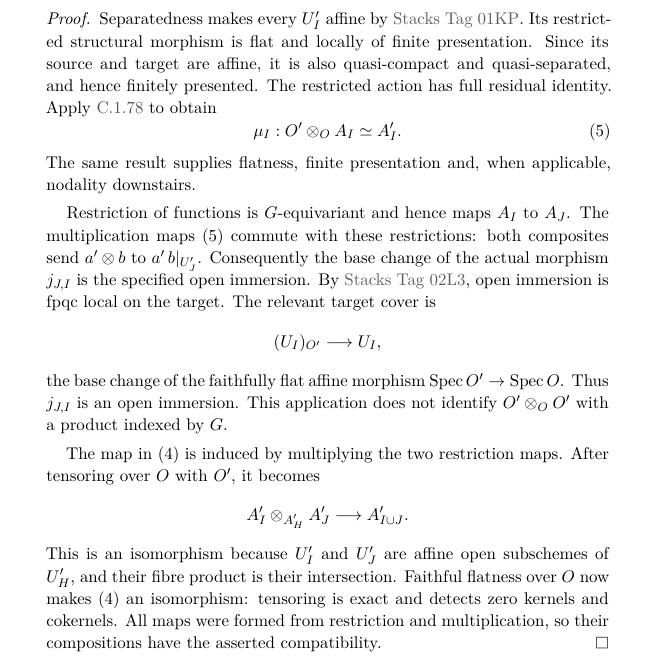
Separatedness makes every \(U'_I\) affine by \stacks{01KP}.
Its restricted structural morphism is flat and locally of
finite presentation. Since its source and target are affine,
it is also quasi-compact and quasi-separated, and hence
finitely presented. The restricted action has full residual
identity.
Apply \dep{cand:f5res:residualidentity} to obtain
\[
                         \mu_I:O'\otimes_O A_I\simeq A'_I.
 \tag{5}
\]
The same result supplies flatness, finite presentation and,
when applicable, nodality downstairs.

Restriction of functions is \(G\)-equivariant and hence maps
\(A_I\) to \(A_J\). The multiplication maps (5) commute with
these restrictions: both composites send \(a'\otimes b\) to
\(a'\,b|_{U'_J}\). Consequently the base change of the actual
morphism \(j_{J,I}\) is the specified open immersion.
By \stacks{02L3}, open immersion is fpqc local on the target.
The relevant target cover is
\[
                 (U_I)_{O'}\longrightarrow U_I,
\]
the base change of the faithfully flat affine morphism
\(\operatorname{Spec}O'\to\operatorname{Spec}O\).
Thus \(j_{J,I}\) is an open immersion. This application does
not identify \(O'\otimes_O O'\) with a product indexed by \(G\).

The map in (4) is induced by multiplying the two restriction
maps. After tensoring over \(O\) with \(O'\), it becomes
\[
            A'_I\otimes_{A'_H}A'_J\longrightarrow A'_{I\cup J}.
\]
This is an isomorphism because \(U'_I\) and \(U'_J\) are affine
open subschemes of \(U'_H\), and their fibre product is their
intersection. Faithful flatness over \(O\) now makes (4) an
isomorphism: tensoring is exact and detects zero kernels
and cokernels. All maps were formed from restriction and
multiplication, so their compositions have the asserted
compatibility.
\end{proof}
Typeset reader excerpt
Typed proof inputs
- NAG-002610 · selected whole (selected native whole)
- NAG-002648 · selected whole (earlier unchanged whole in this batch)
Reader cross-references
Proof map
Verified map inputs · NAG-002682
AND · joint registered proof inputs
- NAG-002610 · Character modules give an exact integral test · accepted whole Exact source window 128–143
- Use the actual faithfully flat affine coefficient morphism and the full special-fibre action over the common residue field.
- NAG-002648 · Residual identity suffices in the nondiscrete class · accepted whole Exact source window 254–263
- The actual intersection is affine, flat and finitely presented over O' with full residual identity. Apply its multiplication isomorphism and persistence for nodal overlaps.
NAG-002682 · Affine overlaps descend as open immersions · Chapter argument