NAG-002683 · Accepted whole
Effective descent of a supplied separated nodal curve
Proper direct image on historical ordinary compact tests
Open in the English reader · PDF page 1898
Statement · exact TeX
\begin{theorem}[Effective descent of a supplied separated nodal curve]
\label{cand:f5glue:globaldescent}
Assume (K). Let \(Y'\to\operatorname{Spec}O'\) be a separated,
flat, finitely presented scheme which is at-worst-nodal of
relative dimension one, equipped with a semilinear \(G\)-action.
The following are equivalent:
\begin{enumerate}
\item \(G\) acts identically on the entire special fibre \(Y'_k\).
\item There is a separated, flat, finitely presented nodal
\(O\)-scheme \(Y\) of relative dimension one and a
\(G\)-equivariant isomorphism
\[
                              Y\times_O O'\simeq Y'.
 \tag{6}
\]
\end{enumerate}
The descent with identification (6) is unique up to a unique
isomorphism compatible with that identification.
It is obtained from the invariant coordinate rings of a
finite invariant affine cover, with the invariant overlap
rings in (3). If \(Y'\) is proper over \(O'\), then \(Y\)
is proper over \(O\).
\end{theorem}
Full selected proof · exact TeX
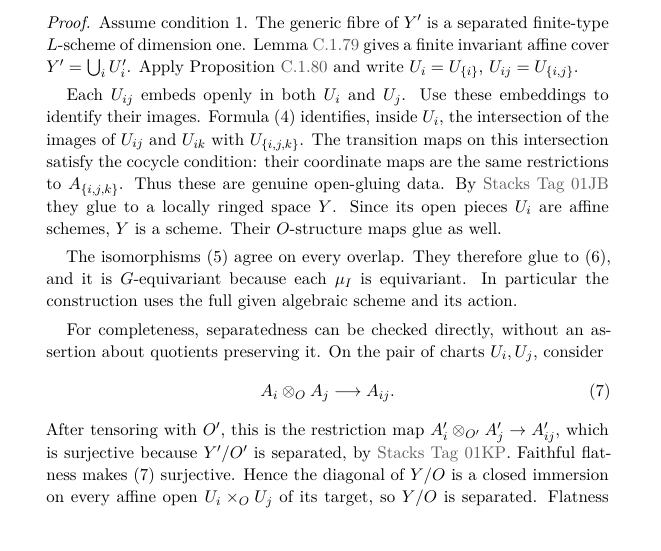
\begin{proof}
Assume condition 1. The generic fibre of \(Y'\) is a
separated finite-type \(L\)-scheme of dimension one.
Lemma~\ref{cand:f5glue:invariantaffines} gives a finite invariant
affine cover \(Y'=\bigcup_iU'_i\). Apply
Proposition~\ref{cand:f5glue:overlaps} and write
\(U_i=U_{\{i\}}\), \(U_{ij}=U_{\{i,j\}}\).

Each \(U_{ij}\) embeds openly in both \(U_i\) and \(U_j\).
Use these embeddings to identify their images. Formula (4)
identifies, inside \(U_i\), the intersection of the images of
\(U_{ij}\) and \(U_{ik}\) with \(U_{\{i,j,k\}}\).
The transition maps on this intersection satisfy the cocycle
condition: their coordinate maps are the same restrictions
to \(A_{\{i,j,k\}}\). Thus these are genuine open-gluing data.
By \stacks{01JB} they glue to a locally ringed space \(Y\).
Since its open pieces \(U_i\) are affine schemes, \(Y\) is
a scheme. Their \(O\)-structure maps glue as well.

The isomorphisms (5) agree on every overlap. They therefore
glue to (6), and it is \(G\)-equivariant because each \(\mu_I\)
is equivariant. In particular the construction uses the full
given algebraic scheme and its action.

For completeness, separatedness can be checked directly,
without an assertion about quotients preserving it.
On the pair of charts \(U_i,U_j\), consider
\[
                         A_i\otimes_O A_j\longrightarrow A_{ij}.
 \tag{7}
\]
After tensoring with \(O'\), this is the restriction map
\(A'_i\otimes_{O'}A'_j\to A'_{ij}\), which is surjective because
\(Y'/O'\) is separated, by \stacks{01KP}.
Faithful flatness makes (7) surjective. Hence the diagonal
of \(Y/O\) is a closed immersion on every affine open
\(U_i\times_O U_j\) of its target, so \(Y/O\) is separated.
Flatness and the nodal relative-dimension-one property hold
on the charts by Proposition~\ref{cand:f5glue:overlaps}.
Each chart is finitely presented over \(O\); the finite cover
makes \(Y\) quasi-compact, and separatedness makes it
quasi-separated. Thus \(Y/O\) is finitely presented.

The construction is independent of the invariant affine cover.
For two such covers, their pairwise intersections give a common
invariant affine refinement. Proposition~\ref{cand:f5glue:overlaps}
identifies its invariant rings and open embeddings on both
sides. The resulting opens cover each descended chart:
they do so after base change, and that base change is
surjective. They therefore produce a canonical isomorphism
between the gluings.
For any other effective descent \(Z/O\) with a specified
equivariant identification \(Z_{O'}\simeq Y'\), pull back an
affine cover of \(Z\). These are invariant affine opens of
\(Y'\). Their invariant rings recover the original coordinate
rings of \(Z\): this is the weight-zero recovery in
\dep{cand:f5tame:charactercriterion} for an effective
presentation. The same common-refinement argument identifies
\(Z\) with \(Y\), compatibly with (6). Uniqueness follows
because equality of maps can be checked after a faithfully
flat base change, the faithful part of \stacks{02W0}.
Here only faithfulness is used; a semilinear action has not
been presumed to be an integral fpqc descent datum.

If \(Y'\) is proper, (6) and \stacks{02L1} imply that \(Y/O\)
is proper. Conversely, any effective presentation (6) has
special fibre \(Y\times_O k\). The action on this scheme is
the identity because the coefficient action on \(k\) is
trivial. This proves condition 1.
\end{proof}
Typeset reader excerpt
Typed proof inputs
- NAG-002610 · selected whole (selected native whole)
- NAG-002681 · selected whole (earlier unchanged whole in this batch)
- NAG-002682 · selected whole (earlier unchanged whole in this batch)
Reader cross-references
Proof map
Verified map inputs · NAG-002683
AND · joint registered proof inputs
- NAG-002610 · Character modules give an exact integral test · accepted whole Exact source window 373–378
- Recover the affine coordinate rings of any competing effective descent using weight zero of the actual coefficient action.
- NAG-002681 · Fixed special points and generic finite orbits · accepted whole Exact source window 321–325
- Full residual scheme identity fixes points; apply to the quasi-compact given scheme with separated finite-type one-dimensional generic fibre.
- NAG-002682 · Affine overlaps descend as open immersions · accepted whole Exact source windows 325–340, 357–368
- Use the actual invariant affine rings and overlap isomorphisms, including triple intersections from (4). They carry the original restrictions.
- Use the actual flat finitely presented nodal charts, same property on overlap refinements, and chartwise faithful flat covering.
NAG-002683 · Effective descent of a supplied separated nodal curve · Chapter argument