NAG-002703 · Accepted whole
Compact ambient separation and completion over a source
Proper direct image on historical ordinary compact tests
Open in the English reader · PDF page 1947
Statement · exact TeX
\begin{theorem}[Compact ambient separation and completion over a source]
\label{gci:ambientcompletion}
Let \(Y=\mathcal M(A)\) be a generalized affinoid.
Let \(U,V\subset Y\) be affinoid domains, and let
\(g_i\in(A^\times)^{m_i}\), \(1\leq i\leq r<\infty\), be
actual unit tuples. Put \(q_i=t_{g_i}\), choose
\(s_i\in q_i(Y)\), and define
\[
 K_i=q_i^{-1}(s_i),\qquad
 G=\operatorname{Int}(Y/K)\cap
       \operatorname{Int}_{\rm top}(U,Y)\cap
       \operatorname{Int}_{\rm top}(V,Y),\qquad B=Y\setminus G.
 \tag{1}\label{gci:badset}
\]
The following are equivalent.
\begin{enumerate}
\item For every \(i\), \(s_i\notin q_i(B)\), or equivalently
      the \emph{entire} \(K_i\) is contained in \(G\).
\item There are full-dimensional closed rectangular boxes \(P_i\),
      with \(s_i\in\operatorname{int}(P_i)\), such that
\[
 C_i=q_i^{-1}(P_i)\subset U\cap V,\qquad
                  g_i:C_i\longrightarrow\mathbb T_{P_i}
                         \quad\hbox{is norm-admissible finite}.
 \tag{2}\label{gci:ambientcollars}
\]
      The inverse image defining \(C_i\) is taken in all of \(Y\).
\item Every \(K_i\) is contained in
      \(\operatorname{Int}_{\rm top}(U,Y)\cap
       \operatorname{Int}_{\rm top}(V,Y)\), and the analytic map
      \(g_i:Y\to(\mathbb G_m^{m_i})^{\rm an}\) is finite at
      \emph{every point of \(K_i\)} in the ordinary-neighbourhood
      sense.
\end{enumerate}
When these conditions hold, the \(P_i\) may be chosen inside any
prescribed real neighbourhoods of their centres, and one may
require \(C_i\subset G\). In particular,
\[
 (q_i|_U)^{-1}(P_i)=(q_i|_V)^{-1}(P_i)=q_i^{-1}(P_i)
 \tag{3}\label{gci:sourceequality}
\]
as actual analytic domains. Over every analytic target point
of \(\mathbb T_{P_i}\), these identities retain the entire
analytic fibres in \(Y,U,V\), including all local factors.
Compatible finite modules on \(U\) and \(V\) give the same
complete module on these fibres.

There is a separate criterion when \(Y\) is only a domain in
a larger intended source. More generally, let \(\Omega\) be a
good Hausdorff analytic space, let \(Z\subset\Omega\) be an
affinoid domain, and suppose that actual unit tuples on
\(\Omega\) restrict to norm-admissible finite saturated collars
over boxes \(P_i^0\) in \(Z\), with
\(s_i\in\operatorname{int}(P_i^0)\).
There exist smaller such boxes \(P_i\subset P_i^0\) with
\[
       q_i^{-1}(P_i)\ \hbox{in }\Omega
          =(q_i|_Z)^{-1}(P_i)
 \tag{4}\label{gci:intendedsource}
\]
if and only if
\[
              s_i\notin
              \overline{q_i(\Omega\setminus Z)}
                       \quad\hbox{for every }i.
 \tag{5}\label{gci:escape}
\]
The closure is taken in \(\mathbb R^{m_i}\).
The equality in (4) is again an equality of analytic domains
and entire fibre algebras, not just of selected Gauss lifts.
\end{theorem}
Full selected proof · exact TeX
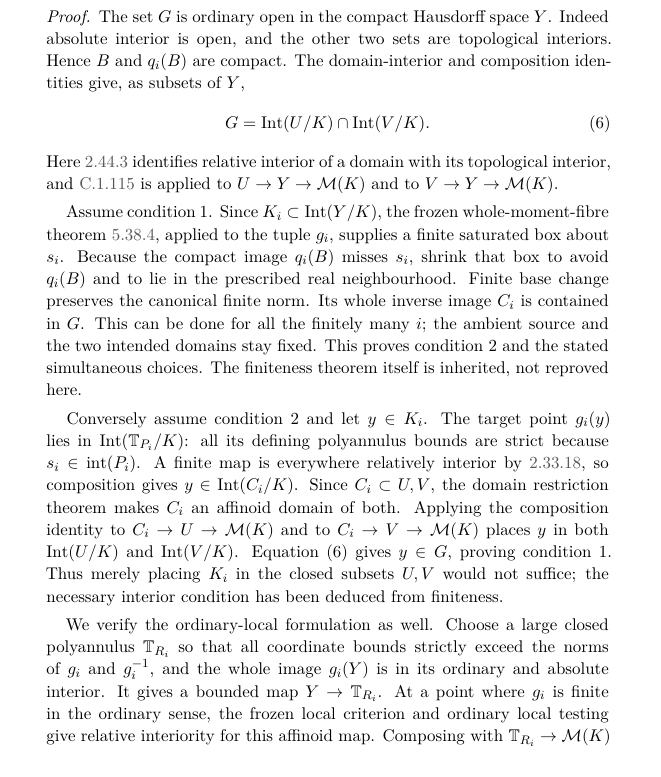
\begin{proof}
The set \(G\) is ordinary open in the compact Hausdorff space
\(Y\). Indeed absolute interior is open, and the other two
sets are topological interiors. Hence \(B\) and \(q_i(B)\)
are compact. The domain-interior and composition identities
give, as subsets of \(Y\),
\[
 G=\operatorname{Int}(U/K)\cap\operatorname{Int}(V/K).
 \tag{6}\label{gci:inneridentity}
\]
Here \Dep{fnd:affinoiddomainordinaryinterior} identifies
relative interior of a domain with its topological interior,
and \Dep{fnd:affinoidinteriorcompositionequality} is applied
to \(U\to Y\to\mathcal M(K)\) and to \(V\to Y\to\mathcal M(K)\).

Assume condition 1. Since \(K_i\subset\operatorname{Int}(Y/K)\),
the frozen whole-moment-fibre theorem
\Dep{v037:analytic:wholemomentcollar}, applied to the tuple
\(g_i\), supplies a finite saturated box about \(s_i\).
Because the compact image \(q_i(B)\) misses \(s_i\), shrink
that box to avoid \(q_i(B)\) and to lie in the prescribed real
neighbourhood. Finite base change preserves the canonical
finite norm. Its whole inverse image \(C_i\) is contained in
\(G\). This can be done for all the finitely many \(i\);
the ambient source and the two intended domains stay fixed.
This proves condition 2 and the stated simultaneous choices.
The finiteness theorem itself is inherited, not reproved here.

Conversely assume condition 2 and let \(y\in K_i\).
The target point \(g_i(y)\) lies in
\(\operatorname{Int}(\mathbb T_{P_i}/K)\): all its defining
polyannulus bounds are strict because
\(s_i\in\operatorname{int}(P_i)\).
A finite map is everywhere relatively interior by
\Dep{fnd:generalizedfinitealgebras}, so composition gives
\(y\in\operatorname{Int}(C_i/K)\).
Since \(C_i\subset U,V\), the domain restriction theorem makes
\(C_i\) an affinoid domain of both. Applying the composition
identity to \(C_i\to U\to\mathcal M(K)\) and to
\(C_i\to V\to\mathcal M(K)\) places \(y\) in both
\(\operatorname{Int}(U/K)\) and \(\operatorname{Int}(V/K)\).
Equation (6) gives \(y\in G\), proving condition 1.
Thus merely placing \(K_i\) in the closed subsets \(U,V\)
would not suffice; the necessary interior condition has been
deduced from finiteness.

We verify the ordinary-local formulation as well.
Choose a large closed polyannulus \(\mathbb T_{R_i}\) so that
all coordinate bounds strictly exceed the norms of \(g_i\)
and \(g_i^{-1}\), and the whole image \(g_i(Y)\) is in its
ordinary and absolute interior. It gives a bounded map
\(Y\to\mathbb T_{R_i}\).
At a point where \(g_i\) is finite in the ordinary sense,
the frozen local criterion and ordinary local testing give
relative interiority for this affinoid map.
Composing with \(\mathbb T_{R_i}\to\mathcal M(K)\) gives
absolute interiority in \(Y\). Thus condition 3 implies 1.
Under condition 2 the whole analytic fibre over any point
with moment \(s_i\) is a fibre of the finite map \(C_i\to
\mathbb T_{P_i}\), and is therefore finite and discrete.
In particular every point of \(K_i\) is isolated in its
analytic fibre in \(Y\). The already proved condition 1
gives absolute interiority, hence relative interiority over
\(\mathbb T_{R_i}\). The frozen local finite criterion gives
ordinary local finiteness at every such point.
This proves condition 3. No flatness hypothesis was used.

The set equalities (3) follow from \(C_i\subset U\cap V\)
and saturation in \(Y\).
The actual domain universal property and domain base change
identify their analytic structures. Further base change to
any analytic target point identifies the entire fibre
algebras. For the module assertion, fix an actual isomorphism
between the restrictions of the two finite modules to
\(U\cap V\). Restrict it to \(C_i\), then to the fibre.
Finite-module tensor comparison makes these the complete
canonical modules, and every such finite-module isomorphism
is bounded with bounded inverse.
Nothing in these operations takes a reduction or discards a
field or local Artinian factor.

Finally consider \(\Omega\) and \(Z\).
If (5) holds, choose \(P_i\subset\operatorname{int}(P_i^0)\)
about \(s_i\) disjoint from
\(\overline{q_i(\Omega\setminus Z)}\).
Every inverse-image point then belongs to \(Z\), proving (4).
The resulting map is finite by restriction of the given
finite collar in \(Z\).
Conversely, (4) implies
\(P_i\cap q_i(\Omega\setminus Z)=\varnothing\).
The open set \(\operatorname{int}(P_i)\) contains \(s_i\)
and is disjoint from that image, so \(s_i\) is outside its
closure. Domain base change gives the analytic assertion as
before. No compactness of \(\Omega\setminus Z\) was assumed;
this is exactly why the closure in (5) is retained.
\end{proof}
Typeset reader excerpt
Typed proof inputs
- CLAUSE:NAG-001626:source_factor_interior_for_actual_affinoid_maps · selected scope (selected native clause)
- NAG-001496 · selected whole (selected native whole)
- NAG-001554 · selected whole (selected native whole)
- NAG-001565 · selected whole (selected native whole)
- NAG-001615 · selected whole (selected native whole)
- NAG-001628 · selected whole (selected native whole)
- NAG-001631 · selected whole (selected native whole)
- NAG-001692 · selected whole (selected native whole)
- NAG-001701 · selected whole (selected native whole)
- NAG-001702 · selected whole (selected native whole)
- NAG-001704 · selected whole (selected native whole)
- NAG-001735 · selected whole (selected native whole)
- NAG-001876 · selected whole (selected native whole)
- NAG-002351 · selected whole (selected native whole)
Proof map
Verified map inputs · NAG-002703
AND · joint registered proof inputs
- CLAUSE:NAG-001626:source_factor_interior_for_actual_affinoid_maps · source factor interior for actual affinoid maps · selected scope Exact source window 157–252
- Exact original proof scope in the signed mainline dependency graph.
- NAG-001496 · Compactness of the bounded spectrum · accepted whole Exact source window 157–252
- Exact original proof scope in the signed mainline dependency graph.
- NAG-001554 · Closed presentations after adjoining coefficients · accepted whole Exact source window 157–252
- Exact original proof scope in the signed mainline dependency graph.
- NAG-001565 · Finite tensors with generalized affinoid targets · accepted whole Exact source window 157–252
- Exact original proof scope in the signed mainline dependency graph.
- NAG-001615 · Fibre products of analytic spaces · accepted whole Exact source window 157–252
- Exact original proof scope in the signed mainline dependency graph.
- NAG-001628 · Interior of an affinoid domain · accepted whole Exact source window 157–252
- Exact original proof scope in the signed mainline dependency graph.
- NAG-001631 · Ordinary local testing for good spaces · accepted whole Exact source window 157–252
- Exact original proof scope in the signed mainline dependency graph.
- NAG-001692 · Affinoid fibres at all Berkovich points · accepted whole Exact source window 157–252
- Exact original proof scope in the signed mainline dependency graph.
- NAG-001701 · Finite algebras with their canonical norm · accepted whole Exact source window 157–252
- Exact original proof scope in the signed mainline dependency graph.
- NAG-001702 · General finite base change · accepted whole Exact source window 157–252
- Exact original proof scope in the signed mainline dependency graph.
- NAG-001704 · Presentation calculus for relative interior · accepted whole Exact source window 157–252
- Exact original proof scope in the signed mainline dependency graph.
- NAG-001735 · Separating the branches of a finite morphism · accepted whole Exact source window 157–252
- Exact original proof scope in the signed mainline dependency graph.
- NAG-001876 · The local finite criterion · accepted whole Exact source window 157–252
- Exact original proof scope in the signed mainline dependency graph.
- NAG-002351 · A finite analytic image around a whole moment fibre · accepted whole Exact source window 157–252
- Exact original proof scope in the signed mainline dependency graph.
NAG-002703 · Compact ambient separation and completion over a source · Chapter argument