NAG-002744 · Accepted whole
Local cancellation forces rank drop
G Stable inertia and original-field models
Open in the English reader · PDF page 2040
Statement and full selected proof · exact TeX
\begin{lemma}[Local cancellation forces rank drop]
\label{f9fm:gausssupport}
The map $\rho$ extends continuously to a section
$\bar\rho:\overline{\mathbf R}^{,d}\to X^\an$ of $\bar t$.
Its image $\bar\Gamma$ is closed, and $\Gamma=\bar\Gamma\cap T^\an$.
For every $x\in T^\an\setminus\Gamma$ there is an ordinary open
neighbourhood $U_x\subset T^\an$ and a finite union $H_x$ of proper
integral-normal affine hyperplanes in $\mathbf R^d$ such that
\[
                         t(U_x)\subset H_x.
\]
Consequently any smooth moment form $t^*\alpha$ with
$\alpha$ of bidegree $(d,d)$ has zero germ at $x$, in both the frozen
ordinary moment convention and the primary algebraic tropical convention.
In particular the two versions of $\theta$ in \eqref{eq:f9fm:toric-product-curvature} satisfy
\begin{equation}\label{eq:f9fm:toric-curvature-support}
                  \supp\theta\subset\rho(S).
\end{equation}
\end{lemma}
\begin{proof}
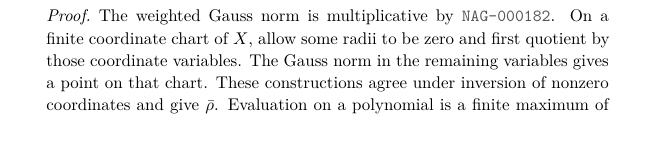
The weighted Gauss norm is multiplicative by \hyperref[fnd:gaussnorm]{\texttt{NAG-000182}}. On a finite
coordinate chart of $X$, allow some radii to be zero and first quotient
by those coordinate variables. The Gauss norm in the remaining variables
gives a point on that chart. These constructions agree under inversion
of nonzero coordinates and give $\bar\rho$. Evaluation on a polynomial
is a finite maximum of continuous monomial functions of the radii,
including zero radii. This proves continuity in each analytic coordinate
chart, hence globally. The equality $\bar t\bar\rho=1$ follows directly.
The domain is compact and $X^\an$ is Hausdorff; thus $\bar\rho$ is a
homeomorphism onto its closed image. A finite tropical coordinate has
positive finite radius, so its image is in $T^\an$, proving the assertion
about $\Gamma$.

Fix $x\notin\Gamma$, and put $w=t(x)$. Distinct points of the torus
analytification are distinct multiplicative seminorms on its Laurent
coordinate ring. The ultrametric inequality always gives
$|f(x)|\leq|f(\rho(w))|$. Hence some Laurent polynomial
$f=\sum_m a_mT^m$, with like terms collected, satisfies
\[
 |f(x)|<M_f(t(x)),\qquad
 M_f(u)=\max_m |a_m|e^{-\langle m,u\rangle}.
\]
Both sides are continuous and $M_f$ is positive. The same strict
inequality defines an ordinary open neighbourhood $U_x$.
At every $y\in U_x$ the largest term in $f$ cannot be unique: a unique
largest summand has the absolute value of the entire sum in a valued
field, and the same statement holds in the completed residue field at
$y$. At least two distinct exponents $m,n$ therefore satisfy
\[
       v(a_m)+\langle m,t(y)\rangle
          =v(a_n)+\langle n,t(y)\rangle.
\]
These are finitely many proper affine hyperplanes with nonzero integer
normal $m-n$. Their union is the required $H_x$.

For the frozen germs, choose an ordinary affinoid neighbourhood of $x$
inside $U_x$, using the neighbourhood construction in \hyperref[v037:forms:germsheaf]{\texttt{NAG-002424}}.
Its actual $T$-moment image is finite polyhedral. Subdivision along
$H_x$ puts every face in dimension at most $d-1$. Restriction of an
alternating $d$-covector to each tangent space is zero. Thus the
representative $t^*\alpha$ is tangentially zero on every face, which is
exactly a zero germ in the frozen definition.

For the primary convention the same argument can be placed on an
explicit algebraic tropical chart. If $f(x)\ne0$, put $g=f$. If $f(x)=0$,
choose $a\in K^\times$ with $|a|<M_f(w)$ and put $g=f-a$.
Then $g(x)\ne0$, $M_g(w)=M_f(w)$ and $|g(x)|<M_g(w)$.
The very affine open $T\setminus V(g)$ has unit coordinates $T_i,g$,
possibly augmented to its canonical unit tuple. On its tropical open
subset defined by $|g|<M_g(t)$, projection to the $T_i$ coordinates
lands in the finite union of hyperplanes just proved. Subdivide its
polyhedral faces accordingly. On every face the projected tangent
space has rank at most $d-1$, so the pullback of $\alpha$ is zero by
polyhedral restriction. This gives the zero primary smooth germ without
an approximation of analytic moment maps.

Finally $\theta$ is already zero off $t^{-1}(S)$ in the torus and near
the toric boundary. The argument just given removes every remaining
point outside $\Gamma$. Since $\rho(S)$ is compact and closed, the
support inclusion \eqref{eq:f9fm:toric-curvature-support} follows.
\end{proof}
Typeset reader excerpt
Typed proof inputs
- DEF-V037-ORDINARY-SMOOTH-MOMENT-GERMS · standing context or base (definitions)
- DEF-V044-F9-FULL-GIVEN-PRIMARY-ACTION · standing context or base (definitions)
- DEF-V044-F9-FULL-PRODUCT-DATA · standing context or base (definitions)
- NAG-000182 · selected whole (prerequisites)
- NAG-001657 · selected whole (prerequisites)
- NAG-001707 · selected whole (prerequisites)
- NAG-001709 · selected whole (prerequisites)
- NAG-001714 · selected whole (prerequisites)
- NAG-002293 · selected whole (prerequisites)
- NAG-002424 · selected whole (prerequisites)
- NAG-000182 · selected whole (explicit current dependencies)
- NAG-001657 · selected whole (explicit current dependencies)
- NAG-001707 · selected whole (explicit current dependencies)
- NAG-001709 · selected whole (explicit current dependencies)
- NAG-001714 · selected whole (explicit current dependencies)
- NAG-002293 · selected whole (explicit current dependencies)
- NAG-002424 · selected whole (explicit current dependencies)
Proof map
Verified map inputs · NAG-002744
AND · joint registered proof inputs
- NAG-000182 · Multiplicativity of the weighted Gauss norm · accepted whole
- NAG-001657 · Dimension of a strict normalization · accepted whole
- NAG-001707 · Affine analytification and its mapping property · accepted whole
- NAG-001709 · Products and extension of the ground field · accepted whole
- NAG-001714 · Compactness of analytified projective maps · accepted whole
- NAG-002293 · Purity of affinoid domains · accepted whole
- NAG-002424 · The sheaf of ordinary smooth moment forms · accepted whole
NAG-002744 · Local cancellation forces rank drop · Chapter argument