NAG-002749 · Accepted whole
A common smooth algebra is uniformly dense
G Stable inertia and original-field models
Open in the English reader · PDF page 2042
Statement and full selected proof · exact TeX
\begin{lemma}[A common smooth algebra is uniformly dense]
\label{f9fm:smoothdensity}
The algebra $\mathcal A_{\rm com}$ separates points of $X^\an$ and
contains the constants. Both $\mathcal A_{\rm com}$ and $\mathcal A$
are uniformly dense in $C(X^\an)$.
\end{lemma}
\begin{proof}
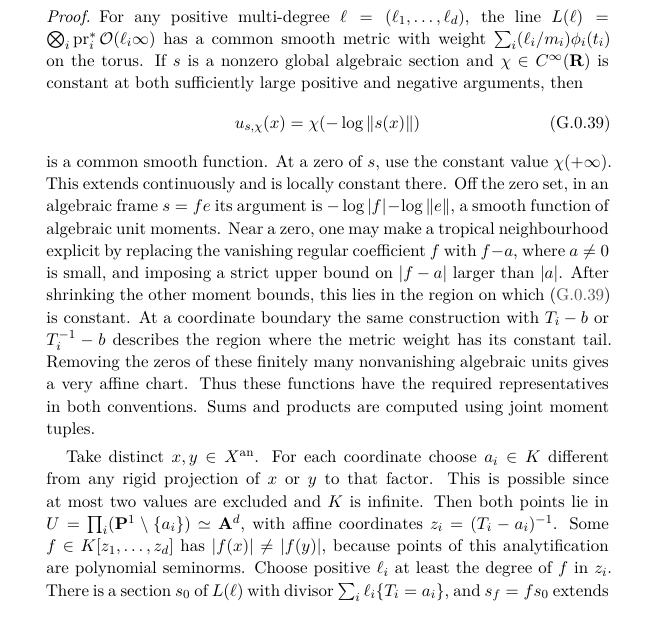
For any positive multi-degree $\ell=(\ell_1,\ldots,\ell_d)$, the line
$L(\ell)=\bigotimes_i\operatorname{pr}_i^*\cO(\ell_i\infty)$ has a
common smooth metric with weight
$\sum_i(\ell_i/m_i)\phi_i(t_i)$ on the torus. If $s$ is a nonzero
global algebraic section and $\chi\in C^\infty(\mathbf R)$ is constant
at both sufficiently large positive and negative arguments, then
\begin{equation}\label{eq:f9fm:toric-common-smooth-test}
 u_{s,\chi}(x)=\chi(-\log\|s(x)\|)
\end{equation}
is a common smooth function. At a zero of $s$, use the constant value
$\chi(+\infty)$. This extends continuously and is locally constant
there. Off the zero set, in an algebraic frame $s=f e$ its argument is
$-\log|f|-\log\|e\|$, a smooth function of algebraic unit moments.
Near a zero, one may make a tropical neighbourhood explicit by replacing
the vanishing regular coefficient $f$ with $f-a$, where $a\ne0$ is small,
and imposing a strict upper bound on $|f-a|$ larger than $|a|$.
After shrinking the other moment bounds, this lies in the region on
which \eqref{eq:f9fm:toric-common-smooth-test} is constant. At a coordinate boundary
the same construction with $T_i-b$ or $T_i^{-1}-b$ describes the region
where the metric weight has its constant tail. Removing the zeros of
these finitely many nonvanishing algebraic units gives a very affine
chart. Thus these functions have the required representatives in both
conventions. Sums and products are computed using joint moment tuples.

Take distinct $x,y\in X^\an$. For each coordinate choose
$a_i\in K$ different from any rigid projection of $x$ or $y$ to that
factor. This is possible since at most two values are excluded and
$K$ is infinite. Then both points lie in
$U=\prod_i(\mathbf P^1\setminus\{a_i\})\simeq\mathbf A^d$,
with affine coordinates $z_i=(T_i-a_i)^{-1}$.
Some $f\in K[z_1,\ldots,z_d]$ has $|f(x)|\ne|f(y)|$, because
points of this analytification are polynomial seminorms.
Choose positive $\ell_i$ at least the degree of $f$ in $z_i$.
There is a section $s_0$ of $L(\ell)$ with divisor
$\sum_i\ell_i\{T_i=a_i\}$, and $s_f=f s_0$ extends to a global
section by the degree bound. The section $s_0$ is nonvanishing at
$x$ and $y$. If its norms there differ, use it in
\eqref{eq:f9fm:toric-common-smooth-test}, with $\chi$ taking different values at the
two logarithmic norms. If its norms agree, the norms of $s_f$ differ
and the same construction with $s_f$ separates the points. This also
covers a zero value of $f$, using the constant tail of $\chi$.

Here is a complete compact-space density argument. Let $Y$ be a
compact Hausdorff space and $A\subset C(Y,\mathbf R)$ a unital
point-separating algebra. Its uniform closure $B$ is an algebra.
It is closed under absolute values: on a compact interval, polynomial
approximation of $|r|$ follows from the Bernstein polynomials
\[
 B_n h(t)=\sum_{k=0}^n h(k/n){n\choose k}t^k(1-t)^{n-k}.
\]
Indeed, for continuous $h$ on $[0,1]$, the binomial mean and variance
give, for every $\delta>0$,
\[
 |B_nh(t)-h(t)|\leq\omega_h(\delta)
             +\frac{\|h\|_\infty}{2n\delta^2},
\]
uniformly in $t$. Choose $\delta=n^{-1/4}$ and use uniform continuity.
Rescaling proves the required approximation of $|r|$. Polynomial
composition therefore puts $|b|$ in $B$ for every $b\in B$.
Thus $B$ is closed under finite maxima and minima.

Given $u\in C(Y)$ and $\epsilon>0$, for any $x,y\in Y$ a suitable
affine function of a separating element of $A$ takes the values
$u(x),u(y)$ at $x,y$; for $x=y$ use a constant. Denote it by $a_{xy}$.
For fixed $x$, the open sets where $a_{xy}>u-\epsilon$ cover $Y$.
Choose finitely many $y$ and let $b_x$ be the maximum of the corresponding
$a_{xy}$. Then $b_x\in B$, $b_x>u-\epsilon$ everywhere and
$b_x(x)=u(x)$. Hence $b_x<u+\epsilon$ on a neighbourhood of $x$.
Finitely many such neighbourhoods cover $Y$. The minimum $b$ of their
$b_x$ satisfies $u-\epsilon<b<u+\epsilon$ on $Y$ and belongs to $B$.
Thus $u\in B$. Apply this argument to the algebra generated by the
functions \eqref{eq:f9fm:toric-common-smooth-test} and the constants. It is contained
in $\mathcal A_{\rm com}\subset\mathcal A$, proving both density claims.
\end{proof}
Typeset reader excerpt
Typed proof inputs
- DEF-V037-ORDINARY-SMOOTH-MOMENT-GERMS · standing context or base (definitions)
- DEF-V044-F9-FULL-GIVEN-PRIMARY-ACTION · standing context or base (definitions)
- DEF-V044-F9-FULL-PRODUCT-DATA · standing context or base (definitions)
- NAG-001657 · selected whole (prerequisites)
- NAG-001707 · selected whole (prerequisites)
- NAG-001709 · selected whole (prerequisites)
- NAG-001714 · selected whole (prerequisites)
- NAG-002293 · selected whole (prerequisites)
- NAG-002424 · selected whole (prerequisites)
- NAG-001657 · selected whole (explicit current dependencies)
- NAG-001707 · selected whole (explicit current dependencies)
- NAG-001709 · selected whole (explicit current dependencies)
- NAG-001714 · selected whole (explicit current dependencies)
- NAG-002293 · selected whole (explicit current dependencies)
- NAG-002424 · selected whole (explicit current dependencies)
Proof map
Verified map inputs · NAG-002749
AND · joint registered proof inputs
- NAG-001657 · Dimension of a strict normalization · accepted whole
- NAG-001707 · Affine analytification and its mapping property · accepted whole
- NAG-001709 · Products and extension of the ground field · accepted whole
- NAG-001714 · Compactness of analytified projective maps · accepted whole
- NAG-002293 · Purity of affinoid domains · accepted whole
- NAG-002424 · The sheaf of ordinary smooth moment forms · accepted whole
NAG-002749 · A common smooth algebra is uniformly dense · Chapter argument