NAG-002778 · Accepted whole
Result G.0.17
G Stable inertia and original-field models
Open in the English reader · PDF page 2031
Statement and full selected proof · exact TeX
\clearpage
\begingroup
\def\cM{\mathcal M}\def\Min{\operatorname{Min}}
\def\length{\operatorname{length}}\def\Int{\operatorname{Int}}
\noindent In the local Cartier setting of
\hyperref[fnd:nag002772:cartier]{NAG-002772}, use the full quotient
\(B=A/(f)\) by the given regular equation on the actual affinoid
chart. The
\hyperref[fnd:nag002772:effective-coefficient]{effective Cartier coefficients}
are those of that quotient. The purity of the zero space is supplied
as stated below.
\NextLinkTarget{foundations.nag-002778.original}
\begin{theorem}[Cartier integration comparison in the pure-zero-space scope; F8ST-I-R1]
\label{thm:integration}
Let \(D=\cM(B)\) be a nonempty pure \(d\)-dimensional Cartier zero
space as above, and let \(g=(g_1,\ldots,g_r)\) be analytic units
on a neighbourhood of the chart. Put \(t_g=-\log|g|\).
For \(\mathfrak p\in\Min B\), let
\(D_{\mathfrak p}=\cM(B/\mathfrak p)\) and
\(c_{\mathfrak p}=\length_{B_{\mathfrak p}}B_{\mathfrak p}\).
Then the frozen integral chains and all their smooth top-form pairings
satisfy
\begin{align}\label{eq:chains}
 \mathcal T_g(B)&=\sum_{\mathfrak p\in\Min B}
                   c_{\mathfrak p}\mathcal T_{g|D_{\mathfrak p}}(B/\mathfrak p),\\
 \mathcal I_{B,g}(\alpha)&=\sum_{\mathfrak p\in\Min B}
                c_{\mathfrak p}\mathcal I_{B/\mathfrak p,g}(\alpha).
 \label{eq:integrals}
\end{align}
Here \(\alpha\) is a smooth \((d,d)\)-superform near the compact
moment image. The same equality holds for ordinary compactly supported
forms after chart localization and a finite partition.
The coefficient \(c_{\mathfrak p}\) is exactly the analytic Cartier
coefficient of Theorem~\ref{fnd:nag002772:cartier}.

In particular, on a good Hausdorff pure \(n\)-dimensional space,
for a regular meromorphic \(f\) whose local numerator and denominator
zero spaces are empty or pure of dimension \(n-1\), the cycles formed
from these presentations are independent among such presentations
and glue. Their analytic Cartier-cycle pairing agrees with the frozen
coherent-cycle pairing on every ordinary \((n-1,n-1)\)-test with compact support in
\(\Int(X/K)\). This purity condition is retained explicitly to match
the frozen integrator; it is not deduced here from a relative-dimension
theorem. The local coefficient result in Theorem~\ref{fnd:nag002772:cartier}
does not require it.
\end{theorem}

\begin{proof}
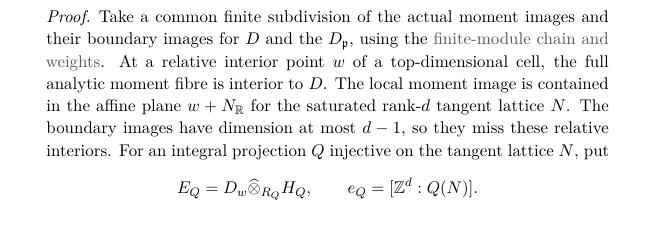
Take a common finite subdivision of the actual moment images and their boundary images for \(D\) and the \(D_{\mathfrak p}\), using the \hyperref[fnd:nag002405:global-finite-module-chain-weights]{finite-module chain and weights}. At a relative interior point \(w\) of a top-dimensional cell, the full analytic moment fibre is interior to \(D\). The local moment image is contained in the affine plane \(w+N_{\mathbb R}\) for the saturated rank-\(d\) tangent lattice \(N\). The boundary images have dimension at most \(d-1\), so they miss these relative interiors.
For an integral projection \(Q\) injective on the tangent lattice
\(N\), put
\[
 E_Q=D_w\widehat\otimes_{R_Q}H_Q,\qquad
 e_Q=[\mathbb Z^d:Q(N)].
\]
Here \(D_w\) is the \emph{actual algebra of the entire moment fibre}
and \(H_Q\) is the projected polytorus Gauss field, precisely as in
\hyperref[v037:degree:moduleweight]{NAG-002362}. That theorem, with structure module \(B\), gives
\begin{equation}\label{eq:weights}
 m_{D,g}(w)=\frac{\dim_{H_Q}E_Q}{e_Q}
       =\sum_{\mathfrak p\in\Min B}c_{\mathfrak p}\,
                                m_{D_{\mathfrak p},g}(w).
\end{equation}
For an empty component fibre its weight is zero. This formula includes
all local Artin lengths and residue degrees in \(E_Q\); no separate
residue-degree multiplier is attached to \(c_{\mathfrak p}\).
The lattice index is divided out exactly once.

The equality holds on every top cell. Lower-dimensional cells carry
no \(d\)-chain term, so the \hyperref[fnd:nag002405:global-finite-module-chain-weights]{finite-module chain and weights} give \eqref{eq:chains}.
By the \hyperref[fnd:nag002405:finite-cell-functional]{finite-cell functional}, integration of the same tangential smooth coefficients on a common subdivision gives \eqref{eq:integrals}. This is a finite sum; no
limiting or measurable-integration extension occurs.
The \hyperref[v037:forms:compactintegral]{ordinary compact integral} and \hyperref[v037:forms:compactpartition]{compact partitions} give the ordinary-form assertion. Actual domain restriction of the coefficients is the \hyperref[fnd:nag002772:effective-domain-transport]{effective domain transport} in the Cartier theorem, so the local formulas agree on overlaps.
For a regular meromorphic function in the stated pure-zero-space scope,
subtract the two effective formulas. On each actual common affinoid
refinement, \hyperref[fnd:generalizeddomainbasechange]{quotient/domain base change} and \hyperref[v037:integration:puritylocality]{domain purity} preserve
the empty-or-pure dimension \(n-1\) condition for all four equations.
The \hyperref[fnd:nag002772:cartier]{antichain clause of the Cartier theorem} therefore
applies to both cross-products and proves representation independence.
A compact test needs finitely many such representatives and partition
terms, whose sum is consequently independent of these choices. Closed immersions have compact inverse support on compact sets and are finite and everywhere relatively interior (\hyperref[fnd:generalizedfinitealgebras]{NAG-001701}); interior composition (\hyperref[fnd:affinoidinteriorcalculus]{NAG-001704}) therefore shows that a test supported in
\(\Int(X/K)\) has the required interior support on its zero spaces.
\end{proof}
\endgroup
Typeset reader excerpt
Typed proof inputs
- NAG-002416 · selected whole (prerequisites)
- NAG-002425 · selected whole (prerequisites)
- NAG-002769 · selected whole (prerequisites)
- NAG-002772 · selected whole (prerequisites)
- NAG-002416 · selected whole (explicit current dependencies)
- NAG-002425 · selected whole (explicit current dependencies)
- NAG-002769 · selected whole (explicit current dependencies)
- NAG-002772 · selected whole (explicit current dependencies)
Reader cross-references
Proof map
Verified map inputs · NAG-002778
AND · joint registered proof inputs
- NAG-002416 · The integral on a compact good analytic space · accepted whole
- NAG-002425 · Integration of compactly supported smooth moment forms · accepted whole
- NAG-002769 · Points computing full generic lengths; F8ST-G · accepted whole
- NAG-002772 · Cartier coefficient transport with scoped gluing; F8ST-C-R1 · accepted whole