NAG-002905 · Accepted whole
Residual identity for finite coefficient modules
Proper direct image on historical ordinary compact tests
Open in the English reader · PDF page 1900
Statement · exact TeX
\begin{proposition}[Residual identity for finite coefficient modules]
\label{cand:f5proj:modulecriterion}
Assume (K). Let \(B'\) be a flat finite-type \(O'\)-algebra
with a semilinear \(G\)-action which is the identity on
\(B'/\mathfrak m'B'\). Set \(B=(B')^G\).
Let \(M'\) be a finitely generated \(B'\)-module, flat over
\(O'\), with a compatible semilinear action, meaning
\(g(bm)=g(b)g(m)\). Put \(M=(M')^G\).
The following conditions are equivalent:
\begin{enumerate}
\item \(G\) acts identically on \(M'/\mathfrak m'M'\).
\item The natural multiplication map is an equivariant isomorphism
\[
             B'\otimes_B M\longrightarrow M'.
 \tag{1}
\]
\end{enumerate}
Here \(B'\simeq O'\otimes_O B\) by
\dep{cand:f5res:residualidentity}, so (1) is also the map
\(O'\otimes_O M\to M'\), with coefficient action on the left.
If these conditions hold and \(M'\) is finite projective of
constant rank \(r\) over \(B'\), then \(M\) is finite projective
of rank \(r\) over \(B\). In particular this applies to rank one.
\end{proposition}
Full selected proof · exact TeX
\begin{proof}
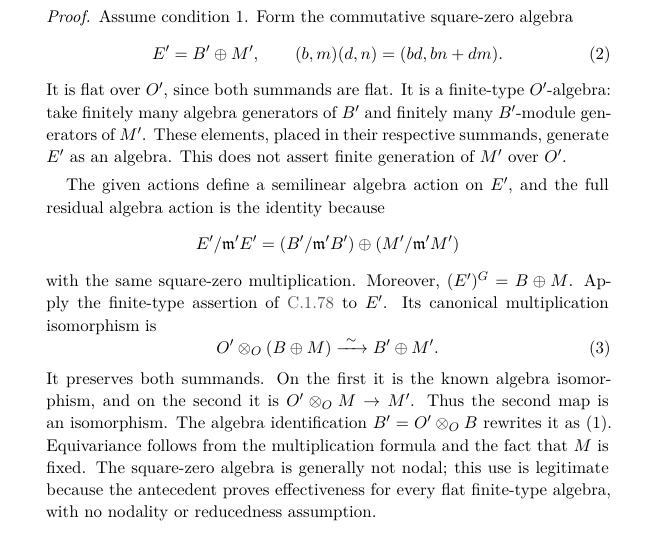
Assume condition 1. Form the commutative square-zero algebra
\[
 E'=B'\oplus M',\qquad
 (b,m)(d,n)=(bd,bn+dm).
 \tag{2}
\]
It is flat over \(O'\), since both summands are flat. It is a
finite-type \(O'\)-algebra: take finitely many algebra generators
of \(B'\) and finitely many \(B'\)-module generators of \(M'\).
These elements, placed in their respective summands, generate
\(E'\) as an algebra. This does not assert finite generation of
\(M'\) over \(O'\).

The given actions define a semilinear algebra action on \(E'\),
and the full residual algebra action is the identity because
\[
 E'/\mathfrak m'E'=
 (B'/\mathfrak m'B')\oplus(M'/\mathfrak m'M')
\]
with the same square-zero multiplication. Moreover,
\((E')^G=B\oplus M\). Apply the finite-type assertion of
\dep{cand:f5res:residualidentity} to \(E'\). Its canonical
multiplication isomorphism is
\[
         O'\otimes_O(B\oplus M)\xrightarrow{\ \sim\ }B'\oplus M'.
 \tag{3}
\]
It preserves both summands. On the first it is the known algebra
isomorphism, and on the second it is \(O'\otimes_O M\to M'\).
Thus the second map is an isomorphism. The algebra identification
\(B'=O'\otimes_O B\) rewrites it as (1). Equivariance follows
from the multiplication formula and the fact that \(M\) is fixed.
The square-zero algebra is generally not nodal; this use is
legitimate because the antecedent proves effectiveness for every
flat finite-type algebra, with no nodality or reducedness assumption.

Conversely, under (1) the reduction of \(M'\) is
\(k\otimes_O M\), on which the coefficient action is the identity.
This proves condition 1.

The map \(B\to B'\) is faithfully flat, being the base change
of \(O\to O'\). If \(M'\) is finite projective, \stacks{058S}
applied to (1) makes \(M\) finite projective. For each prime
\(\mathfrak p\subset B\), choose a prime of \(B'\) above it.
The dimension of the fibre of \(M\) at \(\mathfrak p\) is unchanged
by extending to the corresponding residue field upstairs; it is
therefore \(r\). This proves the rank assertion.
\end{proof}
Typeset reader excerpt
Typed proof inputs
- NAG-002610 · selected whole (selected native whole)
- NAG-002648 · selected whole (earlier unchanged whole in this batch)
Reader cross-references
Proof map
Verified map inputs · NAG-002905
AND · joint registered proof inputs
- NAG-002610 · Character modules give an exact integral test · accepted whole Exact source window 390–408
- Standing exact coefficient class (K), same residue field and faithful flatness of the actual coefficient map.
- NAG-002648 · Residual identity suffices in the nondiscrete class · accepted whole Exact source windows 428–430, 436–467
- Apply the finite-type flat algebra assertion to B' to identify it as O' tensor B.
- Apply the same finite-type flat algebra assertion to the actual square-zero algebra B'⊕M'. Its flatness and finite type follow from the two original module hypotheses. Its full residual identity follows on both summands; no nodality is needed.
NAG-002905 · Residual identity for finite coefficient modules · Chapter argument