NAG-002911 · Accepted whole
Algebraization over the complete rank-one valuation ring
B Recovered native algebraization source
Open in the English reader · PDF page 1754
Statement · exact TeX
\begin{theorem}[Algebraization over the complete rank-one valuation ring]
\label{cand:f5alg:algebraization}
Under the hypotheses of Proposition~\ref{cand:f5alg:towerpolarization},
there exist a projective, flat, finitely presented $O$-scheme $Y$,
an ample invertible sheaf $\mathcal L$ on $Y$, and compatible
isomorphisms
\[
     Y\times_O R_n\simeq X_n,\qquad
     \mathcal L|_{X_n}\simeq\mathcal L_n\quad(n\geq1),
\]
where $(\mathcal L_n,\varphi_n)$ can be any compatible system
provided by that proposition. In particular $\mathcal L|_C$
is the prescribed $\mathcal L_C$.

If $C/k$ is at-worst-nodal of pure dimension one, then $Y/O$ is
at-worst-nodal of relative dimension one. No splitting condition
on its nodes or branches is imposed.

If the tower is the system of quotients of a supplied $\pi$-adic
formal $O$-scheme $\mathfrak X$, and $\mathfrak X$ is recovered
from these quotients with their transition maps, then the compatible
isomorphisms give
\[
                  \widehat Y_\pi\simeq\mathfrak X.
\]
This formal scheme is admissible, and its generic fibre satisfies
$\mathfrak X_\eta\simeq(Y_K)^{\mathrm{an}}$.
\end{theorem}
Full selected proof · exact TeX
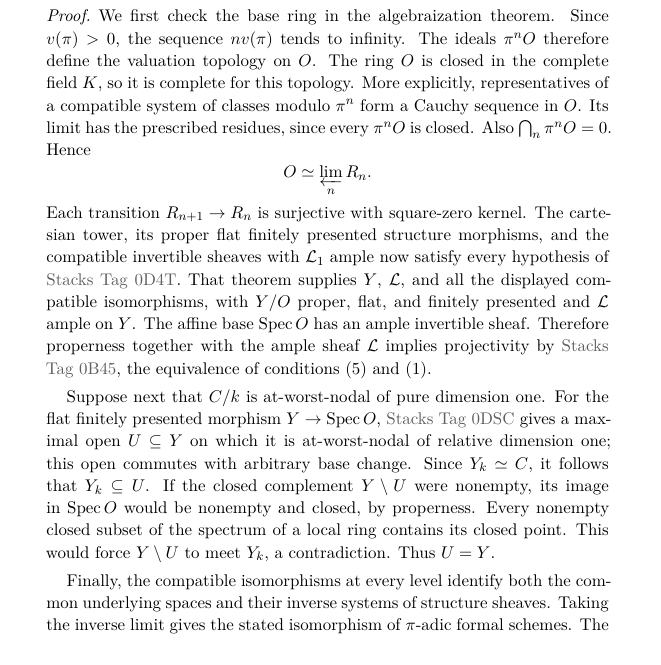
\begin{proof}
We first check the base ring in the algebraization theorem. Since
$v(\pi)>0$, the sequence $nv(\pi)$ tends to infinity. The ideals
$\pi^nO$ therefore define the valuation topology on $O$. The ring
$O$ is closed in the complete field $K$, so it is complete for
this topology. More explicitly, representatives of a compatible
system of classes modulo $\pi^n$ form a Cauchy sequence in $O$.
Its limit has the prescribed residues, since every $\pi^nO$ is
closed. Also $\bigcap_n\pi^nO=0$. Hence
\[
                            O\simeq\varprojlim_n R_n.
\]
Each transition $R_{n+1}\to R_n$ is surjective with square-zero
kernel. The cartesian tower, its proper flat finitely presented
structure morphisms, and the compatible invertible sheaves with
$\mathcal L_1$ ample now satisfy every hypothesis of
\stacks{0D4T}. That theorem supplies $Y$, $\mathcal L$, and all
the displayed compatible isomorphisms, with $Y/O$ proper, flat,
and finitely presented and $\mathcal L$ ample on $Y$.
The affine base $\operatorname{Spec}O$ has an ample invertible
sheaf. Therefore properness together with the ample sheaf
$\mathcal L$ implies projectivity by \stacks{0B45}, the equivalence
of conditions (5) and (1).

Suppose next that $C/k$ is at-worst-nodal of pure dimension one.
For the flat finitely presented morphism $Y\to\operatorname{Spec}O$,
\stacks{0DSC} gives a maximal open $U\subseteq Y$ on which it is
at-worst-nodal of relative dimension one; this open commutes with
arbitrary base change. Since $Y_k\simeq C$, it follows that
$Y_k\subseteq U$. If the closed complement $Y\setminus U$ were
nonempty, its image in $\operatorname{Spec}O$ would be nonempty
and closed, by properness. Every nonempty closed subset of the
spectrum of a local ring contains its closed point. This would
force $Y\setminus U$ to meet $Y_k$, a contradiction. Thus $U=Y$.

Finally, the compatible isomorphisms at every level identify both
the common underlying spaces and their inverse systems of structure
sheaves. Taking the inverse limit gives the stated isomorphism of
$\pi$-adic formal schemes. The established projective-completion
result \dep{cand:projectiveformalcompletion} applies to the
projective, flat, finitely presented scheme $Y$. It says that
$\widehat Y_\pi$ is admissible and that its generic fibre is
$(Y_K)^{\mathrm{an}}$. Transporting this identification through the
formal isomorphism, using the functoriality in
\dep{fnd:formalglobalgenericfaithful}, gives the assertion for
$\mathfrak X$.
\end{proof}
Standing context 1 · exact TeX
\begin{theorem}[Algebraization over the complete rank-one valuation ring]
\label{cand:f5alg:algebraization}
Under the hypotheses of Proposition~\ref{cand:f5alg:towerpolarization},
there exist a projective, flat, finitely presented $O$-scheme $Y$,
an ample invertible sheaf $\mathcal L$ on $Y$, and compatible
isomorphisms
\[
     Y\times_O R_n\simeq X_n,\qquad
     \mathcal L|_{X_n}\simeq\mathcal L_n\quad(n\geq1),
\]
where $(\mathcal L_n,\varphi_n)$ can be any compatible system
provided by that proposition. In particular $\mathcal L|_C$
is the prescribed $\mathcal L_C$.

If $C/k$ is at-worst-nodal of pure dimension one, then $Y/O$ is
at-worst-nodal of relative dimension one. No splitting condition
on its nodes or branches is imposed.

If the tower is the system of quotients of a supplied $\pi$-adic
formal $O$-scheme $\mathfrak X$, and $\mathfrak X$ is recovered
from these quotients with their transition maps, then the compatible
isomorphisms give
\[
                  \widehat Y_\pi\simeq\mathfrak X.
\]
This formal scheme is admissible, and its generic fibre satisfies
$\mathfrak X_\eta\simeq(Y_K)^{\mathrm{an}}$.
\end{theorem}
Typeset reader excerpt
Typed proof inputs
- NAG-001612 · selected whole (selected native whole)
- NAG-001918 · selected whole (selected native whole)
- NAG-002038 · selected whole (selected native whole)
- NAG-002910 · selected whole (selected native whole)
- SUPPORT:NAG-001944:given_atlas_open_preimages_and_contraction · typed target unresolved in this export (retained exact given-atlas support)
Reader cross-references
Proof map
Verified map inputs · NAG-002911
AND · joint registered proof inputs
- NAG-001612 · Local extension and gluing of morphisms · accepted whole Exact source window 185–192
- NAG-001918 · Affinoid generic fibres and integral presentations · accepted whole Exact source window 185–192
- NAG-002038 · Completion of a projective model · accepted whole Exact source window 182–192
- NAG-002910 · Polarization of a supplied curve tower · accepted whole Exact source window 121–131
Unlinked source pointers
These pointers have no operative linked edge in this map.
SUPPORT:NAG-001944:given_atlas_open_preimages_and_contraction
NAG-002911 · Algebraization over the complete rank-one valuation ring · Chapter argument